

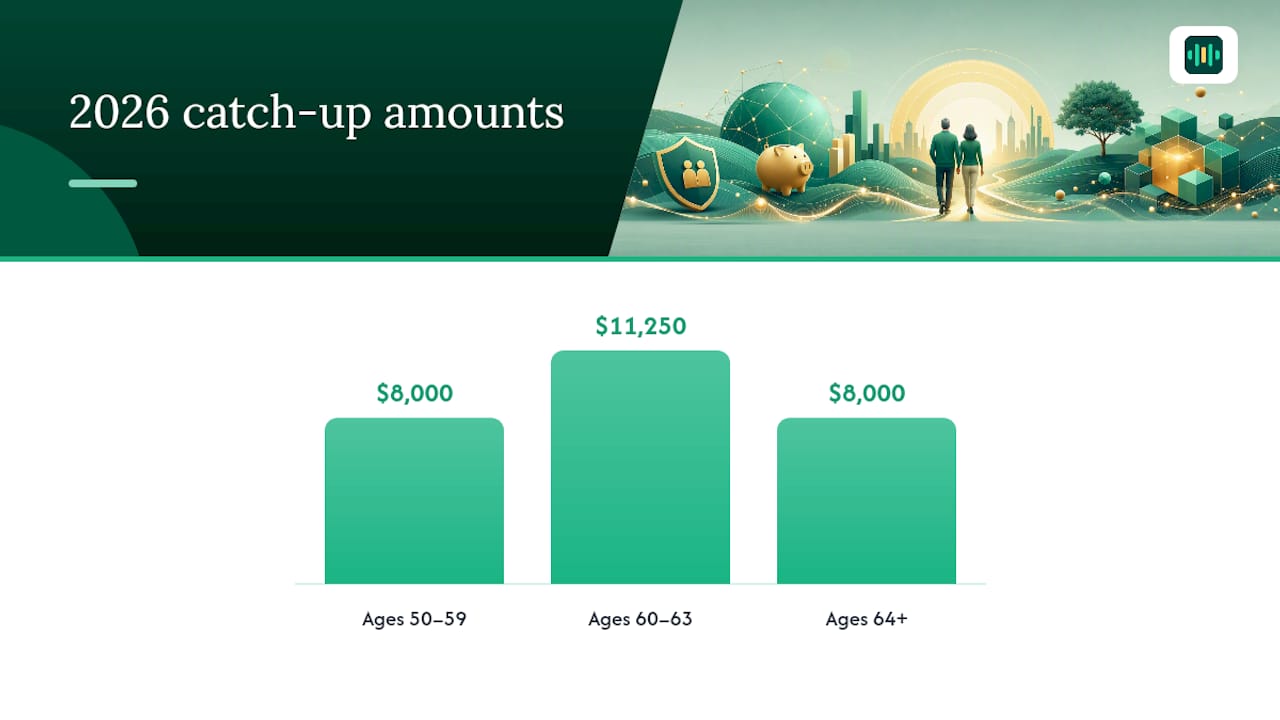
The 2026 elective-deferral limit for 401(k) plans is $24,500. Workers 50 and older can add a standard catch-up of $8,000, while those aged 60 to 63 get an enhanced catch-up of $11,250 if their plan allows it. The bigger change is procedural: anyone who earned $150,000 or more in FICA wages from their employer in 2025 must now make all catch-up contributions as Roth, not pre-tax. Check your plan's Roth option before your first 2026 paycheck.
TL;DR:
- High earners with $150,000 or more in FICA wages from their employer in 2025 must contribute all 2026 catch-up amounts as Roth, not pre-tax.
- The enhanced catch-up contribution of $11,250 replaces the standard $8,000 for ages 60 to 63 and does not stack with it.
- The $72,000 annual additions cap includes employer contributions but excludes catch-up contributions, which are not subject to this limit.
- Confirm your plan's Roth and enhanced catch-up options early, especially if turning 60 mid-year, to ensure proper withholding and maximum contributions.
- Fully modeling your contributions using specific tools is essential, as actual paycheck amounts and employer matching significantly influence your achievable maximum.
Table of Contents
- 2026 401(k) Contribution Limits at a Glance
- How Catch-Up Contributions Work in 2026
- The Roth-Only Catch-Up Rule for High Earners
- What Counts Toward the $72,000 Annual Additions Cap
- Steps to Maximize Your 2026 Contributions
- How Voice-First Guidance Turns These Limits Into a Real Plan
- Practical Takeaways for the 2026 Rule Changes
- Model Your 2026 Contributions With Mali
- Sources
2026 401(k) Contribution Limits at a Glance
Here's the full picture of where the numbers land for 2026, based on the IRS's contribution limit guidance:
| Limit type | 2026 amount |
|---|---|
| Elective deferral limit | $24,500 |
| Standard catch-up (age 50+) | $8,000 |
| Enhanced catch-up (ages 60 to 63) | $11,250 |
| Total deferral, age 50 to 59 or 64+ | up to $32,500 based on plan allowances |
| Total deferral, ages 60 to 63 | up to $35,750 based on plan allowances |
| Annual additions cap (415(c)) | $72,000 |
| Compensation limit (indexed) | $360,000 |
A few things worth flagging before you run your own numbers:
- These limits apply to traditional 401(k)s, safe harbor 401(k)s, and most 403(b) and 457 governmental plans, plus the federal Thrift Savings Plan.
- The 415(c) cap includes employer contributions, not just your own paycheck deferrals.
- Catch-up contributions sit outside the 415(c) ceiling entirely, so they're pure upside once you clear the base limits.
- The $360,000 compensation cap matters mainly for higher earners in plans with profit-sharing or generous match formulas, per the IRS's cost-of-living adjustment tables.
How Catch-Up Contributions Work in 2026
Catch-up eligibility is based on the age you'll turn during the calendar year, not your age on any specific date. Turn 50 anytime in 2026? You qualify for catch-ups for the whole year. The same logic applies to the 60 to 63 window for the enhanced amount.
There's a wrinkle people miss: the enhanced catch-up doesn't stack on top of the standard one. It replaces it for that four-year age band. So someone who is 61 doesn't get $8,000 plus $11,250. They get $11,250, period, and that's the ceiling until they turn 64, when they drop back to the standard $8,000 catch-up.
None of this happens automatically. Your plan document has to explicitly permit catch-up contributions, and separately, it has to permit the enhanced version for ages 60 to 63. Plenty of smaller employer plans still haven't updated their documents for this, per the IRS's catch-up contribution rules.
Here's what your total possible deferral looks like by age group in 2026:
- Under 50: elective deferral up to the plan limit, no catch-up available.
- 50 to 59, or 64 and older: elective deferral plus standard catch-up amount, total depending on plan allowances.
- 60 to 63: elective deferral plus enhanced catch-up amount, total depending on plan allowances.
Pro Tip: If you're turning 60 mid-year, don't assume payroll will automatically bump your catch-up limit. Confirm with HR that your withholding elections reflect the higher enhanced amount, and do it in January, not November, when there's no time left to catch up on catch-ups.
The Roth-Only Catch-Up Rule for High Earners
This is the one that trips people up. Starting January 1, 2026, if you earned $150,000 or more in FICA-taxable wages from your plan sponsor during 2025, every catch-up dollar you contribute in 2026 has to go in as Roth, according to the IRS's rules on catch-up contributions. No exceptions, no pre-tax option for that portion.
The lookback is mechanical and it's specific to the employer, not your total income. It's your FICA wages, from that one plan sponsor, in the prior calendar year. Switch jobs mid-year and your new employer's payroll system won't have last year's wage history from your old job, which is exactly the kind of gap plan administrators are scrambling to close.
A few practical consequences worth knowing:
- Roth catch-ups go in after tax, so you lose the immediate deduction but the growth and qualified withdrawals come out tax-free.
- If your plan doesn't currently offer a Roth option, the IRS has said affected high earners may be blocked from making any catch-up contributions at all until the plan adds one.
- Your regular (non-catch-up) elective deferrals aren't touched by this rule. Only the catch-up portion is affected.
The threshold that changes everything: $150,000 in prior-year FICA wages from a single employer is the line. Cross it in 2025, and 2026 catch-ups must be Roth.
Not sure which side of the line you're on? Pull last year's W-2, check Box 3 or 5, and if you're anywhere close to $150,000, call your plan administrator now rather than after the first paycheck of the year.
What Counts Toward the $72,000 Annual Additions Cap
The 415(c) limit is the lesser of 100% of your compensation or $72,000 in 2026, and it's easy to confuse with the deferral limit because both numbers get thrown around in the same conversation. They're not the same thing. The $24,500 cap is just your paycheck contributions. The $72,000 cap adds in everything your employer puts in too.
Here's what actually counts toward that $72,000 ceiling, based on the IRS's annual additions rules:
- Your elective deferrals (pre-tax and Roth combined)
- Employer matching contributions
- Employer profit-sharing contributions
- Forfeitures allocated to your account
Catch-up contributions are excluded from 415(c) entirely, which is the detail most people never learn until they're deep into a plan document. That exclusion is a gift for older savers: a 62-year-old maxing out at $35,750 in personal deferrals plus a generous employer match can blow past $72,000 in total contributions and still not violate the annual additions test, because the catch-up piece never counts against that cap.
Steps to Maximize Your 2026 Contributions
Hitting the max isn't just about picking a big number in your payroll portal. A few moves make the difference between leaving money on the table and actually capturing everything you're entitled to:
- Confirm your plan's provisions first. Ask HR or check your summary plan description for Roth availability and enhanced catch-up eligibility before you set anything.
- Calculate your personal ceiling based on your age bracket, then divide by your remaining pay periods to set a per-paycheck deferral percentage.
- Capture the full employer match before chasing the catch-up max. Free money from a match beats catch-up flexibility every time.
- Time age-based changes carefully. If you turn 60 partway through 2026, update your election the pay period after your birthday, not at year-end.
- Model it before you commit. A 401(k) growth calculator with employer match shows what your specific numbers actually produce over time, instead of guessing.
If your plan doesn't offer a Roth option and you're a high earner subject to the lookback, you may be locked out of catch-ups entirely for 2026 until the plan sponsor amends the document. That's a plan-level fix, not something you can work around at the individual level.
Pro Tip: Set your 2026 deferral percentage in December, not January. Payroll systems often take one to two cycles to fully implement a new election, and missing the first paycheck of the year means you'll need a higher percentage on every remaining check just to catch up to your own target.
How Voice-First Guidance Turns These Limits Into a Real Plan
Reading a table of IRS numbers is one thing. Figuring out what $35,750 actually means for your specific paycheck, your specific employer match, and your specific age is another. That's the gap Malimoney's voice AI is built to close: you talk to Mali about your real bank-linked accounts and paycheck data, and she works out the math instead of handing you a spreadsheet.
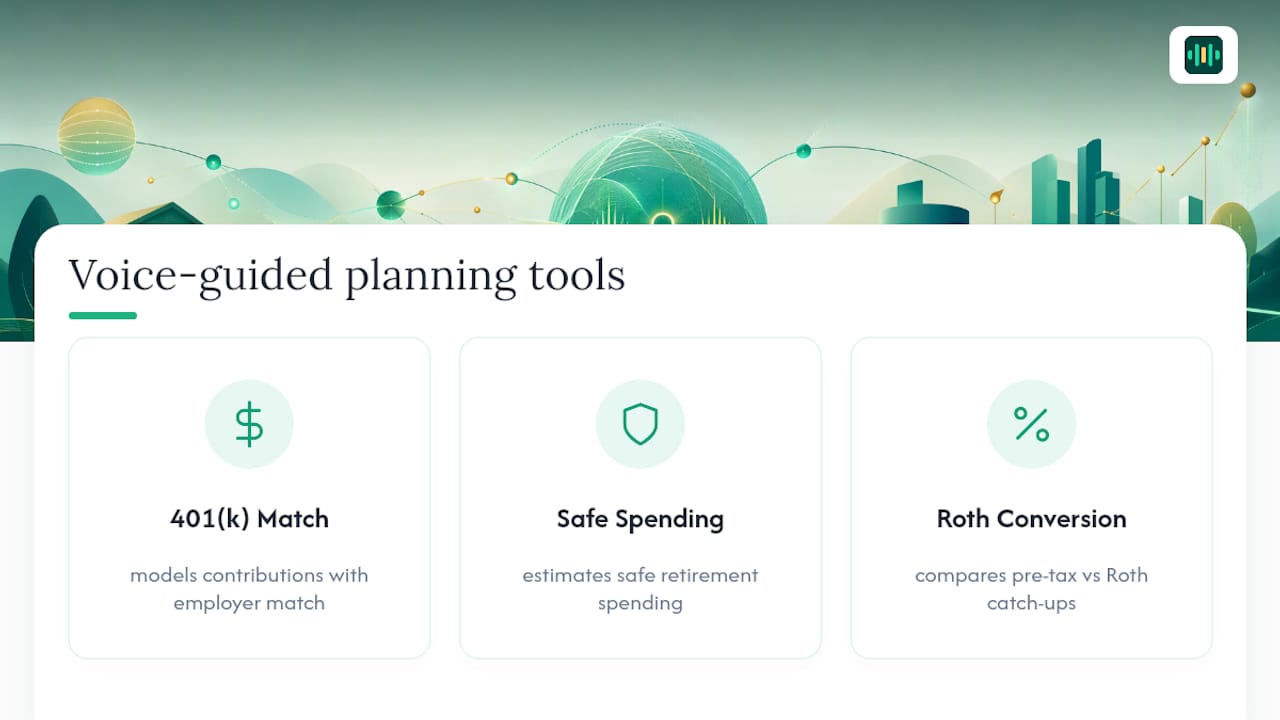
Mali's calculator library includes the 401(k) Growth With Employer Match tool for modeling contribution scenarios, along with a Safe Retirement Spending calculator and a Roth Conversion calculator for weighing pre-tax versus Roth catch-ups. No other personal finance app lets you talk through your actual bank accounts and transactions out loud and get a spoken answer back.
Practical Takeaways for the 2026 Rule Changes
Verify Roth availability in your plan first. That single check determines whether the rest of this article even applies to you if you're a high earner. Second, run your specific numbers through a calculator rather than trusting a mental estimate. Third, loop in payroll early. And one caution: plan provisions genuinely vary by employer, so when in doubt, call your plan administrator before you assume anything about your own account.
— Todd
Model Your 2026 Contributions With Mali
Once you know your limit, the next question is how to actually hit it without overshooting your paycheck or underfunding your match. That's where a calculator earns its keep, and where Malimoney's voice AI does something no budgeting app does: it talks to you directly about your real, bank-linked accounts and transactions, then works out where your monthly cash flow can absorb a higher deferral.

Instead of a dashboard full of charts, you ask Mali what happens if you bump your contribution to hit the $35,750 enhanced catch-up, and she answers out loud, using your actual paycheck and spending patterns rather than a generic assumption. Start with the 401(k) calculator with employer match to see your specific numbers, or browse the full library of free financial calculators to model retirement spending, Roth conversions, and net worth alongside your new contribution rate.