

The fastest way to avoid late fees is autopay for at least the minimum payment, scheduled a few days before the due date and backed by a second reminder in case the payment fails. Add one more habit: if a payment is going to be late anyway, call your issuer before the bill hits 30 days past due. That single call, made in time, can help your credit report even when it can't undo the fee.
TL;DR:
- Setting autopay for at least the minimum payment two to three days before the due date is the most effective way to prevent late fees.
- Calling your issuer before a payment becomes 30 days overdue can help waive fees and protect your credit report.
- Late payments are only reported to credit bureaus after 30 days past due, but a single 30-day delinquency can lower credit scores by 60 to 80 points.
- Moving your due date to align with your paycheck reduces the risk of missed payments caused by timing issues.
- Using tools like Mali, which tracks your actual income and spending, can provide spoken reminders and early alerts to help you stay ahead of due dates.
Table of Contents
- What Are Late Fees, and When Do Issuers Charge Them?
- How Do Late Payments Affect Your Credit and Your Wallet?
- A Prioritized Playbook for Avoiding Late Fees
- What to Do the Moment You Miss a Payment
- The Federal Rules That Actually Protect You
- A One-Page Checklist to Stop Late Fees for Good
- How Mali Helps You Stay Ahead of Due Dates
- What If Money Is Tight? Prioritizing Which Bills Get Paid First
- Can You Negotiate a Payment Plan to Skip the Fee Entirely?
- Automation Beats Willpower Every Time
- Try Mali When You Want Reminders That Actually Talk Back
- Sources
- FAQ
What Are Late Fees, and When Do Issuers Charge Them?
A late fee is the charge your issuer applies when it doesn't receive at least the minimum payment by the due date listed in your cardmember agreement. That agreement, not any general rule, sets the exact dollar amount and the conditions for waiving it.
Fees typically escalate the more you miss. A first late payment often carries a lower fee than subsequent ones, as issuer policies frequently distinguish between a one-time slip and a pattern. There's no federal cap forcing every issuer to charge the same amount, so the number varies by card and by how recently you were late before.
It helps to separate three things that often get lumped together:
- Late fee: a flat dollar charge for missing the due date, set by your card agreement.
- Penalty APR: a higher interest rate some issuers apply after repeated late payments, which can stick around for months.
- Credit reporting: a separate consequence that only kicks in once a payment is significantly overdue, not the moment you miss the due date.
Some issuers have started marketing cards with no late fees or automatic first-time waivers, following reporting on changes to late fee practices after a court struck down a proposed federal fee cap. Read the fine print before switching cards for that reason alone. A fee-free card can still carry a higher standard APR or fewer rewards.
How Do Late Payments Affect Your Credit and Your Wallet?
Here's the number that should change how you think about a missed due date: a single payment that goes 30 days past due can drop an excellent credit score by 60 to 80 points, according to TransUnion's analysis of late payment impact. That mark can sit on your credit report for up to seven years.
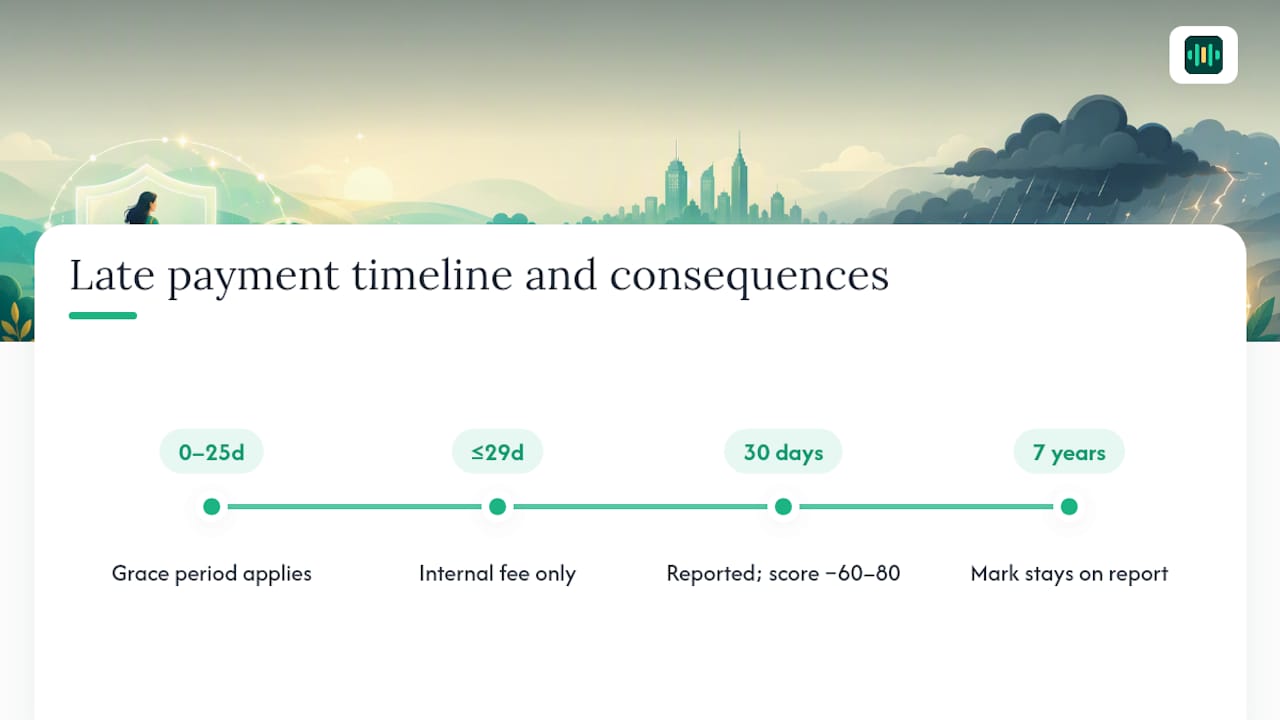
The good news hiding inside that bad news: issuers generally don't report a late payment to the bureaus until it's 30 days overdue. A payment that's five days late, or even three weeks late, is usually still just an internal account penalty, not a credit event. Pay it before day 30 and your score stays intact.
There's a quieter cost too. If you normally pay your statement in full and skip interest charges (credit card people call this being a "transactor"), one late payment can knock out your grace period. Suddenly you're paying interest on new purchases starting the day they post, not after a 21 to 25 day float. For a lot of cardholders, that lost grace period costs more over the following months than the late fee itself.
A Prioritized Playbook for Avoiding Late Fees
Not every fix carries the same weight. Some prevent nearly every late fee on their own; others are backup layers. Here's the order that actually works, starting with the highest-impact move.
- Turn on autopay for at least the minimum payment. This is the single biggest lever. Set it to pull two or three days before the due date, not on the due date itself, since some processing systems have cutoffs earlier than the 5 p.m. deadline the CFPB describes.
- Stack more than one reminder. Your bank's app alert is a start. Add a phone calendar entry three days out, and a voice reminder that checks your linked accounts and tells you out loud when a payment is coming due and whether you'll actually have the cash for it.
- Move your due date to match your paycheck. Most issuers let you pick a new due date once a year. If your due date currently lands five days before payday, that's a structural problem, not a willpower problem, and fixing it removes the whole issue.
- Split payments across the month. Paying half your balance mid-cycle and half near the due date lowers your average daily balance and gives you a second shot if the first payment fails to process.
- Have a backup payment method ready. If mail delays or a bank glitch threaten your due date, know how to make a same-day online payment or an overnight transfer directly through your issuer's site as a last resort.
Pro Tip: Schedule autopay for two days before the due date, not on it. That buffer absorbs weekends, holidays, and the occasional bank processing lag that turns an on-time payment into a late one.
What to Do the Moment You Miss a Payment
Speed matters more than anything else here. The clock that determines whether this becomes a credit problem starts ticking the day the payment was due, and you have real room to fix it before day 30.
- Pay immediately, even if it's partial. Getting current fast keeps you inside that 30-day window where TransUnion's data confirms issuers haven't yet reported anything to the bureaus.
- Call your issuer and ask for a one-time courtesy waiver. Say plainly: "I've been a customer in good standing, this was a one-time miss, and I'd like the late fee waived." Issuers grant these often, especially for first offenses.
- Ask about hardship programs if the problem is bigger than one bill. If you're facing a layoff, medical bill, or ongoing cash shortfall, hardship programs can pause fees and lower interest temporarily, though you'll usually need to show proof of the hardship.
- Write down who you talked to. Get the representative's name, the date, and a confirmation number, then send a follow-up email or secure message repeating what was agreed.
Pro Tip: Ask for the waiver before you mention any hardship. Reps often approve simple courtesy waivers on the spot, but once you bring up hardship, the call routes to a different process that takes longer.
The Federal Rules That Actually Protect You
Most people don't realize they have federal timing protections written directly into how card payments get processed.
A payment counts as on time if your issuer receives it by 5 p.m. on the due date, in the issuer's own time zone. If your due date lands on a weekend or a holiday, you get until the next business day. This isn't a courtesy some issuers offer. It's spelled out in CFPB guidance on when a credit card payment is considered late.
The Federal Reserve's Regulation Z, Section 226.10, backs this up on the issuer's side. It requires prompt crediting of payments and forces adjustments if a payment wasn't credited in time through no fault of yours. Separately, federal law under 15 U.S.C. §1666c requires prompt and fair crediting and limits fees when issuer errors cause the delay, which matters if you're ever disputing a fee that wasn't your fault.
One more rule worth knowing: issuers must mail statements at least 21 days before the due date. If your statement arrives unusually late, call your issuer immediately. You may be entitled to extra time to pay without a fee.
A One-Page Checklist to Stop Late Fees for Good
Set this up once and most of the work is done for the rest of the year.
- Turn on autopay for at least the minimum payment, scheduled two to three days before the due date.
- Set two reminders beyond the due-date alert: one at ten days out, one at three days out.
- Move your due date to a day that lines up with your paycheck if it currently doesn't.
- Check your balance mid-month and make a partial payment if funds allow.
- Reconcile your statement within a few days of it posting, not the night before it's due.
- If you're already late: pay now, call to request a waiver, ask about hardship options if needed, and document the call.
| Timing | Action | Why it matters |
|---|---|---|
| Once, at setup | Enable autopay + move due date | Removes the decision from your plate entirely |
| Every month | Mid-cycle balance check | Catches shortfalls before the due date arrives |
| Within 30 days of a miss | Pay, call, request waiver, document | Prevents credit bureau reporting |
How Mali Helps You Stay Ahead of Due Dates
Mali links to your bank accounts and tracks your actual spending and income, not a budget you set once and forgot about. When it spots a gap between what's coming in and what you owe, it tells you out loud, in plain language, before the due date sneaks up on you.
That voice-first layer solves a real problem: most missed payments aren't about not having reminders, they're about ignoring text alerts that blend into the noise of everyday notifications. A spoken heads-up from Mali is harder to tune out.
- Bank-linked gap analysis flags a shortfall days before your due date, not after the fee posts.
- The Credit Card Payoff Calculator helps you size a mid-month payment that actually moves the needle on your balance.
- Voice reminders work alongside your due date, not instead of autopay, providing an additional layer of protection.
- Scheduling payments a day early specifically beats issuer cutoff times, rather than cutting it close.
What If Money Is Tight? Prioritizing Which Bills Get Paid First
When there isn't enough to cover everything, the order you pay bills in changes how much damage gets done. Credit card minimum payments should usually rank above discretionary spending, but not necessarily above every other bill on your list.
Secured debts like your mortgage, rent, and car payment carry consequences (eviction, repossession) that are harder to reverse than a credit card late fee. Utilities that can be shut off, like electricity or water, generally come next. Credit cards sit below those in true emergencies, mostly because the worst near-term outcome, a fee plus a temporary score dip, is more recoverable than losing housing or utilities.
Inside your credit card obligations themselves, prioritize by which account is closest to its due date and which has the least forgiving issuer history with you. A card where you've never been late has more room to absorb a one-time miss and a successful waiver request than a card where you're already on a second offense.
If you genuinely can't cover every minimum payment this cycle, call the card issuers you can't pay before the due date, not after. Explain the situation and ask whether they can push the due date or offer a short grace extension. Issuers respond better to a heads-up call than to silence followed by a missed payment. This single habit, calling ahead instead of avoiding the phone, is often the difference between a manageable month and a cascade of fees across multiple cards.
Can You Negotiate a Payment Plan to Skip the Fee Entirely?
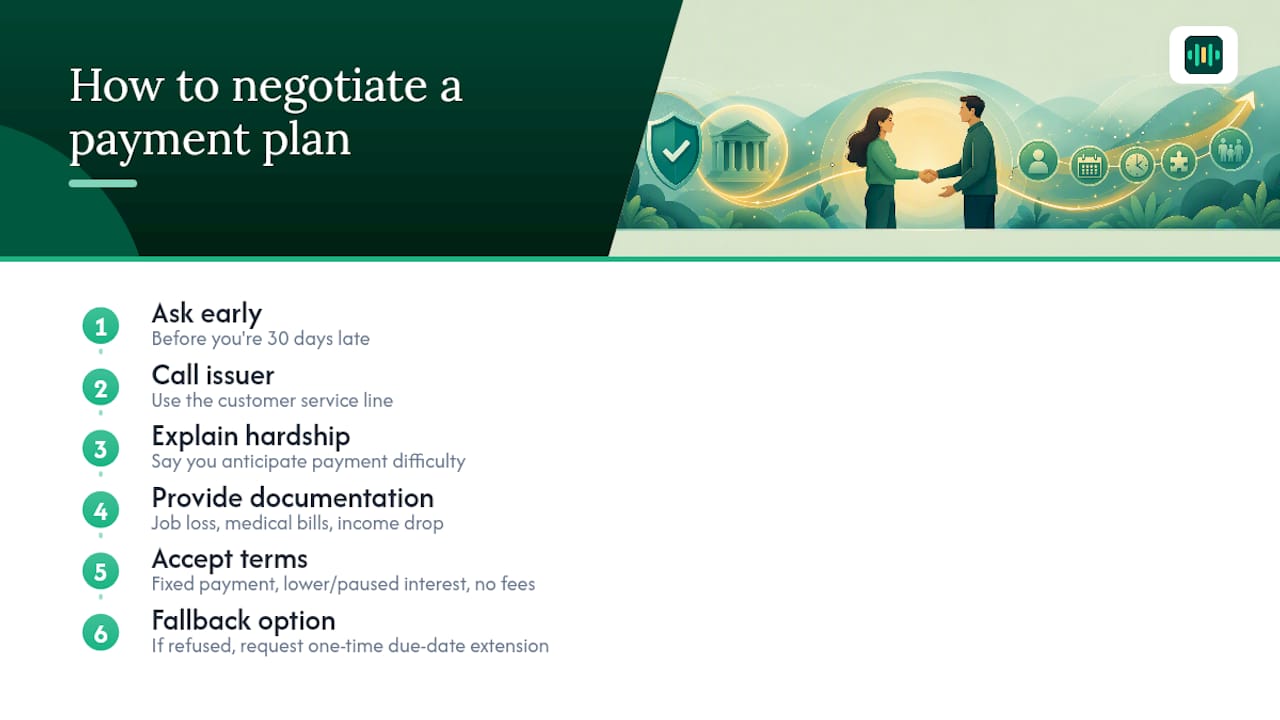
Yes, and more issuers offer this than most cardholders realize. A payment plan, sometimes called a hardship arrangement or an extended payment option, lets you spread what you owe over a set number of months, often with reduced interest and no additional late fees as long as you stick to the new schedule.
The key is asking before you're already 30 days behind. Call your issuer's customer service line and say you're anticipating difficulty making the full payment and want to know what plans are available. Most issuers have a formal hardship or "payment assistance" program, and asking early puts you in a better negotiating position than calling after multiple missed cycles.
Expect to answer a few questions about your situation and possibly provide documentation, like proof of a job loss, medical bills, or a temporary income drop. In exchange, issuers commonly offer a fixed monthly payment, a paused or lowered interest rate, and a promise not to charge late fees for the plan's duration, as long as you make every scheduled payment.
One caveat: entering a formal hardship plan can sometimes get noted on your credit report, depending on the issuer, so it's not a decision to make casually if your credit is otherwise clean. But it beats missing payments outright, and it beats letting a card go to collections. If your issuer says no to a plan, ask specifically about a one-time due-date extension instead. That smaller ask is often granted even when a full restructuring isn't.
Automation Beats Willpower Every Time
The pattern behind almost every late fee I've looked into isn't laziness. It's a good system that had exactly one point of failure: a human being who had to remember, on the right day, to take an action. Remove that single point of failure and the fee mostly disappears on its own.
Picture two people with identical bills and identical incomes. One relies on remembering the due date. The other has autopay covering the minimum, a due date lined up with payday, and a voice reminder flagging the balance three days out. The second person isn't more disciplined. They just built a system that doesn't need discipline to work. That's the whole argument for automating this instead of trying harder. Set up the checklist once, let tools like Mali watch the gap, and stop relying on memory for something memory is bad at.
— Todd
Try Mali When You Want Reminders That Actually Talk Back
This service offers an alternative to juggling multiple banking apps and a calendar full of due-date alerts you eventually start ignoring. It uses voice interaction about linked bank accounts and transactions and responds with a personality instead of a scripted notification.

Where a typical budgeting app hands you a dashboard of charts, Mali tells you out loud when a bill is coming and whether your account can cover it, based on your actual linked spending and income, not a manual budget you set once and forgot about. It also gives you access to a full library of calculators, including the Credit Card Payoff Calculator, so you can size a mid-month payment before your balance becomes a problem. If you're comparing options, see how Mali stacks up against YNAB's zero-based budgeting approach or check the full feature list. Start with a free trial and let Mali flag your next due date before it becomes a fee.
This article is general information, not a substitute for advice from a qualified financial advisor. Consult a qualified financial professional about your own circumstances before acting on anything here.
Sources
- When is my credit card payment considered to be late? | Consumer Financial Protection Bureau
- SECTION 226.10—Payments | Federal Reserve
- How long do late payments stay on your credit report? | TransUnion
- § 1666c. Prompt and fair crediting of payments (U.S. Code)
FAQ
What Is the Best Excuse for a Late Payment?
There's no "excuse" that guarantees a waiver, but issuers respond best to a brief, honest explanation, such as a processing error, a bank delay, or a one-time oversight, paired with a request for a courtesy waiver and proof you've paid on time historically.
How Can I Get a Late Fee Waived?
Call your issuer as soon as possible, explain it was a one-time miss, and directly ask for a courtesy waiver. Issuers grant these often for customers with a clean payment history, especially on a first offense.
Will a Two-Day Late Payment Affect My Credit?
No. Issuers typically don't report a payment to the credit bureaus until it's 30 days past due, so a payment that's a couple of days late usually results in just a late fee, not a credit score hit.
What Does "Late Fee" Mean?
A late fee is the flat dollar charge your card issuer applies when it doesn't receive at least your minimum payment by the due date, with the exact amount set by your cardmember agreement.
Can Mali Actually Remind Me Before a Payment Is Due?
Yes. This service links to your bank accounts, tracks upcoming due dates against your real balance, and gives you a spoken heads-up when a payment is coming and whether your account can cover it.