

A backdoor Roth IRA is legal and works well when your income blocks direct Roth contributions, but it isn't automatic tax relief. The biggest risk is the pro-rata rule, which taxes part of your conversion based on any pre-tax IRA money you already hold. You'll also need to file Form 8606 correctly, every single year, or risk getting taxed twice on the same dollars.
TL;DR:
- The pro-rata rule treats all traditional IRAs as one pool, making most conversions taxable if you have old pre-tax rollover IRAs, regardless of the contribution origin.
- Properly timing and documenting the process, including rolling over pre-tax IRAs into a 401(k) before contributing, can reduce unnecessary tax liabilities.
- Filing Form 8606 annually and keeping all documentation prevents double taxation and helps accurately track nondeductible contributions.
- The mega backdoor Roth allows high earners to bypass the pro-rata rule entirely by using after-tax contributions inside their 401(k) plan instead of IRAs.
- Running personalized calculations with dedicated tools or consulting a CPA is essential to avoid costly mistakes, especially with complex IRA and state tax situations.
Table of Contents
- What Is a Backdoor Roth IRA and Why High Earners Need One
- How to Do a Backdoor Roth Step by Step
- The Pro-Rata Rule: Why Your Old IRA Balance Matters
- Form 8606 and 1099-R: What the IRS Actually Requires
- Is the Backdoor Roth Worth It for You?
- Setting Up Your Backdoor Roth the Right Way
- Mega Backdoor Roth and Other Ways Around the Pro-Rata Rule
- Model Your Own Numbers Before You Convert
- When to Handle This Yourself and When to Call a CPA
- Model Conversions With a Voice Assistant, Not a Spreadsheet
- Where to Verify the Rules Yourself
- Sources
What Is a Backdoor Roth IRA and Why High Earners Need One
A backdoor Roth IRA isn't a special account. It's a two-step move: you contribute after-tax money to a traditional IRA, then convert that balance to a Roth IRA. The IRS doesn't cap conversions by income, so this route stays open even when your paycheck disqualifies you from contributing to a Roth directly.
The reason this workaround exists comes down to a gap in the tax code. Direct Roth contributions phase out at specific income levels, but Roth conversions have no such ceiling. For 2025, the IRS phases out direct Roth eligibility starting at $246,000 modified adjusted gross income (MAGI) for married couples filing jointly, and $165,000 MAGI for single filers. Cross those thresholds and the front door closes. The back door — contribute nondeductible funds to a traditional IRA, then convert — stays wide open because neither step has an income restriction.
Here's what makes this strategy attractive despite its complexity:
- Roth IRAs grow tax free, and qualified withdrawals in retirement owe nothing to the IRS.
- Roth IRAs carry no required minimum distributions during your lifetime, unlike traditional IRAs.
- Nondeductible contributions and conversions are available to any taxpayer, regardless of MAGI.
- The strategy has survived multiple rounds of legislative scrutiny and remains fully legal heading into 2026.
The catch is that "backdoor" doesn't mean "invisible." Every dollar you move gets reported to the IRS, and the tax bill on that conversion depends entirely on what else sits in your traditional IRAs. That's where most people get tripped up.
How to Do a Backdoor Roth Step by Step
The mechanics are simple on paper. The sequencing is where people make expensive mistakes.
For 2026, the IRA contribution limit is the annual maximum amount allowed for your age group, which includes a higher limit for those 50 and older using the catch-up provision. That's the maximum you can put into a traditional IRA before converting it, combined across all your traditional and Roth IRAs.
- Open a traditional IRA if you don't already have one, at any brokerage that offers self-directed accounts.
- Contribute after-tax dollars up to the annual limit. Do not claim a deduction on your tax return, since deducting the contribution defeats the purpose.
- Convert the balance to a Roth IRA, usually through an online form or a phone call to your brokerage's transfer desk.
- Report the contribution and conversion on Form 8606 when you file your taxes for that year.
- Confirm your custodian issues a 1099-R reflecting the conversion, which you'll reconcile against your own records.
Timing matters more than most guides admit. If you let the contribution sit in the traditional IRA for weeks or months before converting, any investment gains during that window become taxable income upon conversion, since only the original contribution counts as basis. Most people convert within a few days specifically to avoid this. Some tax professionals also recommend a short waiting period, rather than same-day conversion, to reduce the appearance of a pre-arranged step transaction, though the IRS has not formally challenged same-day backdoor Roth conversions in published guidance.
Brokers vary in how fast they process conversions. Some execute same-day; others take a few business days to settle the contribution before the conversion request goes through. Your 1099-R won't arrive until the following January, so keep your own transaction confirmations as proof of what happened and when.
Pro Tip: Set your traditional IRA to invest in a money market fund or cash equivalent before converting. That way, if the conversion takes a few days to process, you won't owe tax on stock market gains you never intended to realize.
The Pro-Rata Rule: Why Your Old IRA Balance Matters
This is the part that catches high earners off guard. The pro-rata rule treats every traditional, SEP, and SIMPLE IRA you own as one combined pool when the IRS calculates how much of your conversion is taxable, not as separate buckets you can cherry-pick from.
The IRS aggregation rule means you can't convert only your nondeductible contribution and call it tax free if you're also sitting on an old rollover IRA from a former employer's 401(k). The taxable portion gets calculated using a ratio: your after-tax basis divided by the total year-end balance across all your traditional IRAs, including the amount you just converted.
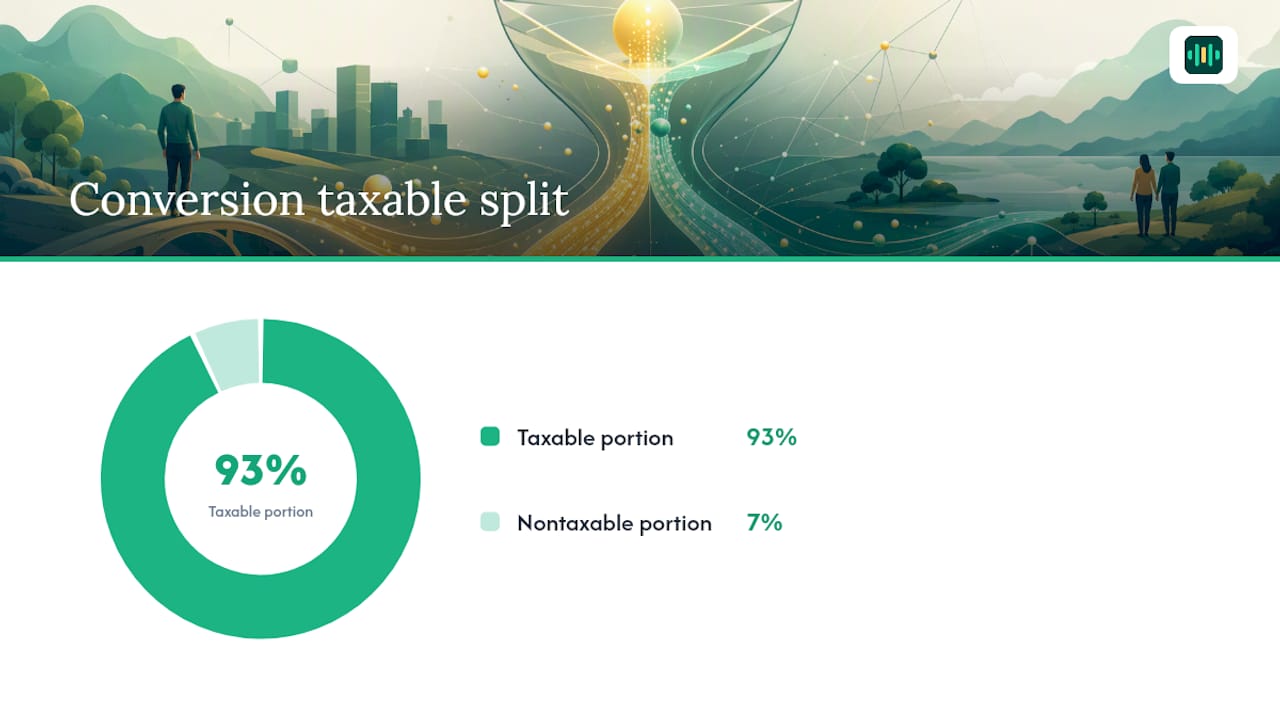
Here's a numeric example that shows how badly this can surprise someone. Say you contribute $7,000 in nondeductible money to a new traditional IRA and convert it immediately. Sounds tax free, right? Not if you also have a $93,000 rollover IRA from an old job sitting untouched. Your total IRA balance is $100,000, and your basis is $7,000. That means only 7% of any conversion is tax free, and 93% is taxable, regardless of which account the money technically came from.
Convert that $7,000, and $6,510 of it becomes taxable income, taxed at your marginal rate.
- The denominator includes ALL traditional, SEP, and SIMPLE IRAs you own as of December 31, plus any distributions taken during the year.
- Roth IRAs and 401(k) balances are excluded from this calculation entirely.
- The ratio applies to every conversion you do that year, not just the newest one.
- State tax treatment of the taxable portion varies. Some states tax it as ordinary income, and a few, like Pennsylvania, have unique rules for retirement distributions, so check your state's specific treatment before assuming your federal calculation is the whole story.
Running this math by hand gets tedious fast once you factor in multiple accounts and partial-year contributions. A pro-rata calculator built specifically for this scenario can save you from a nasty surprise at tax time.
Form 8606 and 1099-R: What the IRS Actually Requires
Form 8606 is the document that proves your nondeductible contribution exists, and skipping it is one of the most common (and costly) backdoor Roth mistakes.
You must file Form 8606 for any year you make a nondeductible contribution to a traditional IRA or complete a Roth conversion. The form tracks your basis, the after-tax money you've already paid tax on, so the IRS doesn't tax it again when you eventually withdraw or convert it.
Your brokerage sends a 1099-R reporting the conversion as a distribution, which can look alarming if you don't know what to expect. That 1099-R doesn't distinguish between taxable and nontaxable portions. It's Form 8606, filed with your Form 1040, that does the actual math and tells the IRS how much of the distribution is taxable.
- Miss filing Form 8606, and the IRS has no record of your basis, meaning your nondeductible contribution could be treated as if it were never made.
- That mistake can lead to paying tax twice on the same money, once when you contributed it (as after-tax income) and again when you eventually withdraw it.
- Fixing a missed filing means filing an amended return or a standalone Form 8606 for the missed year, sometimes going back several years.
- Keep every 1099-R and Form 8606 copy indefinitely. There's no statute of limitations on proving your own basis.
The paperwork burden is real, but it's a one-page form each year. The cost of skipping it, reconstructing years of missed filings with a CPA, is far higher than the ten minutes it takes to file correctly.
Is the Backdoor Roth Worth It for You?
The math favors the backdoor Roth for a specific type of taxpayer, and works against it for another.
The upside is straightforward. Roth accounts grow tax free, skip required minimum distributions, and give you flexibility in retirement to control your taxable income by choosing which account to pull from. For estate planning, Roth IRAs also pass to heirs without the income tax bite that traditional IRA inheritances carry.
The downside is where people underestimate the cost. The pro-rata rule can turn what should be a tax-free move into a tax bill you didn't budget for. Filing Form 8606 correctly every year adds complexity that a lot of DIY filers get wrong. State tax treatment adds another variable. And if the IRS ever decided to apply the step transaction doctrine to same-day conversions, though it hasn't done so in published guidance, it could theoretically challenge the sequencing, not the strategy itself.
Good candidates for a backdoor Roth typically share these traits:
- Income above the Roth MAGI phase-out, with no existing pre-tax traditional IRA balances.
- A 401(k) plan at work that accepts incoming rollovers, giving them a place to park old IRA money.
- Enough cash flow to pay any incidental tax on investment gains without touching the converted funds.
- A long time horizon before retirement, so decades of tax-free growth outweigh the upfront hassle.
Red flags include large rollover IRAs you can't move elsewhere, income near the phase-out threshold where a Roth might still be directly reachable, or a state tax situation you haven't checked.
Setting Up Your Backdoor Roth the Right Way
Sequencing determines whether your backdoor Roth is nearly tax free or unexpectedly expensive. Here's the order that avoids the most common trap.
- Check your existing IRA balances first. Before contributing a single dollar, add up every traditional, SEP, and SIMPLE IRA you own. This number determines your pro-rata exposure.
- Clean up pre-tax balances if you have them. If your current employer's 401(k) accepts rollovers, moving pre-tax IRA money into the plan before year end removes it from the aggregation pool entirely.
- Confirm the rollover completes by December 31. The pro-rata calculation uses your year-end balance, so a rollover that's still processing on January 1 won't help for that tax year.
- Open or reuse a traditional IRA and contribute the nondeductible amount, up to $7,000 or $8,000 with the catch-up provision.
- Convert to Roth promptly, ideally within days, to limit taxable earnings accumulation.
- File Form 8606 the following tax season, documenting both the contribution and the conversion.
If your 401(k) doesn't accept rollovers, or you'd rather not add complexity to your workplace plan, you have a second option: convert the entire pre-tax IRA balance to Roth in one year and pay the tax on all of it at once. This works best in a year when your income dips, a sabbatical, a business loss, or a year between jobs, since it permanently removes that balance from future pro-rata calculations. It costs more upfront but simplifies every backdoor Roth you do afterward.
Pro Tip: Run the rollover-to-401(k) cleanup in the same calendar year you plan your first backdoor Roth. Doing it after you've already converted means you're stuck with a pro-rata bill for that year, even if your IRA balance is clean going forward.
Either path beats doing nothing and hoping the pro-rata math works out. It won't, if you have any meaningful pre-tax balance sitting untouched.
Mega Backdoor Roth and Other Ways Around the Pro-Rata Rule
The mega backdoor Roth sidesteps the IRA pro-rata problem entirely by working through your 401(k) instead. If your employer's plan allows after-tax contributions beyond the standard salary deferral limit, plus in-plan Roth conversions or in-service withdrawals, you can move tens of thousands of dollars a year into Roth space. Because this happens inside the 401(k), it never touches the IRA aggregation pool, so the pro-rata rule doesn't apply.
Not every employer plan supports this, so check your plan documents or ask HR before assuming it's available.
Other alternatives worth knowing:
- Rolling a pre-tax IRA into a current 401(k) removes it from pro-rata calculations without triggering any tax, since it's a same-tax-status transfer.
- Converting a pre-tax IRA to Roth in a deliberately low-income year spreads the tax hit into a year when your marginal bracket is lower.
- A nonworking or lower-income spouse can sometimes make backdoor Roth contributions even when their own IRA balances differ from yours, since the pro-rata rule applies separately to each spouse's IRAs.
Model Your Own Numbers Before You Convert
Reading about the pro-rata rule and calculating your actual exposure are two different things, especially once you factor in multiple IRAs, partial-year contributions, and your specific tax bracket.
A pro-rata rule calculator that accepts your IRA balances, existing basis, conversion amount, and filing status can show you the taxable portion before you file anything. Pair that with the Roth conversion calculator to see the projected federal tax on the specific amount you're planning to convert.
With Mali, you can ask this out loud instead of typing it into a spreadsheet:
- "How much of my Roth conversion will be taxable if I have $40,000 in an old rollover IRA?"
- "What's my projected federal tax if I convert $7,000 this year?"
- "Should I roll my IRA into my 401(k) before converting?"
Mali pulls from your connected account balances to answer with your actual numbers, not generic assumptions. Treat the output as a planning estimate. Final filing decisions, especially with multiple accounts or state tax complications, deserve a conversation with a CPA. Your account data stays encrypted throughout, and nothing gets shared without your permission.
When to Handle This Yourself and When to Call a CPA
The backdoor Roth trades a small tax bill now for decades of tax-free growth later. That trade makes sense for most high earners with clean IRA balances and a long runway to retirement. It gets murkier the moment you're juggling old 401(k) rollovers, multiple state tax exposures, or a spouse with a separate IRA history.
I'd tell anyone with a six-figure pre-tax IRA balance, or income spread across two states in one year, to loop in a CPA before converting anything. The pro-rata math isn't hard once you understand it, but the cost of getting it wrong compounds every year you fail to file Form 8606 correctly. For someone with a single clean traditional IRA and no legacy rollovers, the DIY path is straightforward and the software-guided version of Form 8606 handles most of the heavy lifting.
Where I'd push back on conventional wisdom: too many guides treat the backdoor Roth as a set-it-and-forget-it move. It isn't. Your IRA balance changes every year, your income changes, and the strategy needs a fresh check each time you do it, not a one-time setup you never revisit.
— Todd
Model Conversions With a Voice Assistant, Not a Spreadsheet
Most retirement tools hand you a dashboard full of numbers and expect you to figure out what they mean. This app works differently: you can talk about your bank and IRA balances, and it responds with real answers, not a chart you have to interpret yourself.

For a backdoor Roth specifically, that means asking Mali what your pro-rata exposure looks like before you convert a dollar, instead of guessing or waiting for tax season to find out. The pro-rata rule calculator and the broader retirement planning tools use your connected account data to run the math with your real numbers, not hypothetical examples. Mali's estimates are built for planning, not for filing. Use her to understand your exposure ahead of time, then confirm the final numbers with a CPA when you file. Start a trial and connect your accounts to see what your own backdoor Roth would actually cost this year.
Where to Verify the Rules Yourself
For the primary source rules, consult IRS Publication 590-A on contribution limits, Form 8606 instructions for filing mechanics, and the About Form 8606 page for a quick overview.
This article is general information, not a substitute for advice from a qualified financial advisor. Consult a qualified financial professional about your own circumstances before acting on anything here.