

Pick your method (pay smallest balance first, or highest interest rate first), commit a specific extra dollar amount every month, and set it to autopay tonight. Run your real balances and rates through a calculator before you commit to a number, because the difference between a vague goal and a scheduled payment is usually the difference between paying off debt in three years and paying it off in twelve.
TL;DR:
- Making extra payments of at least $200 monthly and automating them immediately after paychecks significantly cuts overall interest and shortens payoff time.
- Choosing the debt avalanche method saves more interest, but the debt snowball provides quicker wins that may improve motivation and perseverance.
- For balances under $5,000, either avalanche or snowball strategies typically work well; larger or multiple debts may benefit more from balance transfers or consolidation loans.
- Building a $1,000 emergency fund before aggressive debt repayment prevents setbacks from unexpected expenses that could otherwise reset progress.
- Regularly revisiting your payment plan with real data and automating scheduled payments reduces reliance on motivation and increases the likelihood of debt clearance.
Table of Contents
- Your Credit Card Payoff Plan in 3 Steps
- How Do You Calculate Your Credit Card Payoff Timeline?
- Avalanche, Snowball, or a Lower Rate? How to Choose
- Where Does the Extra Payment Money Actually Come From?
- Automating Payments Without Tripping Common Traps
- How Mali Turns Your Numbers Into a Real Schedule
- Speed Matters Less Than Finishing
- Run Your Own Numbers Before You Commit to a Payment
- Where to Verify the Numbers Yourself
- Sources
Your Credit Card Payoff Plan in 3 Steps
You don't need a financial degree to build a working credit card payoff plan. You need three decisions, made in order, and then automation so you stop relying on willpower.
Step 1: Stop the bleeding. Keep paying at least the minimum on every card, but stop charging anything new to the cards you're trying to kill. If you're still swimming, you're not swimming forward.
Step 2: Pick your order. Choose the debt avalanche (highest interest rate first) if you want to minimize total interest and can stay disciplined without quick wins. Choose the debt snowball technique (smallest balance first) if you know from experience that momentum keeps you going better than math does.
Step 3: Pick a number and automate it. Decide on either a fixed extra payment (say, $200 a month above the minimum) or a target payoff date, then set autopay to hit that number automatically, right after payday.
- Set autopay for minimum plus extra on your priority card.
- Switch daily spending to a debit card or cash.
- Delete saved card numbers from your phone and browser.
Pro Tip: Automate the payment for the day after your paycheck lands, not the due date. Money you never see in your checking account is money you can't accidentally spend.
How Do You Calculate Your Credit Card Payoff Timeline?
A payoff calculator needs four inputs: your current balance, your APR, your minimum payment (or its formula), and either a fixed extra payment or a target payoff date. Feed those in and the output shows months to zero and total interest paid, which is the number that actually tells you what debt is costing you.
One nuance that trips people up: some issuers charge interest on your average daily balance, while calculators sometimes model interest as a simple month end charge. That gap explains why your real statement and your calculator's projection might differ by a few dollars. The Federal Reserve tracks the broader interest rate environment that determines what APR you're actually working against, and it's rarely as low as your card's teaser rate implied.
Here's what payment size does to a $6,500 balance at roughly 20.5% APR, a rate in line with what the Federal Reserve reports as typical for cardholders carrying balances:
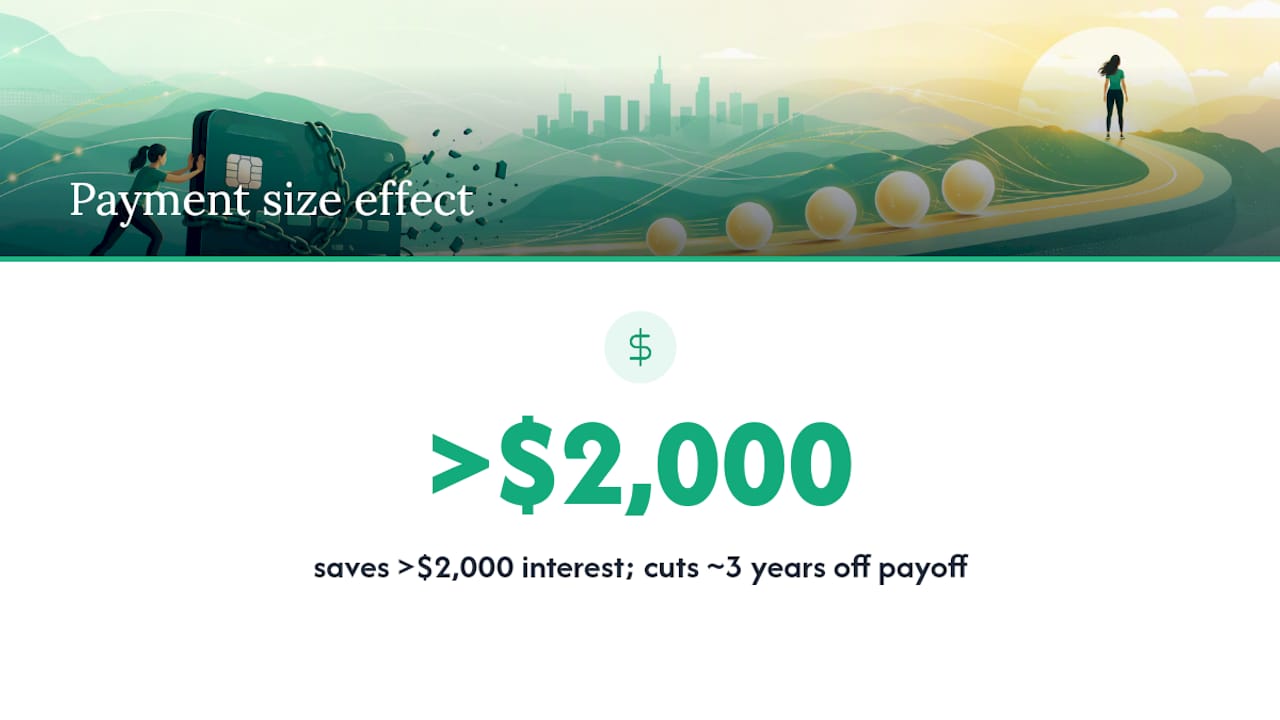
That's not a rounding error. Moving from $200 to $500 a month cuts your interest bill by more than $2,000 and your timeline by nearly three years. Most calculators let you toggle between "fixed extra payment" mode, which shows you the timeline that results from a dollar amount, and "target date" mode, which back solves for the payment you'd need to hit a deadline. Run both. Seeing the actual required number often changes what feels doable.
Avalanche, Snowball, or a Lower Rate? How to Choose
The debt avalanche and debt snowball technique attack the same problem from opposite ends, and the right pick depends less on math and more on what will actually keep you paying.
- Avalanche targets your highest APR card first while paying minimums elsewhere. It saves the most money mathematically, but the payoff can feel slow if your highest rate card also has your biggest balance.
- Snowball targets your smallest balance first regardless of rate. You'll pay slightly more in total interest, but behavioral research on debt repayment suggests people who need early wins to stay motivated are more likely to finish with this method.
- 0% balance transfer moves your balance to a card with a promotional 0% rate, typically for 12 to 21 months, in exchange for a transfer fee of 3% to 5%. This wins big if you can pay off the balance before the promo ends. It backfires if you can't, since the rate afterward often jumps higher than what you started with.
- Personal loan or consolidation replaces multiple card balances with one fixed rate, fixed term loan. It works best when your credit qualifies you for a rate meaningfully below your current APRs and you want a set end date instead of an open ended payoff.
| Method | Best For | Watch Out For |
|---|---|---|
| Avalanche | Minimizing total interest | Slow visible progress |
| Snowball | Staying motivated | Slightly more interest paid overall |
| 0% Balance Transfer | Moderate balances, good credit | Missing the promo deadline, transfer fees |
| Consolidation Loan | Multiple cards, want fixed timeline | Qualifying for a genuinely lower rate |
A rough rule of thumb: under $5,000 and disciplined, avalanche or snowball both work fine. Above that, or with multiple cards, a balance transfer or consolidation loan is worth modeling if your credit score supports it.
Where Does the Extra Payment Money Actually Come From?
Run a quick 50/30/20 check on last month's spending: 50% needs, 30% wants, 20% savings and debt. Most people find $50 to $300 a month sitting in the "wants" column without much sacrifice, subscriptions nobody uses, dining out that's become a habit rather than a treat.

Before you throw every spare dollar at your cards, build a $1,000 starter emergency fund first. A small cash buffer keeps a flat tire or a broken appliance from landing right back on your credit card, which would erase weeks of payoff progress in one swipe.
Reliable sources of extra "snowflake" cash to throw at your balance:
- Tax refunds and work bonuses
- Cash back or rewards redemptions
- Selling items you no longer use
- Side gig income earned specifically to attack debt
Pro Tip: Split any windfall 80/20: eighty percent to debt, twenty percent to your emergency fund, until the fund hits $1,000. After that, send it all to debt.
Automating Payments Without Tripping Common Traps
Set autopay to cover the minimum plus your extra amount, timed to land right after your paycheck. If your budget allows it, split that payment into two smaller ones every two weeks instead of one monthly lump sum. This lowers your average daily balance, which is what many issuers actually calculate interest against, shaving a few extra months off your timeline.
- Call your issuer and ask for a lower APR before you assume you need a transfer. It costs nothing and sometimes works, especially with a solid payment history.
- Mark your balance transfer promo end date on a calendar the day you open the offer, not the day it's about to expire.
- Avoid any "debt relief" service that asks for money up front before doing anything. That's a consolidation scam pattern.
- Never miss a payment during a promo period. One late payment can trigger a penalty APR that erases the entire benefit of the transfer.
How Mali Turns Your Numbers Into a Real Schedule
A payoff plan only works if the number is sized to your actual life, not a generic guess. Mali's Credit Card Payoff Calculator models your months to zero and total interest the same way the scenarios above do, using your real balance and APR.
- Link your accounts and Mali sizes your extra payment against your actual income gap, not a one size fits all suggestion.
- Ask Mali by voice or chat for a payoff timeline update whenever your budget changes.
- Get personalized side income suggestions sized to close the specific gap between your minimum and your target payment.
- Track utilization and progress automatically instead of checking five statements by hand.
Speed Matters Less Than Finishing
Completion beats theoretical optimality every time I've seen this play out. The mathematically perfect avalanche plan is worthless if you abandon it in month four because it felt too slow. Pick the method you'll actually stick with, automate the payment so it doesn't depend on your motivation on any given Tuesday, and revisit your numbers every quarter as your income or balances shift. Small, consistent wins compound faster than perfect plans you quit.
— Todd
Run Your Own Numbers Before You Commit to a Payment
Every scenario in this article started with real numbers plugged into a calculator, not a guess. That's the difference between a payoff plan and a hope. Mali gives you free access to a full library of calculators, including the same credit card payoff model used above, with no signup required to test your own balances and rates.

Enter your card balance, APR, and a monthly extra amount into the Credit Card Payoff Calculator and you'll see your exact months to zero and total interest before you touch a payment. Link your accounts and Mali sizes that extra payment against your real income gap instead of a round number pulled from a blog post, then keeps tracking your progress automatically as you pay it down. Once you know your number, open your banking app and schedule the automatic transfer today.
Where to Verify the Numbers Yourself
For rate context, the Federal Reserve's consumer credit releases track how APRs move over time. For payoff math, Calcxi's payoff calculator models amortization and the minimum payment trap in detail. For balance transfer mechanics, MoneyScale's debt payoff guide walks through fee and promo window math worth running before you transfer a balance.
Sources
- CBS News — How much emergency savings when paying off debt?
- Calcxi — Credit card payoff calculator
- Cardocrat — How to pay off credit card debt
- MoneyScale — 4-step debt payoff plan