

There's no legal cap on how many bank accounts you can open, but the practical answer is simpler than most people think. Start with one checking account and one savings account. From there, most people land comfortably in the 2 to 5 account range depending on their goals. If you're sitting on more than $250,000 at a single bank, that's your cue to think about FDIC insurance limits before you go any further.
TL;DR:
- Most people find two to five bank accounts sufficient, with one checking and one savings account as the basic setup, depending on their goals.
- Opening multiple checking accounts is generally only needed for specific purposes such as household budgeting, business income separation, or backup security, while exceeding two can risk eligibility issues or fees.
- Separating emergency savings from goal-specific savings helps prevent accidental spending, especially when using high-yield accounts or certificates for long-term goals.
- FDIC insurance covers up to $250,000 per depositor at each bank, but ownership categories like joint or IRA accounts can significantly increase coverage beyond that threshold.
- Automating transfers and checking for account activity helps manage multiple accounts efficiently, but having more than five accounts usually adds undue complexity rather than benefit.
Table of Contents
- Practical Account Setups: From Minimalist to Goal-Splitting
- How Many Checking Accounts Do You Actually Need?
- How Many Savings Accounts Should You Have?
- FDIC Insurance: What Happens Above $250,000
- The Trade-Off: Why More Accounts Isn't Automatically Better
- Managing Multiple Accounts Without Losing Track of Them
- Should You Open Another Account? A Quick Checklist
- A Simpler Way to Think About Account Structure
- Try Mali Before You Open Another Account
- Sources
- FAQ
Practical Account Setups: From Minimalist to Goal-Splitting
The right number of accounts depends on how much structure you actually want. Most financial guidance points to a checking and savings pair as the floor, then builds up from there based on your habits and goals.
Three setups cover most situations:
- Minimalist (2 accounts): One checking for daily spending, one savings for emergencies. Best if you find extra accounts more confusing than helpful.
- Everyday plus buffer (3 accounts): Checking, an emergency fund, and a separate goal savings account (a car, a wedding, a down payment). This is the sweet spot for people who want basic separation without a spreadsheet's worth of upkeep.
- Goal splitting (4 to 5 accounts): Checking, emergency fund, and several dedicated savings buckets, one per goal. If you're saving for a car and a house at the same time, mixing those funds in one account makes it hard to know what's actually available for either.
Beyond five accounts, things usually shift for a specific reason rather than pure preference. Freelancers and small business owners often add accounts to keep business and personal money apart for tax and liability reasons. People juggling a dozen micro-goals sometimes prefer a dedicated account for each. Just know that every account past five adds real upkeep. Bankrate's guidance on fees and minimums is worth reading before you scale up that far.
How Many Checking Accounts Do You Actually Need?
One primary checking account handles your paycheck, bills, and daily spending. That's non-negotiable. A second checking account makes sense in specific cases: joint household spending with a partner, keeping business income separate from personal money, or a backup account at a different bank in case your primary card gets frozen or compromised.
Watch for two operational snags. Opening several checking accounts in a short window can trigger a flag with ChexSystems, the reporting agency banks use to screen new applicants. And every dormant checking account is a potential fee trap. If you do run two, designate one as primary, route your direct deposit and essential autopay there, and keep the second account for its one specific job.
How Many Savings Accounts Should You Have?
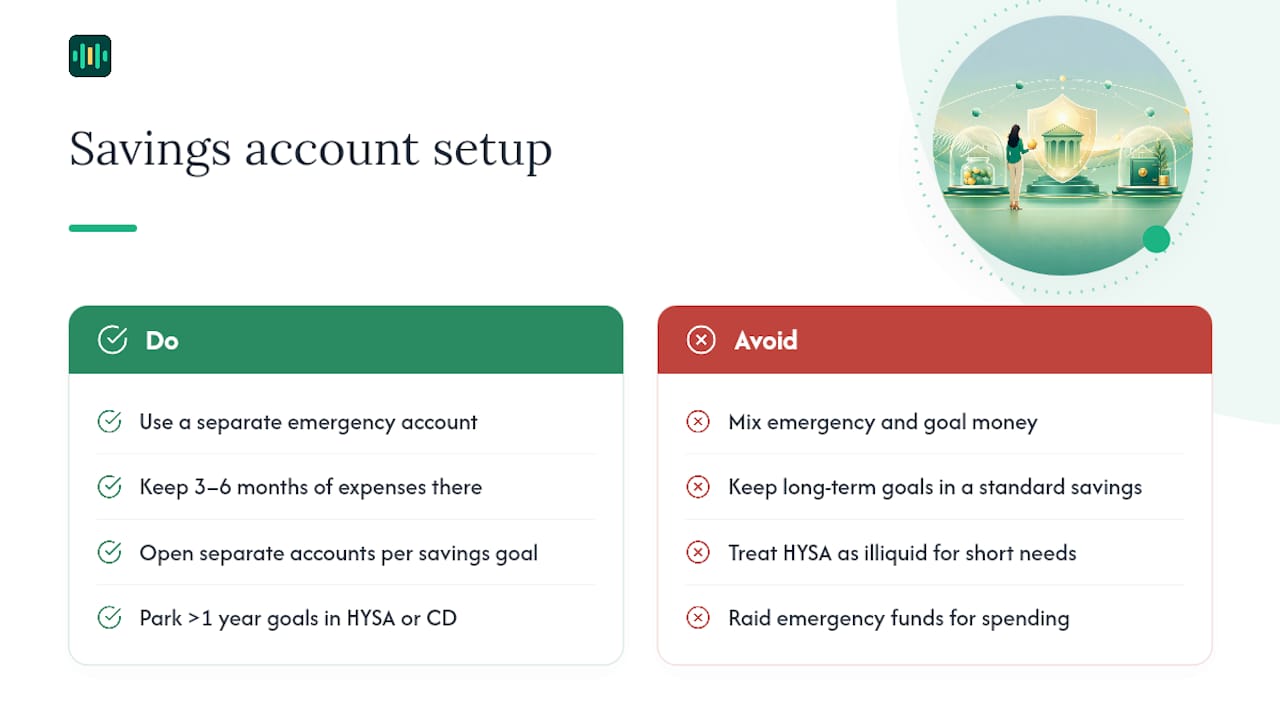
Your emergency fund deserves its own account, separate from any goal savings. Mixing the two is how people accidentally raid their safety net for a vacation. Beyond that baseline, separating goals into their own accounts has a real behavioral upside: it's harder to spend money you've mentally and physically filed under "house down payment."
For money you won't touch for a year or more, a high-yield savings account or a CD usually beats a standard savings account on return. A CD locks your rate and your access for a set term, which works well for a goal with a known date, like a wedding 18 months out. High-yield savings keeps things liquid while still paying more than a traditional account. A common allocation: three to six months of expenses in a liquid emergency fund, and anything earmarked for a goal more than a year away parked in whichever option pays better for that time frame. Mali's savings goal calculator can help you figure out what monthly contribution actually gets you there.
FDIC Insurance: What Happens Above $250,000
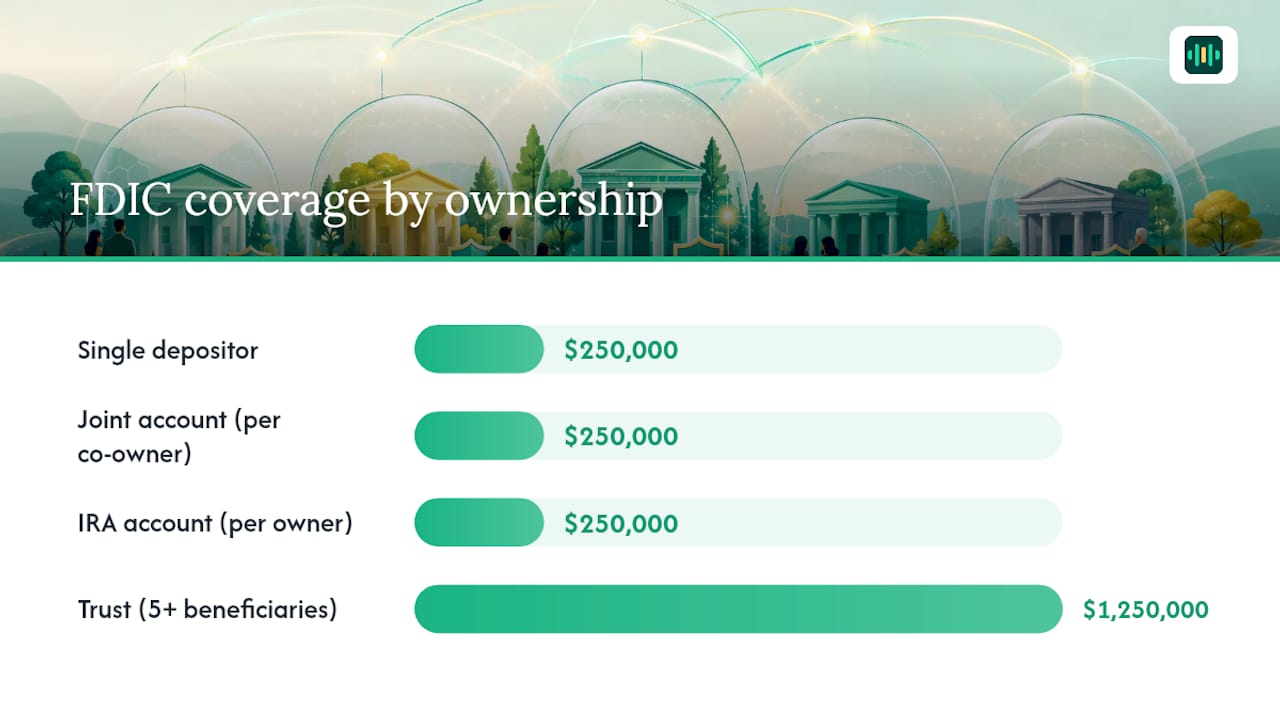
The FDIC insures deposits up to $250,000 per depositor, per insured bank, per ownership category, according to the FDIC's own guidance. If your balance at one bank sits above that number in a single ownership category, the excess isn't covered if that bank fails.
Ownership categories matter more than most people realize. A single account, a joint account, and an IRA are each treated separately, which means a married couple with a joint account and individual retirement accounts at the same bank can legitimately have well over $250,000 protected. Trust accounts go further still. FDIC brochures note that a trust account with five or more beneficiaries can qualify for coverage up to $1,250,000.
The FDIC's EDIE tool, the Electronic Deposit Insurance Estimator, calculates your exact coverage based on your accounts and ownership structure. It's free, and it takes about five minutes. One more thing worth remembering: money market funds, stocks, and other investment products held at a bank are not FDIC insured, even if they sit right next to your savings account on the same statement.
The Trade-Off: Why More Accounts Isn't Automatically Better
Splitting money across accounts gives you cleaner budgeting, real goal separation, and in some cases better interest or deposit insurance coverage. Spreading cash across multiple institutions can meaningfully increase interest income on larger balances over time.
But every account is also one more thing to track:
- Minimum balance requirements can quietly turn a "free" account into one that charges you $15 a month.
- Dormancy rules at some banks kick in after a year of no activity, sometimes with a fee attached.
- More accounts mean more statements, more passwords, and more chances to miss something.
If you're curious about a new bank without committing, soft switching, opening a new account to test it while keeping your old one active, is a low-risk way to compare rates and features.
Pro Tip: Give every single account one job and one job only. The second an account serves two purposes, you'll lose track of what's actually available to spend.
Managing Multiple Accounts Without Losing Track of Them
Automation is what makes multiple accounts sustainable instead of a chore. Scheduling recurring transfers on payday, before you have a chance to spend the money, is one of the most consistently recommended habits in personal finance guidance, and it works because it removes the decision entirely.
A few habits keep the system running:
- Set up automatic transfers for every savings goal so contributions happen without you thinking about it.
- Use an account-linking finance tool to check balances across banks without logging into five different apps.
- Run at least one transaction a year on every account to avoid dormancy fees, and turn on low-balance alerts everywhere.
- Use unique login credentials per bank and check statements monthly for anything unfamiliar.
Should You Open Another Account? A Quick Checklist
Before adding a new account, run through this:
- Does it have a single, clear purpose? If you can't name the one job it does, skip it.
- Can you automate money into it? An account you have to fund manually every month usually goes neglected within a year.
- What does it cost? Check for monthly fees, minimum balance requirements, and transfer restrictions.
- Does it change your FDIC coverage? If you're carrying a large balance, a new account at a different bank might solve two problems at once.
- Can you keep it active? An account that will sit untouched for a year is a future dormancy fee waiting to happen.
Red flags that should make you walk away: unavoidable monthly fees regardless of balance, high minimums that don't match your cash flow, confusing transfer restrictions, or weak security practices like no two-factor authentication.
A Simpler Way to Think About Account Structure
Most people don't actually need more accounts. They need a clearer view of the accounts they already have. That's the gap Mali was built to close. Mali is a voice-first AI financial companion. You talk to her about your real spending and income, linked directly from your bank accounts, and she talks back with specific, spoken recommendations instead of a dashboard full of charts to interpret yourself.
Checking whether your emergency fund is on track, or whether that third savings account is actually pulling its weight, shouldn't require opening four apps and doing mental math. Ask Mali out loud, and she answers based on your actual numbers.
— Todd
Try Mali Before You Open Another Account
If you're staring at three or four accounts and genuinely unsure whether they're helping or just adding noise, that's exactly the situation Mali was built for. 
Mali links to your bank accounts and gives you spoken, personalized recommendations instead of another dashboard to decode. You can ask how your emergency fund stacks up, whether a goal account is on pace, or where your money actually went last month, and get a straight, spoken answer instead of scrolling through transaction history yourself. Beyond the voice conversations, such tools often include calculators for savings goals, retirement, debt payoff, and joint household planning, plus couples support if you're managing money with a partner.
If you're managing several accounts and want one place to make sense of all of them, start with Mali's features page and see what a 7-day trial looks like for your own numbers.
Sources
- Understanding deposit insurance | FDIC
- Managing multiple bank accounts | U.S. Bank
- Is It OK to Have More Than 1 Bank Account? | Investopedia
- How many bank accounts do you need? | Bankrate
FAQ
Is Having 4 Bank Accounts Too Many?
No. Four accounts, for example checking, emergency savings, and two goal accounts, fits comfortably within the commonly recommended range of 2 to 5 accounts as long as each one has a clear purpose.
How Many Americans Have $100,000 in Their Bank Account?
This figure isn't reliably tracked in a way this article can verify, so no specific number is stated here. What matters more at that balance is checking your FDIC coverage using the EDIE tool rather than the exact percentage of people who hit that mark.
What Happens if I Have More Than $250,000 in One Bank?
Anything above $250,000 in a single ownership category at one bank isn't FDIC insured. Spreading the excess across a second bank, or into a different ownership category like a joint account or IRA, restores full coverage.
Can I Have 10 Bank Accounts?
There's no legal limit, so yes. It's just rarely practical for individuals outside of specific cases like running a business alongside personal finances or managing many small, distinct goals, since each added account brings more fees, minimums, and dormancy rules to track.