

A mega backdoor Roth lets you move after-tax 401(k) contributions into Roth status, potentially adding tens of thousands beyond normal limits each year. It only works if your 401(k) plan allows voluntary after-tax contributions plus either an in-plan Roth conversion or in-service distribution. Check that single condition before you calculate anything else.
TL;DR:
- The strategy relies entirely on your plan permitting voluntary after-tax contributions and either in-plan Roth conversions or in-service distributions, which vary widely among plans.
- Your maximum after-tax contribution for 2026 depends on subtracting employee deferrals, employer contributions, and other plan additions from the $72,000 cap, with timing of employer contributions affecting available room.
- To avoid pro-rata taxation, you should roll outside pre-tax IRAs into your 401(k) before converting and execute conversions within days to prevent taxable earnings from accumulating.
- Confirm plan support for after-tax contributions and conversions in writing before making significant contributions, as verbal agreements are insufficient for IRS compliance.
- Exceeding the $72,000 contribution limit or delaying conversion over three months can trigger costly taxes or excise penalties, making precise planning essential.
Table of Contents
- How Does the Mega Backdoor Roth Actually Work?
- What Are the 2026 Mega Backdoor Roth Contribution Limits?
- Does Your 401(k) Plan Actually Allow This?
- How Do You Execute a Mega Backdoor Roth Step by Step?
- What Are the Most Expensive Mega Backdoor Roth Mistakes?
- Is a Mega Backdoor Roth Right for You?
- How Mali Helps You Run the Numbers Before You Commit
- An Editorial Take on the Mega Backdoor Roth in 2026
- Sources
- FAQ
How Does the Mega Backdoor Roth Actually Work?
Your 401(k) can hold up to four different pools of money, and most employees only ever fund one of them. Understanding the split matters, because the mega backdoor Roth lives entirely in the pool almost nobody uses.
- Pre-tax elective deferrals: your normal salary-deferral contributions, taxed on withdrawal.
- Roth elective deferrals: contributions taxed now, tax-free later.
- Employer contributions: match and profit-sharing, always pre-tax until converted.
- Voluntary after-tax contributions: separate from Roth deferrals, made with already-taxed dollars, and the pool a mega backdoor Roth actually uses.
Once money lands in that after-tax bucket, you have two paths to Roth status. An in-plan Roth conversion moves the after-tax balance into the plan's designated Roth account while you're still employed. An in-service distribution sends that same after-tax money out of the plan entirely, typically rolled into a Roth IRA. Both accomplish the same goal, but the second gives you access to a wider range of investments outside your employer's plan menu.
Here's the part people miss: only your after-tax contributions convert tax-free. Any earnings that accumulate on that money before conversion are taxable as ordinary income the moment you convert. Fidelity notes that plan support for these features varies widely, so a coworker at a different company running this exact strategy may have a completely different experience with their custodian's paperwork and turnaround time.
What Are the 2026 Mega Backdoor Roth Contribution Limits?
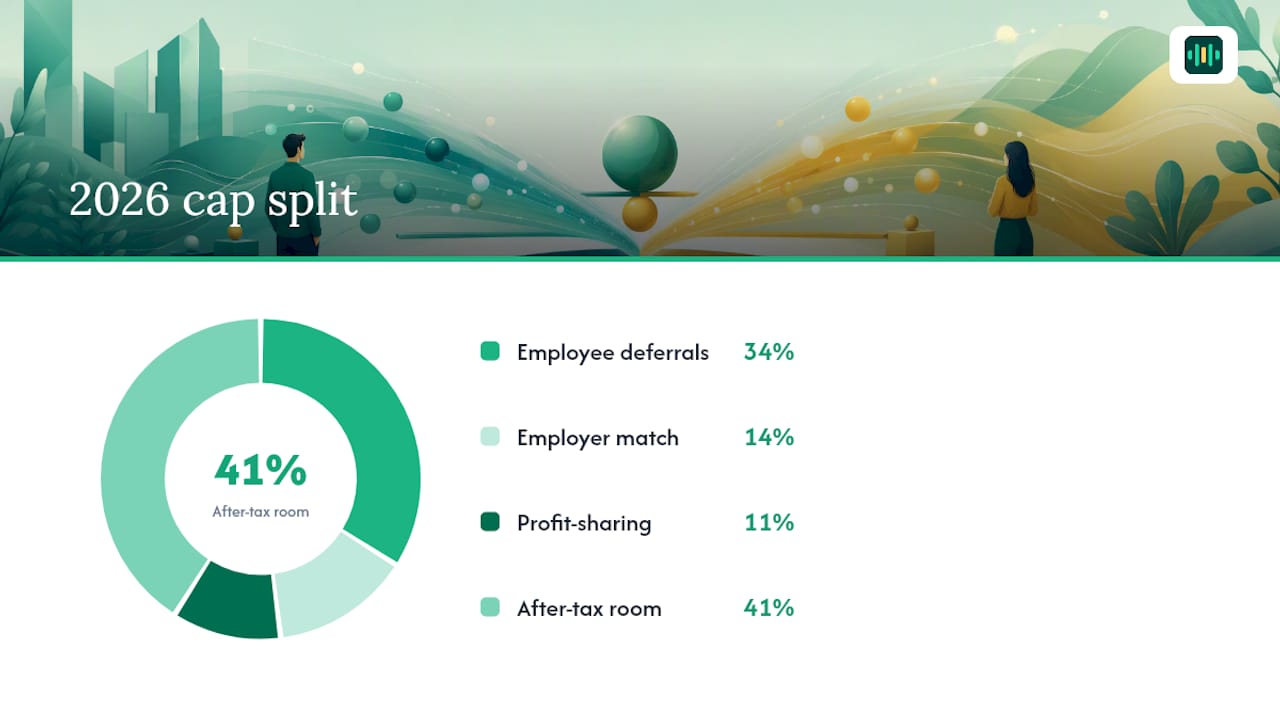
The math starts with one number: the Section 415(c) annual additions limit, which caps total contributions to your 401(k) from every source combined at $72,000 for 2026, with higher figures available to participants eligible for catch-up contributions. That single cap is what determines how much after-tax room you actually have.
The formula is simple, even if the inputs vary person to person:
- Start with the $72,000 Section 415(c) limit for 2026.
- Subtract your employee elective deferrals (pre-tax and Roth combined).
- Subtract employer contributions, including match and profit-sharing.
- Subtract any other plan additions credited to your account.
- What remains is your maximum voluntary after-tax contribution, and therefore your maximum mega backdoor Roth conversion, for the year.
Example 1: A W-2 employee defers $24,500 and gets a $10,000 employer match plus $8,000 in year-end profit-sharing. That's $42,500 against the $72,000 cap, leaving $29,500 in after-tax room to convert.
Example 2: A Solo 401(k) owner defers $24,500 as employee and contributes $20,000 as employer profit-sharing, totaling $44,500. That leaves $27,500 in after-tax capacity, an amount Solo 401(k) guides note is often easier to plan around because the owner controls both the deferral and the employer contribution decision.
Pro Tip: Profit-sharing contributions often land in December or January, well after your last paycheck of the year. Ask HR exactly when that deposit hits your account, because it changes how much after-tax room you have available before year-end.
Does Your 401(k) Plan Actually Allow This?
Most plans don't support the mega backdoor Roth, and the only way to know for sure is to get answers in writing before you contribute a dollar. Ask HR or your plan administrator three specific questions:
- Does the plan permit voluntary after-tax contributions separate from Roth elective deferrals?
- Can that after-tax balance be converted in-plan to a Roth account?
- If not, does the plan allow in-service distributions of after-tax contributions for rollover to a Roth IRA?
Request the plan document language or a written custodian confirmation covering all three, and keep it. A verbal "yes" from an HR rep who isn't reading from the plan document isn't worth much when tax season arrives.
Some employers deliberately skip the after-tax bucket. Ascensus explains that voluntary after-tax contributions trigger separate nondiscrimination testing requirements, and plans that fail that testing can face corrective distributions affecting highly compensated employees specifically. That's often the real reason a plan document simply doesn't offer the feature.
If your plan lacks these provisions, you're not out of options. A standard backdoor Roth IRA conversion still works for smaller amounts, and self-employed readers can look at a Solo 401(k), which frequently permits after-tax contributions and in-plan conversion by design since the owner controls the plan's own terms.
How Do You Execute a Mega Backdoor Roth Step by Step?
Sequence matters more than most guides admit. Do these steps out of order and you can end up with a surprise tax bill or a rejected conversion.
- Clean up outside pre-tax IRAs first. If your 401(k) accepts roll-ins, move any pre-tax traditional IRA balances into the plan before you start. This avoids the pro-rata complications covered below.
- Calculate your after-tax room using the 415(c) formula, factoring in when your employer actually deposits match and profit-sharing dollars.
- Make the after-tax contribution through payroll, then request conversion immediately, specifying in writing whether you want an in-plan conversion or an in-service distribution to a Roth IRA.
- Confirm the conversion executed correctly. Ask your custodian to confirm the after-tax basis converted with little or no taxable earnings attached.
- Track your tax forms. You should receive a Form 1099-R reporting the conversion; verify Box 2a shows a taxable amount close to zero if you converted quickly.
A few things to watch along the way:
- Some plans only allow quarterly or annual conversions, not automatic same-day ones, so ask about frequency before you contribute a large lump sum.
- If you leave your job before converting, the after-tax balance typically still qualifies as a distributable event, letting you roll it to a Roth IRA at separation.
- Payroll systems sometimes cap after-tax contribution percentages per paycheck, which can prevent you from hitting your calculated room by December unless you adjust your election early in the year.
Running this calculation by voice, saying your income, deferral rate, and employer match out loud to an app rather than typing into a spreadsheet, is exactly the kind of task a voice-first design is well suited for. It's one thing this site does that a static calculator page can't.
What Are the Most Expensive Mega Backdoor Roth Mistakes?
The pro-rata rule catches more people off guard than any other part of this strategy. IRS Publication 590-B treats all your traditional IRAs, across every custodian, as one combined pool when you convert any of them to Roth. If you have a large pre-tax IRA sitting at an old employer's rollover account, converting after-tax dollars elsewhere doesn't isolate cleanly. A chunk of what you convert gets taxed as if it came proportionally from your pre-tax balance too.
The fix: ask whether your current 401(k) accepts roll-ins of outside pre-tax IRAs, and move that pre-tax money into the plan before converting after-tax contributions. Since 401(k) balances aren't counted in the IRA pro-rata calculation, this step alone can eliminate the entire problem.
Speed is the second biggest trap. CNBC's reporting on common mega backdoor Roth mistakes points out that any earnings your after-tax contribution generates before conversion get taxed as ordinary income when you convert. Wait three months and let the market move, and you've created a taxable event out of what should have been a tax-free transfer. Advisors generally recommend converting within days, and some custodians offer automatic conversions on a set schedule specifically to close that gap.
The third trap is simpler but costlier: exceeding the $72,000 Section 415(c) cap. Over-contributing triggers a 6% excise tax on the excess amount for every year it remains uncorrected, so double-check your math against actual payroll deposits, not projected ones, especially if your employer's profit-sharing contribution can shift based on year-end results.
- Roll outside pre-tax IRAs into your 401(k) before converting, if the plan allows it.
- Convert after-tax contributions within days, not months.
- Recalculate your 415(c) room whenever an employer contribution amount changes.
- Get written confirmation that your plan supports in-plan conversion or in-service distribution before contributing a large sum.
Is a Mega Backdoor Roth Right for You?
This strategy rewards a specific profile: high earners who've already maxed their 401(k) elective deferrals and their backdoor Roth IRA, and who have enough stable cash flow that locking additional money into a retirement account for decades doesn't strain their emergency fund.
It's the wrong move if any of these apply to you:
- You don't have three to six months of expenses saved outside retirement accounts.
- Your plan doesn't offer after-tax contributions or a conversion path, and amending it isn't realistic.
- You're carrying a large pre-tax IRA balance you haven't rolled into your 401(k) and can't move it.
Compared to a standard backdoor Roth IRA, which caps out at the regular IRA contribution limit, the mega version can move many times more money in a single year. Against simply investing in a taxable brokerage account, the mega backdoor Roth wins on tax treatment every time you can actually execute it cleanly. Do it consistently for several years and the compounding tax-free growth becomes the real payoff, not any single year's conversion.
How Mali Helps You Run the Numbers Before You Commit
Before you contribute a dollar, you need three numbers right: your after-tax room, your pro-rata exposure if you have outside IRAs, and what a conversion will actually cost in taxable earnings if it's delayed. Malimoney's Backdoor Roth pro-rata calculator, Roth conversion calculator, and 401(k) contribution calculator handle each of those, and you can talk through your specific numbers out loud instead of hunting through spreadsheet formulas. No other personal finance app lets you talk to an AI about your actual linked bank accounts and 401(k) contributions this way. Malimoney's voice-first design speeds up the sanity checks, but treat plan verification with HR and final tax decisions with a qualified tax advisor as non-negotiable steps Mali doesn't replace.
An Editorial Take on the Mega Backdoor Roth in 2026
Most articles on this topic bury the one thing that actually determines success: plan design. Readers spend far more time worrying about contribution math than they do getting three sentences from HR in writing, and that's backwards. The math is arithmetic. Whether your plan even permits an in-plan conversion is a yes-or-no fact you can't calculate your way around.
The conventional advice also underweights speed. Everyone quotes the contribution limit; almost nobody emphasizes that a two-month delay in converting can quietly turn a tax-free move into a taxable one. If you take one thing from this guide, make it this: get the HR confirmation in writing first, then convert within days of contributing, not months. The Section 415(c) cap matters, but it's the second problem, not the first.
Where I'd push back hardest on the typical framing: this strategy gets marketed as universally smart for high earners, and it isn't. If you've got a stray pre-tax IRA you haven't rolled into your 401(k), running this strategy without fixing that first is a documented way to lose a chunk of the tax benefit to the pro-rata rule. Sequence beats enthusiasm every time.
— Todd
This article is general information, not a substitute for advice from a qualified financial advisor. Consult a qualified financial professional about your own circumstances before acting on anything here.
Sources
- IRS Notice N-25-67 (2026 cost-of-living adjustments)
- What is a "mega backdoor Roth"? | Fidelity
- These are the biggest mega backdoor Roth conversion mistakes | CNBC
- What is the Mega Backdoor Roth Strategy, Anyway? | Ascensus
FAQ
Is the Mega Backdoor Roth Still Allowed in 2026?
Yes. The strategy remains legal under current IRS rules for 2026, governed by the Section 415(c) annual additions limit of $72,000, but it only works if your specific 401(k) plan supports after-tax contributions and a conversion path.
Is There a Downside to the Mega Backdoor Roth?
The main risks are the pro-rata rule taxing part of your conversion if you have outside pre-tax IRAs, taxable earnings if you delay converting after-tax contributions, and a 6% excise tax if you exceed the annual 415(c) limit.
Is a Mega Backdoor Roth Better Than a Regular Backdoor Roth IRA?
It isn't strictly better, it's larger. A standard backdoor Roth IRA is capped at the regular annual IRA limit, while a mega backdoor Roth can move tens of thousands more per year, but only if your 401(k) plan design actually allows it.
What Happens if My Employer's 401(k) Doesn't Support After-Tax Contributions?
You can't execute a mega backdoor Roth without that plan feature. Your best alternatives are a standard backdoor Roth IRA, or, if you're self-employed, a Solo 401(k) structured to include after-tax contributions and in-plan conversion.
How Quickly Should I Convert After-Tax Contributions to Roth?
Convert within days of contributing whenever possible. Any earnings that accrue before conversion are taxed as ordinary income, so a fast turnaround minimizes the taxable portion of the move.