

Name a specific dollar figure, not a vague percentage, and lead with the business impact behind it. State your number, then stop talking and let the silence work. Come in ready with market data and at least two non-salary items you'd accept instead, because a manager who can't move on base pay often can move somewhere else.
TL;DR:
- Negotiating for a raise should be based on specific dollar figures tied to measurable impact and market data, not vague percentages or general claims.
- Timing your request after key achievements or during budget planning cycles increases the likelihood of success and avoids delays.
- Silence after stating your desired raise is a powerful tactic that encourages your manager to respond without weakening your position.
- When facing objections, propose alternative rewards like bonuses, title changes, or flexible arrangements if a salary increase is unavailable.
- Using precise numbers and explicit milestones in follow-up plans enhances your chances of receiving a future pay bump even after a rejection.
Table of Contents
- How Do You Build a Case to Negotiate a Raise?
- When Is the Best Time to Ask for a Raise?
- What Do You Say When You Negotiate a Raise?
- How Do You Respond When Your Manager Pushes Back?
- What Happens If Your Manager Says No?
- Why Most Negotiation Advice Skips the Math
- Turn Your Raise Target Into a Real Number With Mali
- Sources
How Do You Build a Case to Negotiate a Raise?
Before you say a word to your manager, build a paper trail proving your value. This is sometimes called a brag file, and it should read less like a diary and more like a court exhibit: dates, numbers, names.
Start collecting now, even if your conversation is months away.
- Specific projects you led and their measurable results (revenue generated, costs cut, hours saved)
- KPIs tied to your role, tracked over at least two review cycles
- Direct quotes of praise from managers, clients, or peers, pulled from emails or Slack
- Instances where you took on responsibilities above your job title
- Comparisons showing how your output changed before and after a key contribution
Once you have the raw material, convert it into dollars wherever possible. If you automated a report that used to take a colleague six hours a week, multiply that by their hourly rate and 52 weeks. If you closed deals or influenced a renewal, tie your name to the revenue number. Vague claims like "I've been a strong contributor" don't move a budget conversation.
For market data, cross-reference at least two salary sources for your role, location, and experience level, then narrow that spread into a specific target instead of a broad range. Candidates who negotiate their salary increase their starting pay by an average of $5,000, and that gap tends to widen further for people who skip the ask entirely. Framing your request around objective benchmarks also matters for reasons beyond your own paycheck: transparent, benchmark-driven asks help close the gender pay gap, since ambiguity in negotiation tends to disadvantage the same groups every time.
When Is the Best Time to Ask for a Raise?
Timing shapes outcomes almost as much as the number you name. A request that lands the week after a big win reads very differently than the same request made at a random Tuesday standup.
- Watch for natural openings. Right after closing a major project, during your formal performance review, or just before your company sets next year's budget are all strong windows.
- Learn your company's budget cycle. Many organizations lock departmental budgets months in advance; asking after that lock happens usually pushes any increase to the next cycle, no matter how good your case is.
- Go to your direct manager first, not HR. Your manager controls the recommendation; HR typically just executes it once approved.
- Request the meeting deliberately. Send a short note: "I'd like to grab 20 minutes to talk about my role and compensation going forward." That framing signals a collaborative conversation, not an ultimatum.
- Prepare a one-page packet with your key results, your target range, and a proposed agenda, and send it a day or two ahead so your manager isn't caught flat-footed.
Giving your manager advance notice also gives them time to advocate for you before the meeting rather than reacting to you inside it.
What Do You Say When You Negotiate a Raise?
This is where preparation turns into performance, and the actual words matter more than most people expect. Vague requests get vague answers. Precise requests get real conversations.
Try one of these openers depending on your situation:
- After a strong review: "Based on the impact we just discussed, I'd like to talk about adjusting my compensation to $X."
- At a scheduled check-in: "I've put together a summary of my results this year, and I think it supports a salary of $X. Can we talk through it?"
- Mid-cycle, after a big win: "Given what this project delivered, I want to revisit my salary now rather than wait for the annual review."
Notice none of these use a percentage. Precise, specific dollar figures signal that you've done real analysis, while round percentages read as guesswork. Before the meeting, decide on three numbers privately: your target, a fallback you'd accept happily, and the walk-away point below which you'd rather look elsewhere. Employers often set initial offers below what they're actually willing to pay, which is exactly why your opening number should anchor near the top of your researched range, not the middle.
Then comes the hardest part: after you name your number, stop talking. Silence after your ask is a documented negotiation tactic, because it forces the other person to respond first instead of you filling the gap with justifications that weaken your position.
Pro Tip: Practice out loud, not in your head. Say your ask to your phone's voice recorder, play it back, and count the seconds of silence you can actually hold before you feel the urge to speak. Most people cave at three seconds; aim for ten.
How Do You Respond When Your Manager Pushes Back?
Objections aren't rejections. They're usually a signal to redirect, not retreat.
If your manager says there's no budget this cycle, respond with something like: "I understand. Can we agree on a timeline to revisit this, and are there other ways to recognize the impact in the meantime?" If they cite pay bands, pivot immediately: pay bands are about the role, not necessarily about every lever available to reward you inside it.
When base pay genuinely can't move, these items are usually still on the table:
- A one-time bonus tied to a specific project or milestone
- A title change that reflects your actual scope of work
- An accelerated review date, moved up from 12 months to 3 or 6
- A professional development budget or paid certification
- Flexible hours or remote days, which carry real financial value even without a bigger check
The best trades give your manager something they can approve easily (a title change costs nothing; a bonus is often easier to justify than a permanent salary bump) while still moving you closer to your actual target.
What Happens If Your Manager Says No?
A "no" today doesn't have to mean "no" forever, but only if you leave the room with something concrete.
- Ask for specific, measurable milestones tied directly to a future raise. "Hit X by Q3" is far stronger than "keep doing good work."
- Get a date in writing. A follow-up email summarizing what was discussed, or a note in your HR system, protects you if managers change or memories fade.
- Set a real deadline for yourself. If those milestones pass and the promised conversation doesn't happen, that's useful information about whether this company will ever pay you what you're worth.
Building a short written plan with explicit checkpoints measurably raises your odds the second time around.
Why Most Negotiation Advice Skips the Math
Most guides tell you to "know your worth" and leave it there. That phrase sounds good and helps nobody, because worth isn't a feeling, it's a number you can defend in a five-minute conversation.
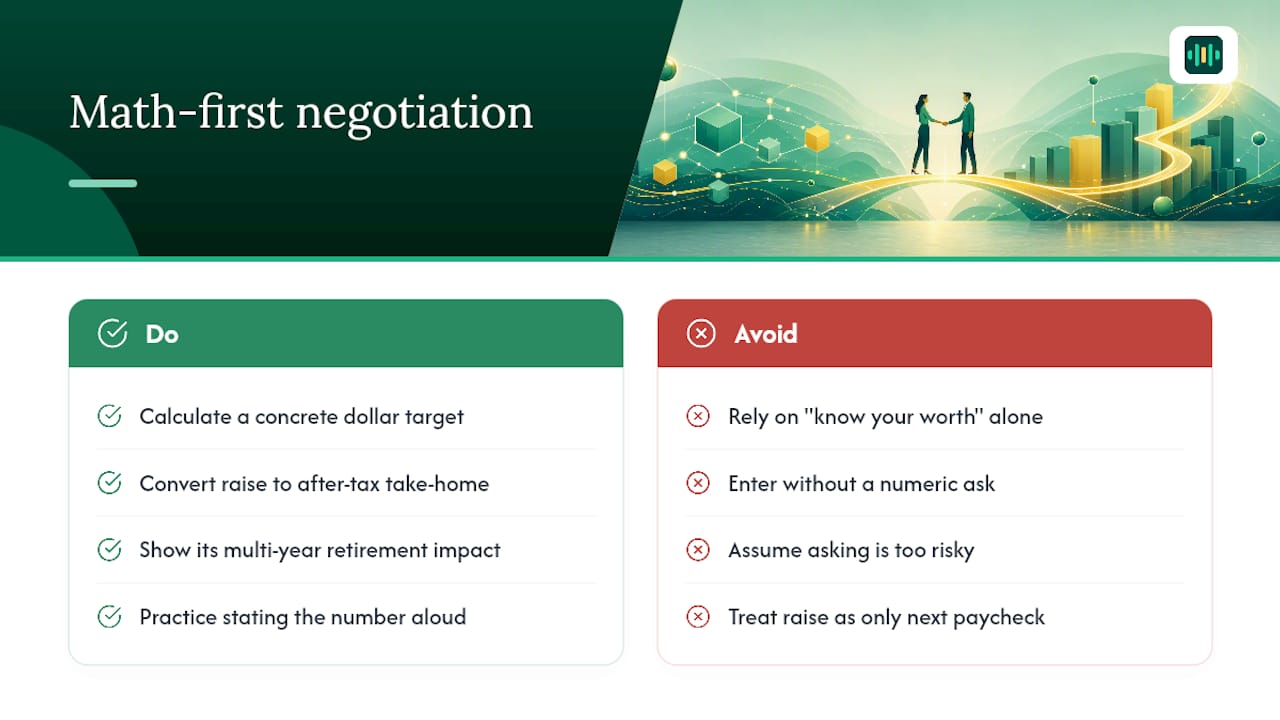
The gap I keep seeing isn't confidence. It's arithmetic. People walk into these conversations with a general sense they deserve more, but no dollar figure they can say out loud without flinching. A large share of people who counter an offer get at least part of what they ask for, which tells you the risk of asking is lower than most people assume and the cost of not asking compounds every year you stay quiet.
Where a tool like Malimoney fits into this is less about the negotiation itself and more about the number underneath it. Because Mali links to your real accounts, it can translate a target raise into what actually lands in your checking account after taxes, and what that shift does to your retirement timeline over years, not just your next paycheck.
— Todd
Turn Your Raise Target Into a Real Number With Mali
Malimoney is the one place you can talk out loud, not type into a form, about what a specific raise actually does to your finances. Say "what if I got a $7,000 raise" and Mali walks you through the real take-home impact, not a rounded estimate, because she's reading your actual linked accounts and income, not a generic calculator template.

That distinction matters heading into a negotiation. A target that sounds good in your head can fall apart once taxes, withholding changes, and your current spending gap get factored in, and Mali runs that math out loud in seconds instead of leaving you guessing at a spreadsheet. She'll also show what that raise does further out, whether it closes a savings gap faster or shifts your retirement timeline. If you want the same clarity before your next review, try the free calculators or start the demo to see what your specific number looks like once it hits your actual bank account.
Sources
- How to Successfully Negotiate a Salary Increase — Harvard Professional Development (DCE)
- How to negotiate a higher salary after a job offer — PON
- How to negotiate salary and a job offer — Fidelity
- The central role of the ask gap in gender pay — Yale Economics