

Most freelancers who expect to owe a threshold amount of tax after subtracting withholding must pay quarterly estimated taxes. The safest move if you're unsure how much to send: pay 100% of last year's total tax bill (110% if your prior-year income topped $150,000), split across four payments. That safe-harbor math protects you from penalties even if this year turns out bigger than expected.
TL;DR:
- Paying estimated taxes is necessary if your projected liability minus withholding exceeds $1,000, especially for freelancers earning more than a modest amount annually.
- The IRS deadlines are April 15, June 15, September 15, and January 15, but the quarters do not align with calendar months, requiring calendar reminders and separate state considerations.
- Using the safe-harbor method by paying 100% of last year's taxes or 110% if income exceeded $150,000 provides protection from penalties, with the current-year estimate suited for unpredictable income.
- Payments can be made via IRS Direct Pay, EFTPS, IRS2Go, or credit card, with tracking confirmation recommended to avoid misapplied payments and penalties.
- To reduce stress, incorporate monthly reconciliations and use tools like Mali's voice-first checks to monitor income against thresholds, preventing surprises at each deadline.
Table of Contents
- Quarterly Due Dates and Why the Tax Calendar Trips Up Freelancers
- Who Must Make Estimated Payments?
- How to Calculate Your Quarterly Payments
- How to Pay Your Quarterly Taxes
- A Low-Friction Routine for Quarterly Taxes
- What Happens If You Underpay or Miss a Deadline
- Small Habits That Remove the Quarterly-Tax Stress
- Simplify Quarterly Estimates With Mali's Voice-First Checks
- Sources
- FAQ
Quarterly Due Dates and Why the Tax Calendar Trips Up Freelancers
The IRS doesn't split the year into four equal quarters, and that trips up almost every new freelancer at least once. The standard federal due dates are:
- Q1: April 15
- Q2: June 15 (adjusted to the next business day if the 15th falls on a weekend)
- Q3: September 15
- Q4: January 15 of the following year (adjusted to the next business day if the 15th falls on a weekend)
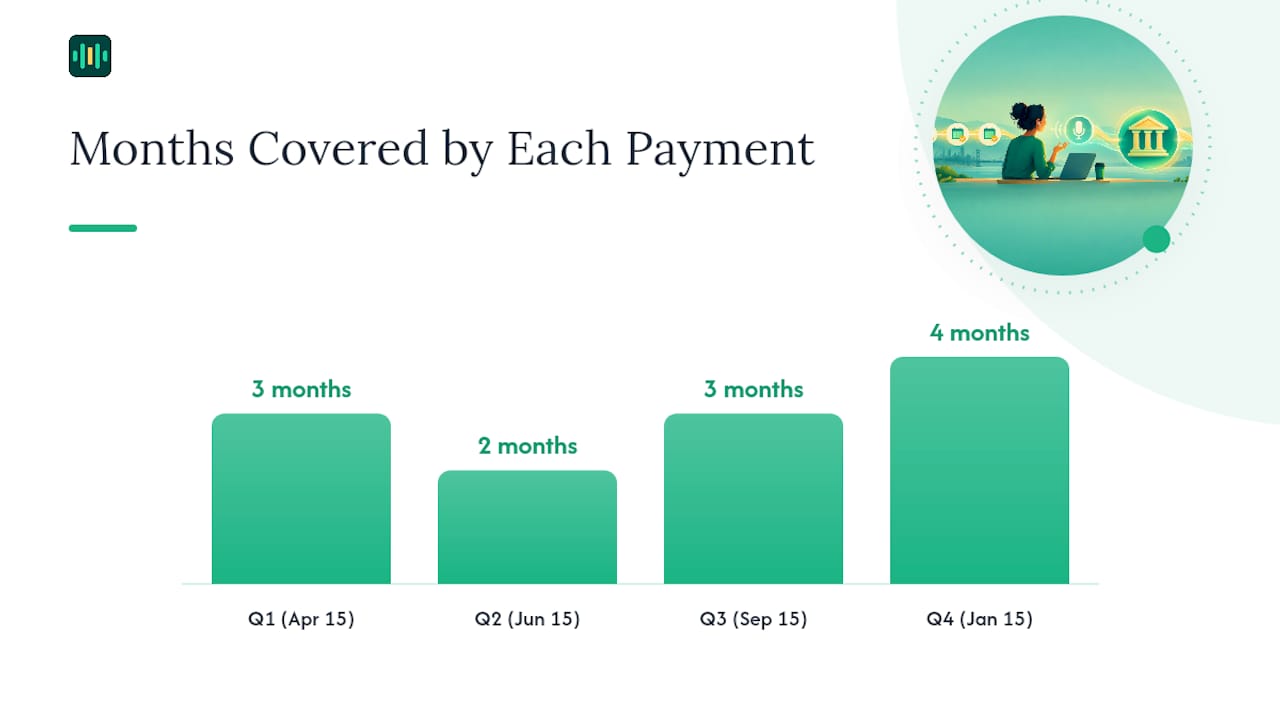
Q2 only covers two months of income, April and May, while Q1 and Q3 each cover three. The January payment is the odd one out too. It covers four months, September through December, unless you file your full tax return and pay everything owed by January 31, in which case you can skip that last estimated payment entirely.
The mismatch between calendar quarters and tax quarters is exactly why Publication 509 exists as a reference. Set calendar reminders two weeks ahead of each deadline, not on the day itself, and double-check your state's due dates separately. Several states use different spacing, and a few don't require estimated payments at all.
Who Must Make Estimated Payments?
The IRS test comes down to two things: how much you expect to owe, and how much is already being withheld. If your projected tax liability minus withholding and credits comes to $1,000 or more, you're generally on the hook for estimated tax payments.
That plays out differently depending on your situation:
- Full-time freelancers with no withholding at all almost always clear the $1,000 threshold once income passes a modest level, since nothing is being sent to the IRS automatically.
- Freelancers with a day job can sometimes skip estimated payments altogether by increasing withholding on their Form W-4 at the W-2 employer instead, letting payroll cover the gap.
- First-year freelancers with income that started slow and ramped up mid-year often benefit from the annualized method, covered below, rather than guessing at flat quarterly amounts.
A few exceptions matter too: farmers and fishermen follow different rules, and married couples filing separately calculate the threshold on their own income only, not combined.
How to Calculate Your Quarterly Payments
You have two realistic paths here, and picking the right one depends on whether your income is stable or swinging wildly.
1. Safe-harbor method. Pay 100% of last year's total tax liability (110% if your prior-year adjusted gross income was above $150,000), divided into four equal payments. If you owed $12,000 last year and your AGI was under $150,000, you'd send $3,000 each quarter. This method is popular precisely because it removes the guesswork. It fixes your payment at a known number regardless of how this year performs, which is why it tends to appeal to freelancers in growth years who don't want to keep recalculating as income climbs.
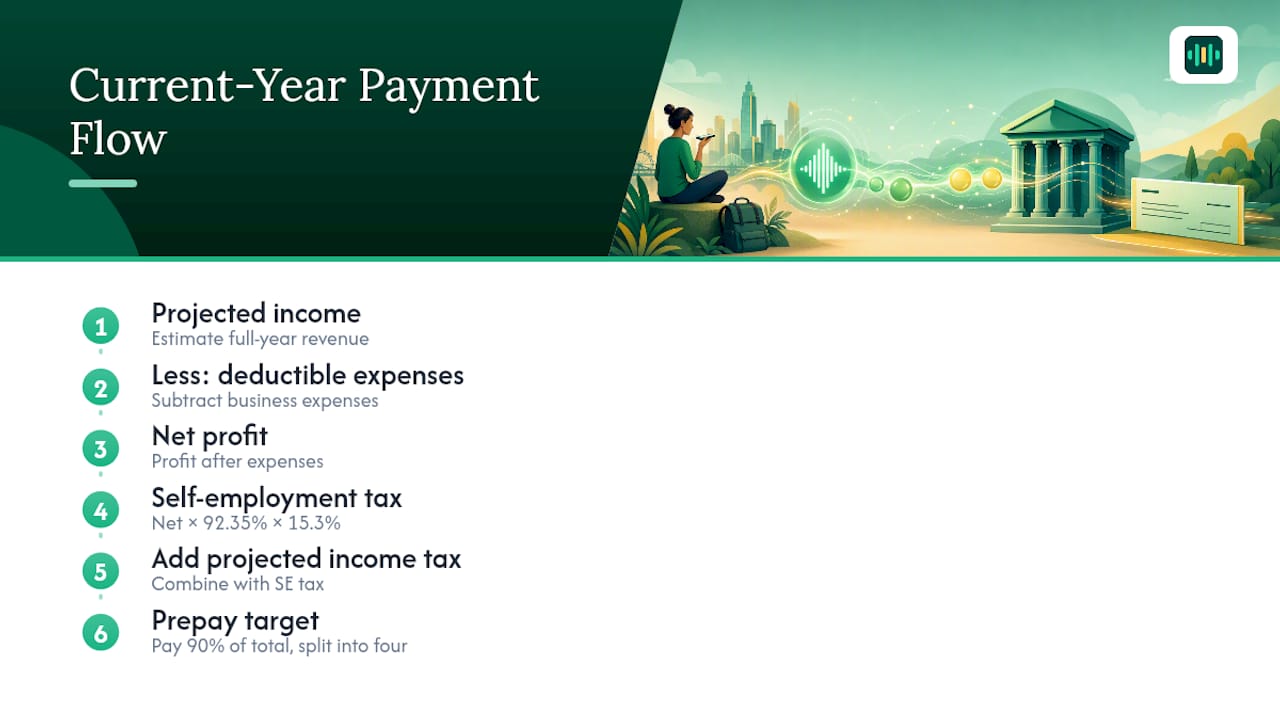
2. Current-year estimate. Project your full-year income, subtract deductible business expenses, and you get net profit. From there, calculate self-employment tax: net profit × 92.35% × 15.3%. That 15.3% rate covers Social Security and Medicare combined, and the 92.35% adjustment accounts for the employer-equivalent portion you get to deduct before applying the rate. Add that self-employment tax figure to your projected income tax, then aim to prepay 90% of the total across your four installments, using the worksheet inside Form 1040-ES to walk through it line by line.
Pro Tip: If your income is genuinely lumpy, seasonal work, a big client project that landed in Q3, don't force it into four equal payments. The annualized income installment method, calculated on Form 2210 Schedule AI, lets you match each quarter's payment to what you actually earned in that period, which can eliminate penalties that a flat quarterly split would otherwise trigger.
How to Pay Your Quarterly Taxes
You've got four main channels, and picking the right one mostly comes down to convenience and fees.
- IRS Direct Pay pulls straight from your bank account with no processing fee, and it's the simplest option for most freelancers.
- EFTPS (the Electronic Federal Tax Payment System) requires enrollment ahead of time but lets you schedule payments months in advance.
- IRS2Go, the mobile app, mirrors Direct Pay for people who'd rather handle it from a phone.
- Card payments go through third-party processors that charge a convenience fee, usually worth avoiding unless you need the float or the rewards points outweigh the cost.
If you'd rather mail a check, use the vouchers inside Form 1040-ES and write your Social Security number, the tax year, and "1040-ES" on the memo line so the payment gets applied correctly.
Pro Tip: Save every confirmation number in one document, a simple spreadsheet works fine, so you have proof of payment if the IRS ever misapplies one to the wrong quarter.
A Low-Friction Routine for Quarterly Taxes
Quarterly taxes get painful when you treat them as a once-a-quarter fire drill instead of a light monthly habit. Here's a routine that keeps the workload small:
- Monthly: Reconcile bank deposits against invoices, log deductible expenses (home office, software, mileage), and update a running profit-and-loss total.
- Each quarter: Pick your calculation method (safe-harbor or current-year), run the numbers through the Form 1040-ES worksheet or a calculator, and schedule the payment a few days before the deadline.
- After paying: Save the confirmation and note the amount somewhere you'll actually check again, like a shared note or your accounting app.
For the tracking piece, a bank-linked accounting app handles the profit-and-loss math automatically. For the quick sanity check before a deadline, Mali's free calculators and its voice-first checks can tell you in a spoken answer whether your current numbers actually clear the $1,000 threshold, without opening a spreadsheet.
What Happens If You Underpay or Miss a Deadline
The underpayment penalty isn't a flat fee. It's calculated as interest on the shortfall, using the federal short-term rate plus 3 percentage points, and that rate resets every quarter. Penalties accrue separately for each missed installment, from the date it was due until you pay it.
That structure catches a lot of freelancers off guard: paying your full annual tax in one lump sum in December doesn't erase penalties accrued from missed earlier payments. The IRS charges interest for each unpaid installment until paid 31.
If you've fallen behind:
- Make a catch-up payment as soon as possible to stop the clock on further interest.
- Use Form 2210 to calculate the exact penalty or to request a waiver if you qualify (retirement, disability, or a casualty event can sometimes qualify).
- Bring in a CPA if your income was irregular enough that the annualized method might reduce or eliminate what you owe.
Small Habits That Remove the Quarterly-Tax Stress
The freelancers who dread quarterly taxes the most are usually the ones treating each deadline as a surprise. Set a recurring calendar reminder two weeks out from each due date, and get in the habit of a 15-minute monthly reconciliation instead of a frantic quarter-end scramble. In a growth year, safe-harbor is your friend. It locks in a number you already know instead of forcing you to guess at income that hasn't fully landed yet.
Before each deadline, a quick spoken check against your actual bank activity, rather than a mental guess, tells you fast whether you're on track or need to adjust. Pick one habit this month. That's usually enough to stop the deadline panic for good.
— Todd
Simplify Quarterly Estimates With Mali's Voice-First Checks
A personal finance assistant you talk to out loud about your actual bank accounts can change how quarterly tax prep feels. Instead of digging through a spreadsheet every three months, you can ask it whether your year-to-date income and expenses put you near the $1,000 threshold, and get a spoken answer based on your real, linked transactions rather than a generic worksheet.

Mali's free calculators cover savings goals, net worth, and other planning basics with no signup required, so you can test one before deciding whether to link an account. For freelancers who want ongoing, bank-linked reminders instead of a one-time estimate, the accounts page explains how the voice-first setup works and what it takes to connect your bank securely. Try the calculators first. If they save you even fifteen minutes this quarter, the full setup is worth the next step.
FAQ
How Much Do I Need to Set Aside for Self-Employment Tax?
Self-employment tax equals your net profit multiplied by 92.35%, then multiplied by 15.3%, covering Social Security and Medicare. Most freelancers set aside 25% to 30% of net income to cover both self-employment tax and income tax combined, though your exact rate depends on your tax bracket.
When Are Quarterly Taxes Due?
The four due dates are April 15, June 15, September 15, and January 15 of the following year. Because Q2 only spans two months and the January payment covers four, the amounts aren't automatically equal even under the current-year method.
What Happens If I Pay Quarterly Taxes Late?
You'll owe interest on the underpaid amount, calculated at the federal short-term rate plus 3 percentage points, accruing from the missed due date until you pay. Catching up later in the year doesn't remove interest already charged for that specific missed installment.
Can I Avoid Quarterly Payments Entirely?
Yes, if you also hold a W-2 job, you can increase your withholding there to cover your freelance income instead of sending separate estimated payments. Full-time freelancers without a W-2 job to lean on generally can't avoid quarterly payments once they clear the $1,000 threshold.
Does Mali Help With Quarterly Tax Estimates?
Mali offers free calculators and a voice-first, bank-linked assistant that can check your year-to-date income and expenses against common tax thresholds. It won't file your taxes, but it gives you a fast, spoken way to sanity check whether you're on track before a deadline hits.