

Your rent-to-income ratio is the percentage of your monthly earnings that goes to rent, calculated as rent divided by income. Most guidance points to two numbers: HUD's 30% affordability threshold and the 3x gross monthly income rule landlords use for screening. Below, the math, current U.S. figures, and where both benchmarks fall short.
TL;DR:
- Strict rent-to-income thresholds like 30% or 3x gross income often do not reflect actual affordability, especially when accounting for taxes and deductions.
- Landlords typically use gross income and multiples between 2.5x and 3.5x rent depending on market conditions and locality, with vouchers affecting the calculation differently.
- Budgeting based on net income provides a more accurate picture of affordability, especially when utilities and debt payments are considered.
- Renters should verify how landlords screen income, especially if they use vouchers or variable income, and run customized calculations before applying or signing a lease.
Table of Contents
- What Is Rent-to-Income Ratio? The Formula Explained
- How to Calculate Your Rent-to-Income Ratio: 3 Examples
- Current U.S. Rent-to-Income Statistics and Trends
- How Landlords Apply the Rent-to-Income Ratio in Screening
- Why the 30% Rule Breaks Down for Some Households
- What Renters and Landlords Should Do Next
- How Mali Helps You Run These Numbers Against Your Real Accounts
- The Real Question Behind Every Rent Calculation
- Sources
What Is Rent-to-Income Ratio? The Formula Explained
The core formula is simple: divide monthly rent by monthly income, then multiply by 100 to get a percentage. Landlords often flip it into a multiple instead, dividing income by rent to see how many times over a tenant's earnings cover the lease.
- Percentage formula: (Monthly rent ÷ monthly income) x 100 = rent-to-income ratio
- Multiple formula: Monthly income ÷ monthly rent = income multiple (landlords typically want 3x or higher)
The trickier part is deciding which "rent" and which "income" to plug in. Some calculations use base rent alone; a more accurate housing-cost version adds utilities, since HUD's own cost-burden definition folds utilities into housing costs. On the income side, landlords almost always use gross pay before taxes, because that's what appears on a pay stub or offer letter and is easy to verify.
For your own budgeting, gross income tells only part of the story. Net, or take-home, income after taxes and deductions is what actually lands in your checking account, and it's the number that determines whether rent leaves room for groceries, transportation, and savings.
How to Calculate Your Rent-to-Income Ratio: 3 Examples
Example A: A renter earning $4,500 gross monthly pays $1,350 rent. That's 30% on a gross basis. Same rent, a very different budget reality.
Example B: In a high-cost metro, a $2,800/month apartment triggers the 3x screening rule, requiring $8,400 in monthly gross income, or $100,800 annually. Landlords often phrase this as "40x rent" for annual income screening.
Example C: A renter with $500 in monthly debt payments earning $5,000 gross has effectively $4,500 available before rent.
Passing a 3x gross income check can still leave a renter spending nearly half of net pay on rent once taxes and deductions come out.
To find your own number:
- Pull your gross and net monthly income from a recent pay stub.
- Add rent plus average monthly utilities.
- Divide housing cost by each income figure separately.
- Subtract fixed debt payments before running the calculation if you carry a car loan or student loans.
- Compare both results against the 30% guideline.
Pro Tip: Run the math on net income, not just gross. A rent-to-income calculator that toggles between the two will show you exactly how much the gap matters.
Current U.S. Rent-to-Income Statistics and Trends
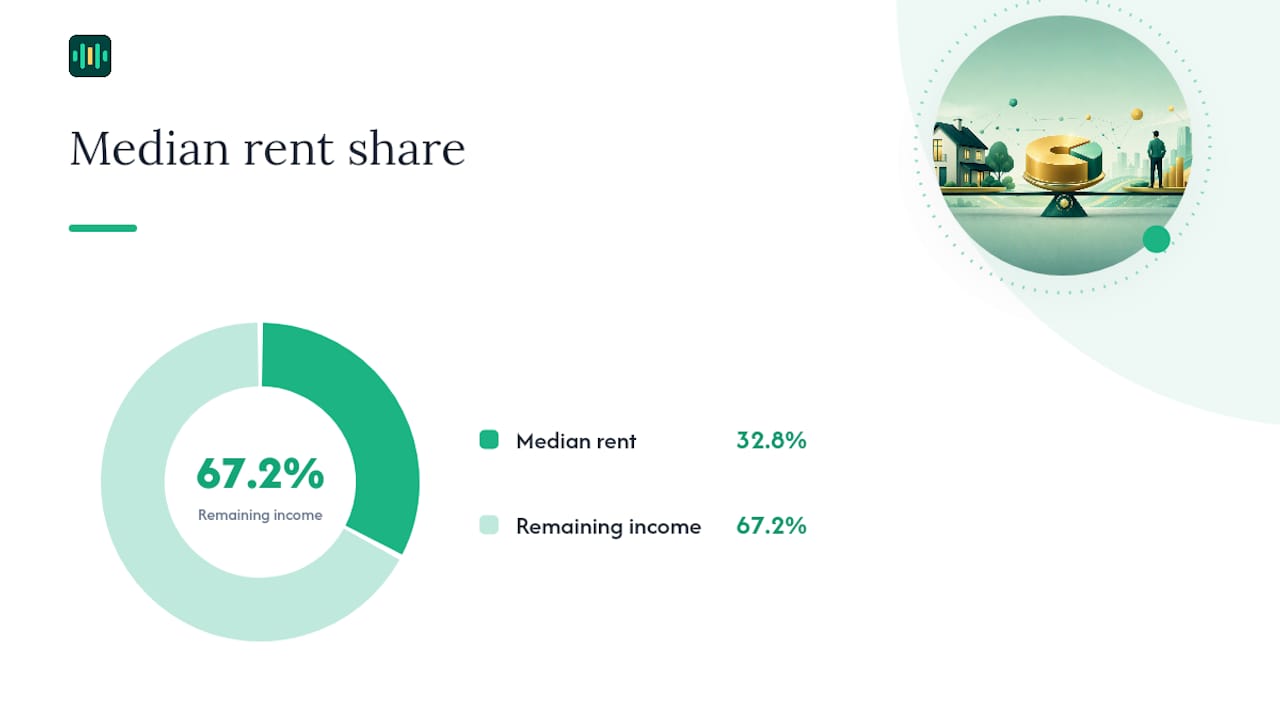
Median monthly rent sits around $1,487, while median monthly income among renting households runs about $4,537, putting the national median rent-to-income share at 32.8% in 2024. That's a national median, not a hard cap, but it shows the "standard" affordability rule is already the exception rather than the norm for half of renting households.
HUD's framework breaks the burden into two tiers:
- Cost-burdened: housing costs, including utilities, exceed 30% of monthly income
- Severely cost-burdened: housing costs exceed 50% of monthly income, per HUD's CHAS methodology
Geography stretches that median in both directions. The gap between a moderate-cost city and an expensive one often has less to do with income differences and everything to do with local rent levels.
How Landlords Apply the Rent-to-Income Ratio in Screening
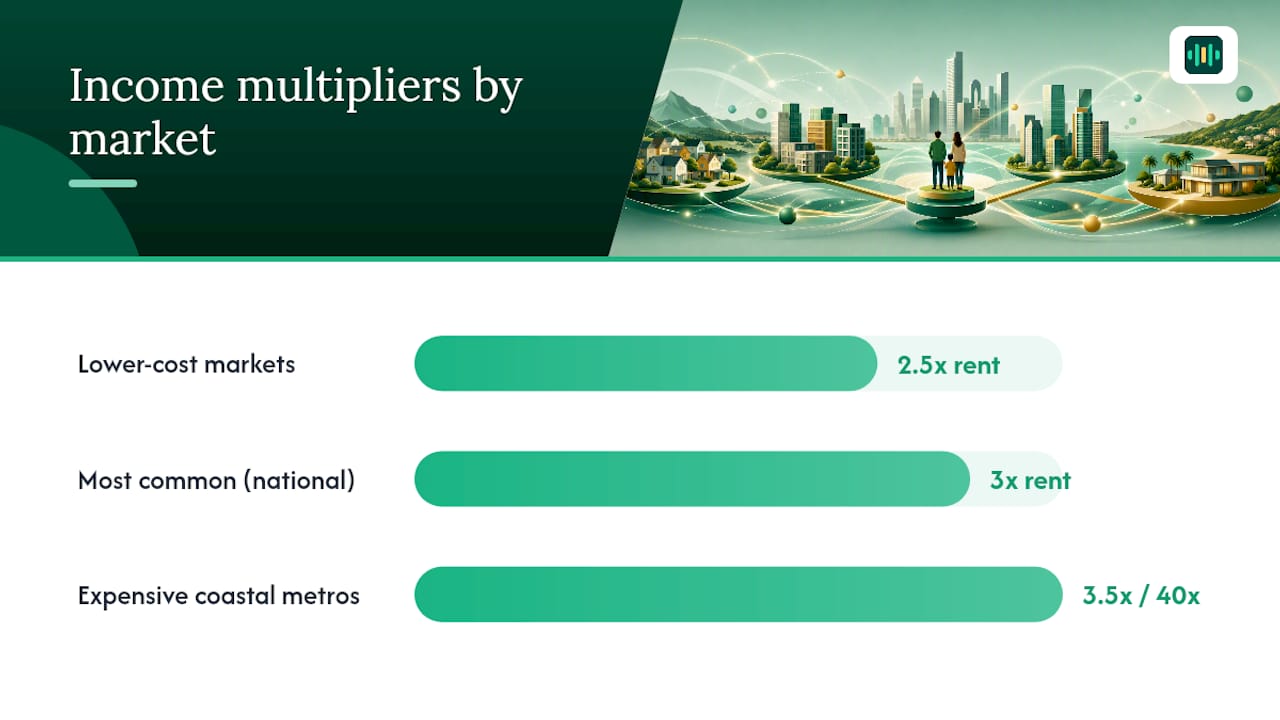
Variations exist depending on the market:
- 2.5x rent in lower-cost markets with tighter rental supply competition
- 3x rent as the most common national standard
- 3.5x or "40x annual rent" in expensive coastal metros where landlords want a wider cushion
Gross income gets used instead of net because it's what a pay stub or offer letter states directly, without landlords having to estimate tax withholding or deductions.
Voucher holders face a different calculation. Housing Choice Voucher programs typically measure the tenant's share of rent against income, not the full contract rent, since the subsidy covers the remainder. Many states and cities also have source-of-income laws that require landlords to count vouchers, disability benefits, and other lawful income when screening, so it's worth checking local rules before assuming a listing's income requirement applies to your situation.
Pro Tip: If you're voucher-eligible, ask the landlord directly whether they screen against your portion of rent or the full contract rent; the two numbers can look wildly different on paper.
Why the 30% Rule Breaks Down for Some Households
It traces back to federal housing policy, and Congressional Research Service reporting traces its adoption and persistent use in program eligibility despite decades of criticism from housing economists. The rule works fine as a national policy benchmark. It works less well as personal financial advice, because it ignores everything else in a budget.
- A household with no car payment and no childcare costs can often handle 35% of income in rent without strain.
- A household with student loans, a car payment, and dependent care might struggle at 25%.
- Researchers point to residual-income approaches as a better fit, which start from income, subtract non-housing essentials like transportation, childcare, and health costs, and see what's genuinely left for rent.
It becomes one when there's no cushion left for savings, debt payments, or an emergency.
What Renters and Landlords Should Do Next
For renters, the practical fix is budgeting off net income, not the gross figure a landlord uses to qualify you. Add renter's insurance and average utility costs to your rent line before running the percentage, and subtract fixed debt payments first. Document irregular income (freelance, tips, gig work) with several months of bank statements rather than a single pay stub, since inconsistent income is the first thing landlords flag.
For landlords, fairness starts with a published, consistent standard, applied the same way to every applicant regardless of income source. Vouchers and benefits should count as income where required by law, and any exception to the standard multiple deserves a documented reason on file.
| Step | Renters | Landlords |
|---|---|---|
| Income basis | Net (take-home) pay | Gross monthly income |
| Debt handling | Subtract fixed payments first | Not typically factored in |
| Subsidy handling | Count voucher as income | Screen against tenant's rent share |
| Tool to use | Rent vs. buy calculator | Published written screening policy |
How Mali Helps You Run These Numbers Against Your Real Accounts
Spreadsheet math gets you close. It doesn't know about your actual take-home pay, your existing debt, or the $200 subscription creep eating your budget every month. That's the gap Malimoney is built to close: you talk to Mali the way you'd talk to a sharp friend who happens to have your real bank data in front of them, and she talks back with actual numbers instead of a generic percentage.
Mali's calculator library includes tools directly relevant to this decision:
- The home affordability calculator for comparing rent against a future purchase
- The rent vs. buy calculator for weighing long-term wealth impact
- The net worth calculator for seeing rent decisions in the context of your full balance sheet
- The emergency fund calculator for setting a buffer before signing a lease that pushes past 30%
No other personal finance app lets you have a spoken conversation about your actual linked bank accounts and transactions the way Mali does.
The Real Question Behind Every Rent Calculation
Neither one knows what's actually in your bank account.
If there's one habit worth building, it's running the math on net income before you sign anything, then deciding, deliberately, whether the tradeoff is worth it. Calculate your own ratio, adjust your budget or negotiate before you commit, and if you're voucher-eligible, confirm exactly how a landlord is screening your application before you assume you don't qualify.
— Todd
This article is general information, not a substitute for advice from a qualified financial advisor. Consult a qualified financial professional about your own circumstances before acting on anything here.
Sources
- How much do households in the US spend on rent? (USAFacts)
- CHAS data background (HUD User)
- Congressional Research Service: housing affordability/cost burden analysis (CRS)
- Minimum income to rent an apartment (Renting Explained)