

A Roth conversion moves pre-tax retirement savings into a Roth IRA, and the entire amount you convert counts as ordinary income the year you do it. There's no income cap and no dollar limit on how much you can convert, and once it's done, it's done. Recharacterizing a conversion back to pre-tax hasn't been allowed since 2018. The real complexity lives in the details: the pro-rata rule, two different 5-year clocks, and a strict order of operations with required minimum distributions.
TL;DR:
- Converting large IRA balances with pre-tax funds into a Roth can result in significant tax bills due to the pro-rata rule, especially if balances are not moved into a 401(k).
- Timing of conversions matters; performing them during low-income years or market downturns can reduce the tax impact and maximize future tax-free growth.
- Conversions made before reaching RMD age must be carefully coordinated with required distributions to avoid penalties and excess contributions.
- Using in-plan Roth conversions or rolling pre-tax balances into a 401(k) can help avoid the pro-rata rule complications in backdoor Roth strategies.
- Converting significantly boosts MAGI, which may affect eligibility for health subsidies, Social Security taxation, Medicare premiums, and other income-based benefits.
Table of Contents
- What Are the Roth Conversion Rules for Eligible Accounts?
- Tax Implications of a Roth Conversion: How the Math Actually Works
- The Pro-Rata Rule and Why Backdoor Roth Conversions Go Wrong
- The 5-Year Rules and How RMDs Change the Order of Operations
- Timing a Conversion: When It Works and When It Backfires
- How to Execute a Roth Conversion Step by Step
- Could a Roth Conversion Affect Your Tax Credits or Benefits?
- Modeling Your Conversion Before You Commit
- Sources
What Are the Roth Conversion Rules for Eligible Accounts?
You can convert money from a Traditional IRA, a SEP IRA, or a SIMPLE IRA once you've held the SIMPLE for at least two years. Employer plans work too. Money in a 401(k), 403(b), or 457(b) can move directly into a Roth IRA through a rollover, or into a Roth account inside the same plan if your employer offers an in-plan Roth conversion option.
There's no income phase-out and no annual ceiling on conversion amounts, a point that trips up people who remember the old income limits on Roth contributions. Those contribution limits still exist. Conversion limits don't. The IRS confirms directly that anyone can convert any amount, regardless of earnings, and the conversion is permanent. You cannot reverse it later if your tax bill turns out bigger than expected.
The paperwork follows a predictable path:
- Your custodian issues a Form 1099-R reporting the distribution from the pre-tax account.
- You report the conversion on your tax return and file Form 8606 to track any after-tax basis involved.
- The taxable amount lands on your Form 1040 as ordinary income, not capital gains.
One limitation worth flagging: SIMPLE IRA funds can't be converted during the first two years of participation without triggering a 25% early withdrawal penalty on top of the regular tax. Outside that window, the mechanics are the same as a Traditional IRA conversion.
Tax Implications of a Roth Conversion: How the Math Actually Works
The dollar amount you convert gets added to your other income for the year, and that stacking effect is what catches people off guard. If you convert a substantial amount in a year when you already have income, your total taxable income increases, potentially moving some of the conversion amount into a higher tax bracket.
State income tax applies on top of the federal bill in most states, though a handful (Florida, Texas, Nevada, and a few others) don't tax income at all. If you live in a high-tax state like California or New York, run the combined federal-plus-state math before you convert, not after.
Here's a practical breakdown of what to watch:
- Withholding from the conversion itself is optional and usually a bad idea, since it shrinks the amount that actually lands in the Roth.
- Paying the tax bill from outside funds (savings, a brokerage account) preserves the full conversion amount and its tax-free growth potential.
- Underpaying throughout the year can trigger an estimated tax penalty, so many people make a fourth-quarter estimated payment or adjust withholding elsewhere.
Pro Tip: If you convert late in the year, you can often avoid an underpayment penalty by increasing withholding from a paycheck or pension in December, since withholding is treated as paid evenly throughout the year regardless of when it happens.
Form 8606 does more than satisfy a filing requirement. It's the IRS's record of your after-tax basis in Traditional IRAs, and it's the only document that proves you already paid tax on some of that money. Skip filing it after a nondeductible contribution or conversion, and the IRS has no record that any of it was after-tax. Years later, that missing basis can mean paying tax twice on the same dollars. The rollover guidance in Notice 2014-54 reinforces just how much weight this form carries when pre-tax and after-tax dollars mix in the same account.
The Pro-Rata Rule and Why Backdoor Roth Conversions Go Wrong
The pro-rata rule is where good intentions meet bad math. The IRS doesn't let you cherry-pick which dollars you're converting. Instead, it looks at every non-inherited Traditional, SEP, and SIMPLE IRA you own, added together, and calculates what fraction of that total is after-tax versus pre-tax. That fraction applies to your conversion, no matter which specific account the money came from.
The formula is: taxable portion equals the amount converted, multiplied by (pre-tax balance divided by total IRA balance), measured across all your IRAs as of December 31.
Here's where it bites people doing a "backdoor Roth." For example, if most of your IRA balances are pre-tax and only a small portion represents after-tax contributions, only the after-tax portion of a conversion is tax-free. This means that a large pre-tax balance can increase the taxable portion of any conversion, even if you intend to convert only after-tax funds.
Three workable fixes exist:
- Roll pre-tax IRA balances into your current employer's 401(k), if the plan accepts incoming rollovers. This removes those dollars from the pro-rata calculation entirely, since 401(k) balances aren't counted.
- Convert all pre-tax IRA money in a single low-income year, clearing the pre-tax balance to zero so future backdoor contributions convert cleanly.
- Accept the pro-rata tax hit and convert gradually, treating each year's conversion as partially taxable until the pre-tax balance shrinks.
Timing matters more than people realize here. The balances that count are measured on December 31, not on the day you convert. A rollover you complete in January doesn't help if you still hold a pre-tax balance somewhere else at year-end.
The 5-Year Rules and How RMDs Change the Order of Operations
Roth conversions come with two different 5-year clocks, which can be confusing and costly if misunderstood.
- The conversion-specific 5-year rule applies to each conversion separately. If you're under 59½ and withdraw converted funds before five years have passed since that specific conversion, you owe a 10% early withdrawal penalty on the converted principal, even though you already paid income tax on it.
- The Roth earnings 5-year rule is different and applies once, starting with your first Roth contribution or conversion of any kind. Earnings inside the Roth aren't tax-free until this five-year window has passed and you're at least 59½.
- Multiple conversions mean multiple clocks. Convert $20,000 this year and another $20,000 next year, and each batch has its own five-year countdown before it's penalty-free if withdrawn early.
The RMD interaction is stricter than most people expect. If you're of RMD age and you plan to convert money in the same year, you must take your full required minimum distribution first. You cannot use any part of that RMD as the conversion. Fidelity's guidance is direct on this point: RMDs have to come out before conversion dollars move. Convert first and take the RMD after, and you risk an excess contribution problem, since RMD amounts aren't eligible to be converted at all.
Timing a Conversion: When It Works and When It Backfires
The best conversion years share one trait: your taxable income is lower than usual. That might be a year between jobs, an early-retirement gap before Social Security starts, or a year with unusually large deductions. Converting when your marginal bracket is temporarily low means more of the converted amount gets taxed at that lower rate instead of bleeding into a higher one.
Market downturns create a similar opening. Converting when your account value has dropped means you pay tax on a smaller number, and if the market recovers afterward, that growth happens tax-free inside the Roth rather than being taxed later. Kiplinger's analysis of conversion timing points to exactly this pattern: temporarily depressed balances during a downturn often make for the cheapest conversions available. Advisors frequently recommend staged, partial conversions over several years rather than one large lump sum, spreading the tax hit across multiple brackets instead of stacking it all at once.
Planning to move to a state with no income tax? Converting after you've established residency there, rather than before, can shave off a meaningful state tax bill, depending on your current state's rules on part-year residency.
When converting is usually a bad idea:
- You'll need the converted money within five years and can't absorb the early withdrawal penalty on earnings or on funds withdrawn before each conversion's own clock runs out.
- You'd have to pull the tax payment out of the IRA itself, which reduces your retirement balance and often triggers an early withdrawal penalty on the withdrawn tax amount if you're under 59½.
- You genuinely expect your future tax rate to be lower than it is now, which flips the whole math against you.
Pro Tip: Before converting, compare your current marginal bracket against your projected bracket in retirement, including how Social Security taxation and Medicare premium surcharges (IRMAA) might shift once RMDs start. A conversion that looks smart today can look different once you factor in a Medicare premium bump two years out.
How to Execute a Roth Conversion Step by Step
- Estimate the tax hit before you touch anything. Run the numbers through a Roth conversion calculator to see how the converted amount stacks on your current income and whether it pushes you into a higher bracket.
- Check whether you hold pre-tax IRA balances anywhere else. If you do, run the pro-rata math using a backdoor Roth calculator before assuming any part of the conversion is tax-free.
- Take your RMD first, if you're required to take one that year. This has to happen before any conversion dollars move.
- Confirm your employer plan accepts rollovers, if you're using the 401(k) workaround to sidestep pro-rata exposure.
- Request a trustee-to-trustee transfer or in-plan conversion directly through your custodian rather than taking a personal distribution, which avoids withholding complications and the 60-day rollover deadline risk.
- Cover the tax bill with outside funds, through withholding elsewhere or an estimated payment, not by pulling from the IRA.
- File Form 8606 and reconcile it against the Form 1099-R your custodian sends, making sure the numbers match what you report on your return.
Could a Roth Conversion Affect Your Tax Credits or Benefits?
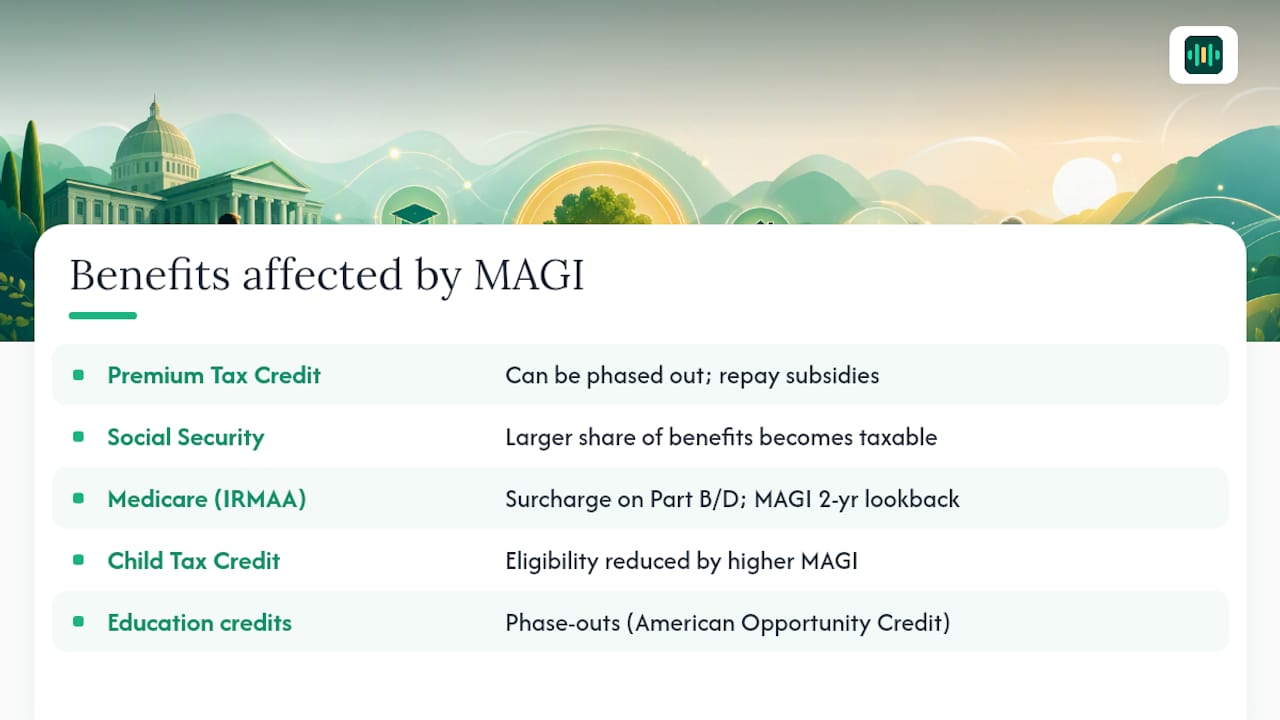
Converting adds to your Modified Adjusted Gross Income (MAGI) for the year, and MAGI is the trigger for a surprising number of benefit calculations beyond your tax bracket. A large conversion can phase you out of the Premium Tax Credit for ACA marketplace health insurance, potentially forcing you to repay subsidies you already received that year.
It can also affect the taxability of your Social Security benefits if you're already collecting them, since a chunk of your benefit becomes taxable once combined income crosses certain thresholds. For Medicare recipients, a conversion made two years before you enroll (or while already enrolled) can trigger IRMAA, the income-related surcharge added to Medicare Part B and Part D premiums. That surcharge is based on your MAGI from two years prior, so a big conversion this year can raise your Medicare premiums in a future year you might not be thinking about yet.
Other income-tested benefits worth checking before converting include the Child Tax Credit, education credits like the American Opportunity Credit, and eligibility for certain state assistance programs tied to income thresholds. None of these get better with a higher MAGI. If any of them apply to your household, weigh the conversion's tax savings against the benefit you might lose that same year.
Modeling Your Conversion Before You Commit
Reading the rules is one thing. Seeing how they apply to your actual accounts is another. Mali's Roth conversion calculator and backdoor Roth pro-rata calculator let you test conversion amounts against your real income and IRA balances instead of guessing at a spreadsheet. Because Mali connects to your linked accounts and talks through the numbers with you by voice, you can run a scenario, ask a follow-up question out loud, and catch a cash-flow problem with the tax bill before it becomes one. For conversions involving large balances, multiple accounts, or IRMAA exposure, pairing that modeling with a tax advisor is still the safer path.
This article is general information, not a substitute for advice from a qualified financial advisor. Consult a qualified financial professional about your own circumstances before acting on anything here.
Sources
- Retirement plans FAQs regarding IRAs | Internal Revenue Service
- Roth IRA Pro‑Rata Rule 2026: §408(d)(2) Mechanics for Conversion + Backdoor Roth | USTax Tools