

Roth wins if you expect a higher tax rate in retirement, want tax-free withdrawals, and would rather skip required minimum distributions altogether. Traditional wins if you need the deduction now or expect to land in a lower bracket later. If your income tops the Roth phase-out, a backdoor Roth or a deductible workplace plan usually fills the gap.
TL;DR:
- Roth contributions are after-tax and offer tax-free withdrawals, ideal if you expect higher taxes in retirement and want to skip required minimum distributions.
- Traditional IRAs provide immediate tax deductions but tax all withdrawals later, making them better if you need a current deduction or plan to be in a lower tax bracket later.
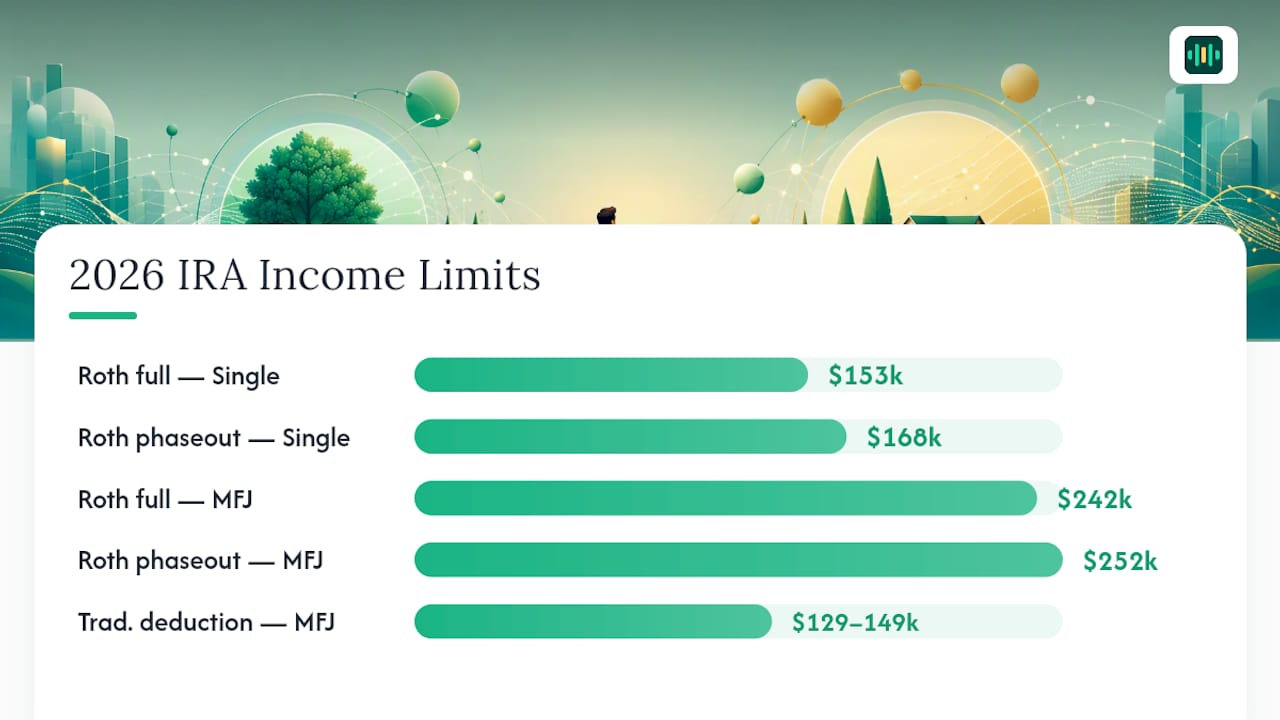
- Income limits for Roth contributions phase out between $153,000 and $168,000 for singles or $242,000 and $252,000 for married filing jointly in 2026, but anyone with earned income can contribute to a Traditional IRA regardless of income.
- The contribution limit is $7,500 for those under 50 and $8,600 for those 50 or older, combined across all IRA accounts, with contributions needing earned income at least equal to the amount contributed.
- Early withdrawals from either account can result in taxes and penalties, with Roth contributions always accessible tax-free and earnings qualifying only after meeting certain conditions.
Table of Contents
- Roth vs. Traditional IRA: The Core Differences
- Who Can Actually Contribute? 2026 Income Limits Explained
- How Much Can You Contribute in 2026?
- What Happens When You Withdraw the Money?
- RMDs, Conversions, and the Backdoor Roth Explained
- Which IRA Fits Your Situation? A Quick Decision Check
- How to Run the Numbers on Your Own Situation
- Why Personalized Numbers Beat Rules of Thumb
- Test Your Roth vs. Traditional Numbers With Mali
- Sources
Roth vs. Traditional IRA: The Core Differences
The entire decision boils down to one question: would you rather pay the IRS now or later? A Roth IRA takes contributions after tax, then lets qualified withdrawals come out tax-free. A Traditional IRA often gets you a deduction this year, but the IRS taxes every dollar you pull out later, including growth.
Beyond timing, a few mechanical differences shape which account fits your situation:
- Contributions: Roth contributions are never deductible; Traditional contributions may be deductible depending on income and workplace coverage.
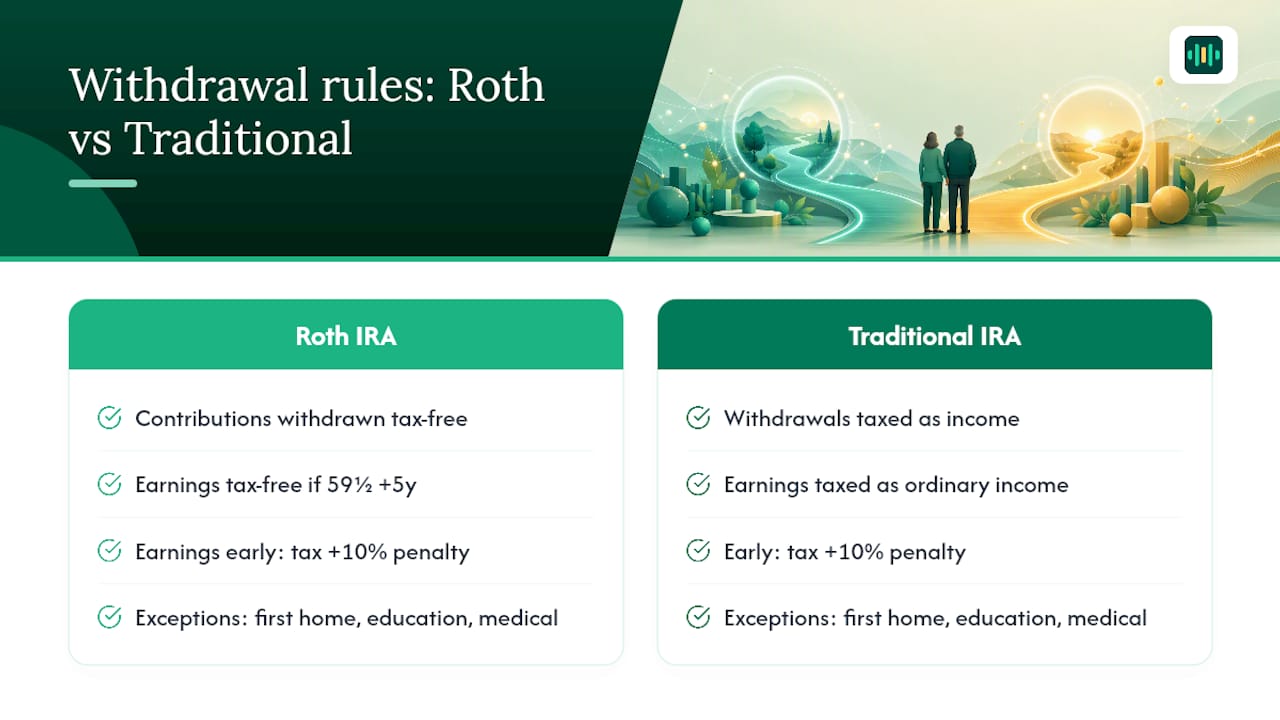
- Access: You can withdraw Roth contributions (not earnings) anytime without tax or penalty; Traditional withdrawals before 59½ generally trigger both tax and a 10% penalty.
- RMDs: Traditional IRAs force required minimum distributions starting at a set age; Roth IRAs carry no lifetime RMDs for the original owner.
- Eligibility: Roth contributions phase out above certain income levels; Traditional contributions are open to anyone with earned income, though the deduction phases out.
- Conversions: Both accounts can be converted to Roth, but converting pre-tax Traditional dollars creates a taxable event the same year.
That last point matters more than most people realize. A Traditional IRA isn't locked into staying Traditional forever, and a Roth conversion is often the workaround when your income disqualifies direct Roth contributions.
Who Can Actually Contribute? 2026 Income Limits Explained
Roth eligibility depends entirely on your modified adjusted gross income (MAGI), and the IRS resets these numbers every year. For 2026:
- Single filers get full Roth access under $153,000, with contributions phasing out completely at $168,000.
- Married filing jointly gets full access under $242,000, phasing out at $252,000.
- Traditional IRA contributions have no income cap at all. Anyone with earned income can put money in.
The catch with Traditional IRAs is the deduction, not the contribution. If you're covered by a workplace retirement plan, the deduction itself phases out. For 2026, that's $81,000 to $91,000 for single filers and $129,000 to $149,000 for married couples where the contributing spouse is covered. Miss the deduction window and you can still contribute. You just won't get a tax break for it, which usually makes Roth the better move if you're also under the Roth income cap.
Two more wrinkles worth knowing: a working spouse can fund a spousal IRA for a non-working partner, and minors with earned income (think summer jobs) can open custodial IRAs, usually Roth, since their tax bracket is often near zero anyway.
How Much Can You Contribute in 2026?
The dollar limits are the same whether you choose Roth, Traditional, or split between both. For 2026, the combined limit across all your personal IRAs is $7,500 if you're under 50, and $8,600 if you're 50 or older. That extra $1,100 catch-up amount exists because Congress assumes people closer to retirement need to accelerate savings.
A few rules to keep straight:
- The limit is combined, not per-account. Put $4,000 in a Roth and $3,500 in a Traditional, and you've hit the $7,500 cap for someone under 50.
- You need earned income at least equal to your contribution. No paycheck, no IRA contribution (spousal IRAs are the exception).
- You can make prior-year contributions up until the tax filing deadline in April, so a contribution made in early 2027 can still count for tax year 2026 if you designate it that way.
What Happens When You Withdraw the Money?
This is where the two accounts diverge most sharply, and where a lot of savers get surprised.
With a Roth, you can pull out your contributions at any age, for any reason, tax and penalty free, since you already paid tax on that money. Earnings are a different story. To withdraw earnings tax-free, you need a qualified distribution: you must be at least 59½ and have held the account for five years. Pull earnings out early and you're generally on the hook for income tax plus a 10% penalty.
Traditional IRA withdrawals get taxed as ordinary income no matter when you take them, because you likely deducted that money going in. Take a distribution before 59½ and you'll usually owe the same 10% penalty on top of the tax bill.
Both accounts share the same penalty exceptions, so this isn't a case where one account is riskier than the other. The IRS allows exceptions for early withdrawals used toward a first home purchase (up to a lifetime cap), qualified higher education expenses, and certain unreimbursed medical costs, among others.
Pro Tip: If you're converting Traditional dollars to Roth, the tax bill comes due in the year of conversion, based on your income that year, not the year you eventually withdraw. Converting during a low-income year (a layoff, a sabbatical, early retirement before Social Security starts) can shrink that bill substantially.
RMDs, Conversions, and the Backdoor Roth Explained
Traditional IRAs come with a deadline: the government eventually wants its tax revenue, so required minimum distributions kick in at a set age, forcing you to withdraw and pay tax on a portion each year whether you need the cash or not. Roth IRAs have no such deadline for the original account owner, which is a real advantage for estate planning. Money can keep growing tax-free for as long as you're alive, and heirs typically get more flexibility with an inherited Roth than an inherited Traditional account.
Converting Traditional dollars to Roth is a taxable event on any pre-tax portion, but once converted, that money starts its own five-year clock toward qualified, tax-free status.
- Backdoor Roth: high earners who exceed the Roth income cap often contribute non-deductible dollars to a Traditional IRA, then convert to Roth almost immediately. It's a process, not a separate account type, and it requires Form 8606 to report correctly.
Pro Tip: Before doing a backdoor Roth, check whether you already hold pre-tax money in any Traditional IRA. The pro-rata rule forces you to treat the conversion as partly taxable based on your total IRA balances, not just the amount you just contributed, which can create a tax bill you weren't expecting.
Which IRA Fits Your Situation? A Quick Decision Check
Run through these checks in order, and stop as soon as one applies to you.
- Are you capturing your full employer 401(k) match first? If not, redirect money there before funding either IRA. Free money beats any tax argument.
- Do you have earned income this year? No earned income means no IRA contribution, aside from a spousal IRA if your partner works.
- Is your MAGI under the Roth phase-out? Single under $153,000 or married filing jointly under $242,000 for 2026 means Roth is open to you outright.
- Are you covered by a workplace plan, and does your income exceed the deduction phase-out? If yes, your Traditional contribution won't be deductible, which usually tips the scale toward Roth instead.
- Do you expect a higher tax rate in retirement than you're in now? Higher future rate favors Roth. Lower future rate favors Traditional and the current-year deduction.
- Is your income above the Roth cap entirely? A backdoor Roth is your workaround, provided you don't have a large pre-tax IRA balance triggering pro-rata complications.
Many savers land on a split: some Roth, some Traditional, for tax diversification in retirement. That's a reasonable default when you genuinely don't know what your future bracket will look like.
How to Run the Numbers on Your Own Situation
Every decision tree above is a shortcut. The real answer depends on your specific numbers, and that means collecting a few inputs: your age, current MAGI, current tax bracket, a realistic estimate of your retirement tax bracket, whether you're covered by a workplace plan, and your existing IRA balances (pre-tax and Roth separately).
Once you have those, the outputs that matter are your projected after-tax balance at retirement under each scenario, the tax bill a conversion would trigger today, and the break-even horizon where Roth's tax-free growth catches up to Traditional's upfront deduction.
- Mali's Roth vs. Traditional calculator runs these comparisons using your actual numbers instead of textbook assumptions.
- The Roth conversion calculator estimates the tax cost of converting existing pre-tax balances.
Pro Tip: Because Mali links directly to your bank and retirement accounts, it can pull your real balances and spending patterns instead of asking you to guess at numbers from memory, then walk you through the scenario out loud.
Why Personalized Numbers Beat Rules of Thumb
Rule-of-thumb advice ("just pick Roth if you're young") ignores the actual math sitting in your accounts. Two 28 year olds in the same tax bracket can land on opposite answers once you factor in existing pre-tax balances, state tax exposure, or a spouse's income. Mali was built around running your real numbers instead of a generic checklist, though nothing here replaces a tax professional once you're dealing with a large conversion, business income, or multi-year Roth ladder strategy.
— Todd
Test Your Roth vs. Traditional Numbers With Mali
Every calculator in this article gives you a static answer based on assumptions. Mali gives you a conversation based on your actual bank-linked accounts, your real income, and your real IRA balances, spoken out loud instead of buried in a spreadsheet. No other personal finance app lets you talk through your accounts and transactions with a voice AI that already knows your numbers.

Ask Mali to run your Roth vs. Traditional comparison or model a Roth conversion, and she'll walk through the tradeoffs using your linked accounts rather than generic assumptions. Your data stays encrypted and private, and Mali is upfront about her limits. She helps you understand your numbers; she doesn't replace a CPA when your situation gets complicated. If you're also weighing retirement income sources beyond IRAs, Family Guard Life & Health covers retirement income and annuity tax considerations worth understanding alongside your IRA strategy. Start a free trial and ask Mali where you stand on Malimoney.
Sources
- Traditional and Roth IRAs | Internal Revenue Service
- Roth vs. Traditional IRA 2026: A Decision Tree With The New IRS Limits
This article is general information, not a substitute for advice from a qualified financial advisor. Consult a qualified financial professional about your own circumstances before acting on anything here.