

Self-employment tax is the combined Social Security and Medicare tax rate you pay when you work for yourself, and if your net earnings hit the IRS threshold, you owe it. You report it on Schedule SE, attach that to Form 1040, and in most cases you pay it in four estimated installments rather than one lump sum. Half of what you pay comes back to you as a deduction.
TL;DR:
- Self-employment tax applies to net earnings of $400 or more from any business, including side jobs and partnerships, but not wages from other jobs where FICA is withheld.
- The total rate is 15.3%, comprising 12.4% for Social Security up to the wage base and 2.9% for Medicare, with an additional 0.9% Medicare surtax above income thresholds.
- Calculate the tax by applying 92.35% of net profit to the combined rates, and claim half as an above-the-line deduction on Schedule 1.
- Most self-employed filers should pay quarterly estimated taxes using Form 1040-ES to avoid penalties, especially if income fluctuates.
- State taxes generally mirror federal adjustments, but business-specific state levies can stack on top of federal SE tax, varying by state.
Table of Contents
- Self Employment Tax Explained: What It Is and Who Owes It
- Self-Employment Tax Rates and the Social Security Wage Base
- How to Calculate Self-Employment Tax Step by Step
- Filing Self-Employment Taxes: Forms, Payments, and Deadlines
- How the Self-Employment Tax Deduction Affects Your Income Tax
- Special Cases: Partnerships, S Corps, and Church Income
- Common Self-Employment Tax Mistakes and How to Avoid Penalties
- Turning the Numbers Into a Real Quarterly Plan
- Self-Employment Tax and State Taxes
- Self-Employment Tax for Spouses and Household Businesses
- Why Most Self-Employment Tax Advice Misses the Point
- Sources
Self Employment Tax Explained: What It Is and Who Owes It
Self-employment tax is not a separate tax bracket or a penalty for freelancing. It is the self-employed version of the FICA taxes an employer normally splits with a W-2 worker. When you have a boss, that boss pays half your Social Security and Medicare tax and deducts the other half from your paycheck. When you are the boss, you owe both halves yourself, and the IRS collects it through Schedule SE instead of a payroll withholding.
This is separate from federal income tax. You calculate and pay them independently, even though both show up on the same Form 1040 at the end of the year. A lot of new freelancers assume their income tax bracket already covers this. It does not.
Who actually owes it? The definition is broader than "freelancer":
- Sole proprietors running any kind of business, from consulting to lawn care
- Independent contractors and gig workers, including rideshare drivers and delivery couriers
- Partners in a partnership or multi-member LLC who receive a share of business profit
- Anyone with a side business that generates net income, even alongside a regular job
The trigger is net earnings from self-employment of $400 or more in the year. That is the threshold set by the IRS self-employed tax center, and it applies whether you cleared $400 from one client or from ten. There is one carve-out worth knowing: church employees have a lower threshold of $108.28 in wages from a church that does not withhold Social Security and Medicare tax, a quirk tied to how certain religious organizations are treated under federal tax law.
Note what does not count: unemployment benefits, most investment income, and wages from a regular job where an employer already withheld FICA taxes. Those go through different rules entirely.
Self-Employment Tax Rates and the Social Security Wage Base
The total rate for self-employment tax combines Social Security and Medicare taxes, splitting into two parts that behave differently as your income changes. Social Security tax comprises a larger portion, and Medicare tax makes up the remaining share of the total self-employment tax rate.
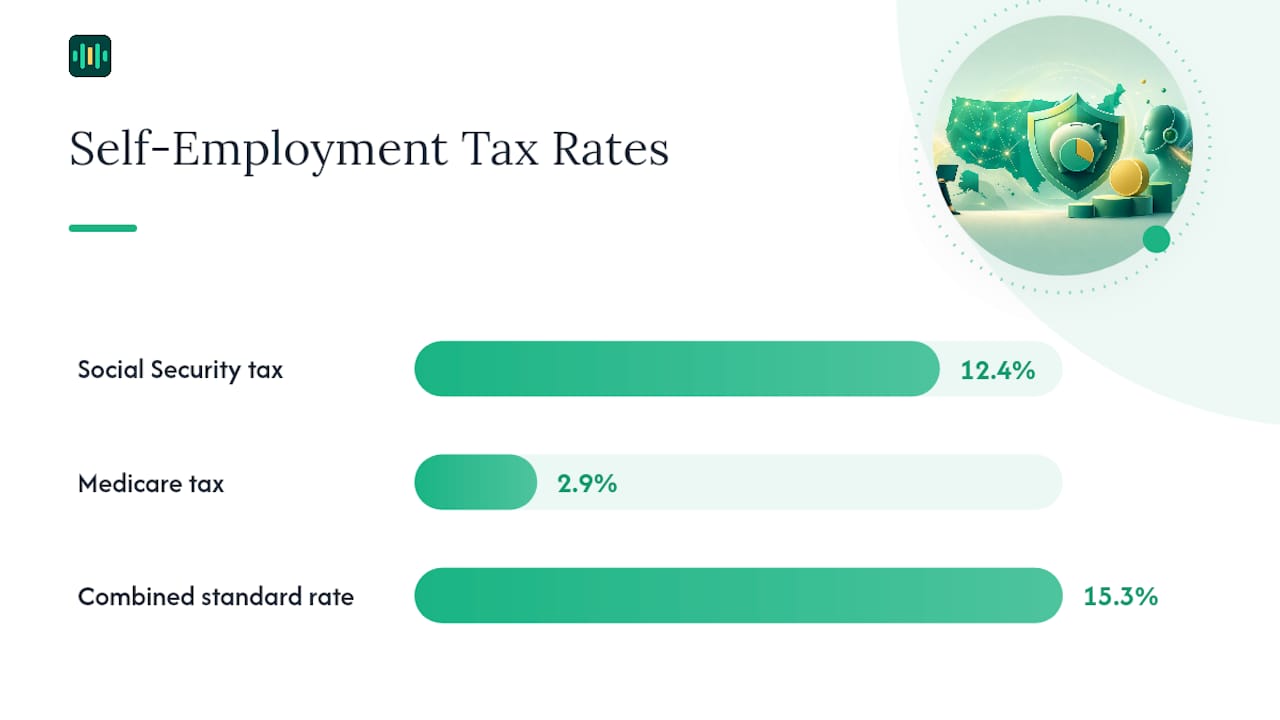
The Social Security portion only applies up to a wage base limit that the Social Security Administration adjusts annually for inflation; earnings above that cap owe no additional Social Security tax, whether self-employed or not. Medicare tax has no such ceiling. Every dollar of net self-employment earnings owes the 2.9% Medicare portion, no matter how high your income goes.
High earners face one more layer: an Additional Medicare Tax of 0.9% kicks in once income crosses $200,000 for single filers or $250,000 for married couples filing jointly, per the IRS. That surtax is not split, and it applies on top of the standard 2.9%.
| Component | Rate | Applies to |
|---|---|---|
| Social Security tax | 12.4% | Net earnings up to the annual Social Security wage base |
| Medicare tax | 2.9% | All net self-employment earnings, uncapped |
| Additional Medicare Tax | 0.9% | Earnings above $200,000 (single) / $250,000 (married filing jointly) |
| Combined standard rate | 15.3% | Net earnings up to the Social Security wage base |
Pro Tip: If you also hold a W-2 job, your employer's withheld wages count toward the Social Security wage base first. Only self-employment earnings above that combined total (wages plus net self-employment income) escape the Social Security portion of SE tax, per IRS guidance on combined wage and self-employment income.
How to Calculate Self-Employment Tax Step by Step
Calculating self-employment tax is mechanical once you know the sequence. The mistake almost everyone makes on their first attempt is applying the rate to gross revenue instead of net profit after business expenses. That single error can double or triple what you think you owe.
Here is the actual procedure the IRS and tax preparers use:
- Start with net profit from your business. Pull this from Schedule C, line 31, if you are a sole proprietor. Say your net profit for the year is $80,000.
- Multiply by 92.35%. This step exists because the employer-equivalent half of SE tax is not itself subject to SE tax, mirroring how a real employer's contribution never appears in an employee's taxable wages. $80,000 × 0.9235 = $73,880. That figure, not the full $80,000, is what actually gets taxed.
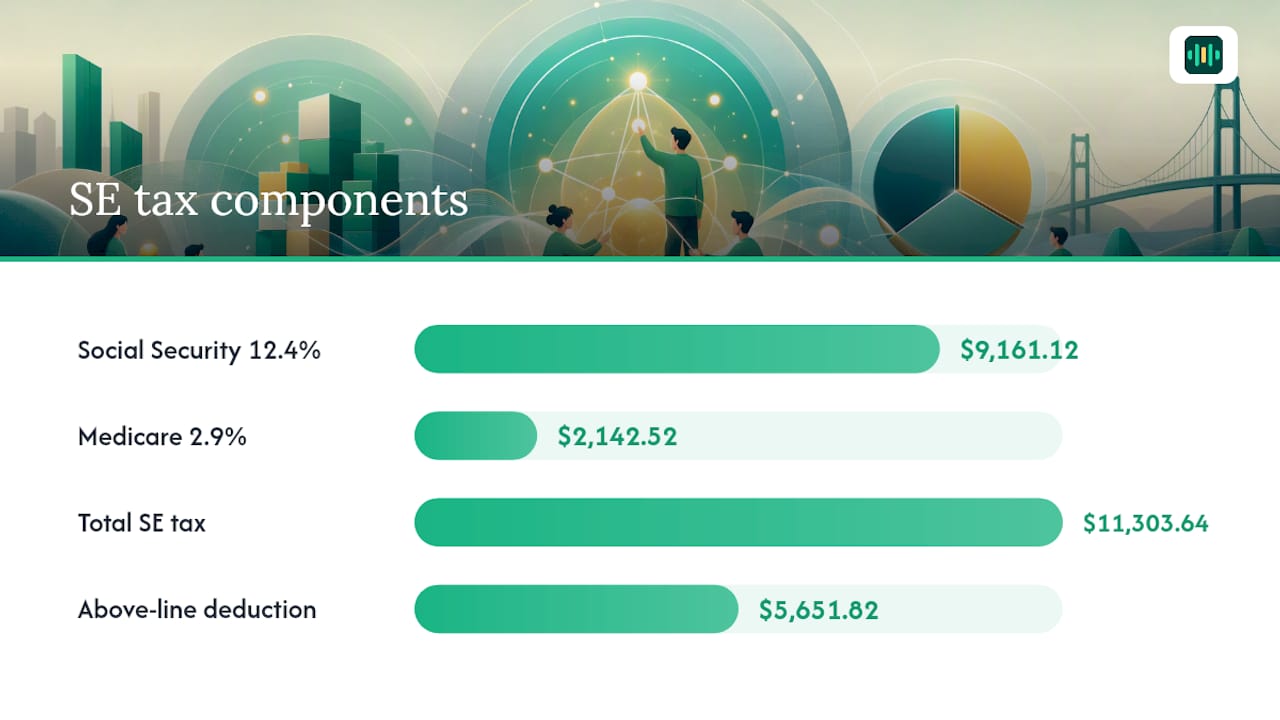
- Apply the Social Security portion. Multiply $73,880 by 12.4%, assuming you are under the wage base cap. That comes to $9,161.12.
- Apply the Medicare portion. Multiply the same $73,880 by 2.9%. That comes to $2,142.52.
- Add the two together. $9,161.12 + $2,142.52 = $11,303.64. That is the total self-employment tax owed for the year.
- Claim the deduction. Half of $11,303.64, or $5,651.82, becomes an above-the-line deduction on Schedule 1, which reduces adjusted gross income and, in turn, federal income tax.
This structure, including the 0.9235 multiplier and the two-rate split, matches the calculation method Investopedia and H&R Block both walk through for filers computing SE tax by hand.
If net profit is higher and exceeds the Social Security wage base limit, the Social Security tax portion stops accruing while the Medicare portion continues along with any Additional Medicare Tax on income above IRS thresholds. That is the exact mechanic that makes higher earners pay a lower effective SE tax rate on their top dollars even though nothing about the tax is capped for Medicare.
The deduction in step 6 is worth repeating because it surprises people: it lowers your taxable income for income tax purposes, but it does not lower the self-employment tax bill itself. You still owe the full $11,303.64. The deduction only softens the income tax hit that comes afterward.
Filing Self-Employment Taxes: Forms, Payments, and Deadlines
Self-employment tax gets reported on Schedule SE, which flows into Form 1040. If you run a sole proprietorship, Schedule C feeds the net profit figure into Schedule SE, and the SE tax total then lands on Schedule 2 of your 1040. That is the whole reporting chain for most solo filers.
Where it gets more involved is payment timing. The IRS expects most self-employed people to pay as they earn, not once a year, through quarterly estimated tax payments. Miss that rhythm and you can owe a penalty even if you pay everything in full by April.
- Estimated payments are generally due mid-April, mid-June, mid-September, and mid-January of the following year, using Form 1040-ES worksheets to calculate each installment.
- You can pay through the Electronic Federal Tax Payment System (EFTPS), IRS Direct Pay, a debit or credit card processor, or mailed vouchers included with Form 1040-ES.
- Many tax software packages, including the ones e-filers use each spring, will calculate and schedule these payments automatically once you enter projected income.
- A safe-harbor rule protects you from underpayment penalties if you pay at least 90% of the current year's tax owed or 100% of last year's tax liability (110% if last year's adjusted gross income was over $150,000).
Pro Tip: Set your quarterly payment based on last year's actual tax bill whenever your income is unpredictable. The safe-harbor rule rewards you for matching last year's number even if this year turns out to be a much bigger one, and it protects you from guessing wrong on a business that swings month to month.
If you underpay, the IRS calculates a penalty based on how much you owed each quarter and how late the payment was, not just the total shortfall at year-end. That is why a single late Q3 payment can generate a penalty even if you caught up by Q4.
How the Self-Employment Tax Deduction Affects Your Income Tax
The deduction for half of self-employment tax is one of the few tax breaks self-employed people get automatically, with no receipts, no eligibility test, and no phase-out based on income. It shows up on Schedule 1 as an adjustment to income, which means it reduces your adjusted gross income before you even get to itemizing or claiming the standard deduction.
Lower AGI has ripple effects. It can affect eligibility for other credits and deductions that phase out at certain income levels, and it can change how much of your Social Security benefits (if you are also collecting them) get taxed. What it will never do is touch the self-employment tax bill itself. That number is fixed the moment you finish the Schedule SE calculation.
A few practical levers worth knowing about beyond the automatic deduction:
- Retirement contributions. A SEP IRA or Solo 401(k) lets you shelter a meaningful chunk of net self-employment income from income tax, though not from self-employment tax, since SE tax is calculated on net profit before retirement plan contributions are subtracted.
- Self-employed health insurance premiums. If you pay for your own health coverage and are not eligible for an employer plan through a spouse, you can generally deduct those premiums above the line as well, similarly reducing income tax but not SE tax.
- Entity structure. Some business owners elect S corporation taxation specifically because reasonable salary is subject to payroll tax while additional profit distributions may not be. This is a real strategy, but it comes with salary reasonableness rules, added payroll complexity, and real audit risk if the salary is set too low. Thomson Reuters' guidance for small business owners frames this as worth discussing with a tax professional rather than a do-it-yourself move.
If you are contributing to an HSA alongside these other deductions, Mali's HSA contribution and tax savings calculator shows how pre-tax contributions stack against your other above-the-line deductions.
Special Cases: Partnerships, S Corps, and Church Income
Not every self-employed situation runs through a straightforward Schedule C. A few structures change the math enough that it's worth checking which one applies to you.
- Partners in a partnership or multi-member LLC generally owe SE tax on their distributive share of ordinary business income reported on Schedule K-1, even if that income was never actually distributed to them in cash. The tax follows the profit allocation, not the bank withdrawal.
- S corporation owners who work in the business are legally required to pay themselves a reasonable salary through payroll, which is subject to standard FICA withholding. Profit distributed beyond that salary is typically not subject to self-employment tax, which is the entire reason this structure appeals to profitable solo businesses.
- Church employees face the special $108.28 threshold mentioned earlier, tied to income from churches exempt from the employer share of Social Security and Medicare tax.
- Anyone under the $400 net earnings threshold for the year generally owes no self-employment tax at all, even if income tax still applies to that smaller amount.
- Workers with both a W-2 job and self-employment income need to track combined earnings against the Social Security wage base, since wages from an employer count toward that cap first, before any self-employment earnings do.
Each of these carries enough nuance that a generic calculator can miss the details, particularly the K-1 and S corp scenarios, where the line between salary and distribution decides your entire SE tax exposure.
Common Self-Employment Tax Mistakes and How to Avoid Penalties
Most self-employment tax problems trace back to a handful of repeat mistakes, and nearly all of them are avoidable with basic habits.
- Skipping quarterly payments entirely. Waiting until April to pay everything at once almost guarantees an underpayment penalty, even if the total amount owed is correct.
- Calculating tax on gross income instead of net profit. Forgetting to subtract business expenses before applying the SE tax rate inflates the bill and, worse, can lead someone to overpay and misjudge their true cash flow.
- Forgetting the 92.35% adjustment. Applying 15.3% straight to net profit instead of to 92.35% of net profit overstates the tax owed on every calculation.
- Poor recordkeeping that muddies Schedule C. Missing receipts or vague categorization makes it hard to verify the net profit figure that Schedule SE depends on.
Pro Tip: Set aside 25% to 30% of every payment you receive in a separate savings account the moment it lands, before you touch it for expenses. That range covers self-employment tax plus a reasonable income tax cushion for most solo earners, and it turns quarterly payments into a transfer instead of a scramble.
Turning the Numbers Into a Real Quarterly Plan
The worked example above only helps if you translate it into your own numbers, updated as income changes throughout the year rather than guessed once in January. That is where a static spreadsheet usually falls apart. Income fluctuates, expenses shift, and the $80,000 example rarely matches what actually lands in your account by June.
Mali's free calculators cover this exact gap, including tools for retirement contributions, Social Security estimates, and savings goals that connect directly to the tax planning above. What sets Mali apart is not another dashboard of numbers to interpret alone. It's the voice AI. You can talk to Mali out loud about your actual bank accounts and transactions, describe your quarter, and get a spoken, personalized read on what you likely owe next, something no other personal finance app currently offers.
| If you need to... | Use this |
|---|---|
| Estimate your quarterly SE tax set-aside | Talk to Mali about your linked account income |
| Plan retirement contributions against SE tax | HSA and retirement calculators |
| See how SE tax contributions affect future benefits | Social Security claiming calculator |
| Get a fast estimate with no signup | 15 free financial calculators |
Self-Employment Tax and State Taxes
Self-employment tax itself is a federal tax collected through the IRS, and it does not change based on which state you live in. Where states enter the picture is on the income tax side, and that is where the rules genuinely diverge.
Most states with an income tax use federal adjusted gross income as their starting point, which means the above-the-line deduction for half of your SE tax typically flows through and reduces state taxable income too, since it already lowered your federal AGI before the state return even begins. A handful of states, including Texas, Florida, and Washington, have no state income tax at all, which removes that layer of complexity entirely for self-employed residents there.
Some states also impose their own business or gross receipts taxes on top of standard income tax, entirely separate from anything the IRS collects. California's LLC fee structure and Ohio's Commercial Activity Tax are examples of state-level charges that self-employed business owners need to track alongside federal obligations. None of these state-level charges reduce or replace federal self-employment tax. They stack on top of it, and the rules vary enough by state that a general federal guide cannot cover them accurately. Check your state revenue department's own guidance for the specific business and income tax rules that apply to self-employed filers in your state.
Self-Employment Tax for Spouses and Household Businesses
When both spouses work in the same business, or one spouse works for the other, self-employment tax rules get more particular than most married filers expect. Each spouse's self-employment tax is calculated individually and reported separately on their own Schedule SE, even when the couple files a joint Form 1040. There is no combined or shared SE tax calculation, regardless of filing status.
If a business is jointly owned and operated by spouses, the IRS generally requires it to be treated as a partnership for tax purposes, with income split between the two Schedule SE filings, unless the couple qualifies for and elects the qualified joint venture treatment available to spouses in states that are not community property states. That election lets each spouse report their share of income and expenses on a separate Schedule C, simplifying the paperwork while still requiring each spouse to file their own Schedule SE.
One detail that catches people off guard: a spouse legitimately employed by the other spouse's sole proprietorship is treated as a regular W-2 employee for FICA purposes, not as self-employed, which means their share of the business's payroll goes through standard employer withholding instead of Schedule SE at all. Sorting out which category applies, employee, partner, or qualified joint venture, changes both the paperwork and the actual tax owed, so it is worth confirming before assuming the default treatment fits your household's setup.
Why Most Self-Employment Tax Advice Misses the Point
The conventional advice on self-employment tax focuses almost entirely on the math, and the math genuinely matters, but it is not where most self-employed people actually go wrong. The 92.35% adjustment and the wage base cap are mechanical details you can look up every single time you need them. What sinks people is the cash-flow discipline required to have the money ready four times a year instead of once.
Framing self-employment tax purely as a bureaucratic hurdle undersells what it buys you. It is the mechanism funding your own future Social Security and Medicare benefits, calculated on your actual work, and treating it as a bill to dodge rather than a contribution to track tends to produce worse financial habits overall, not just tax mistakes. The self-employed people who handle this well are not the ones with the fanciest spreadsheet. They are the ones who set aside a percentage the day money arrives and check that number against reality every few months instead of every April.
Prioritize the habit over the formula. Get the math right once, then build a system that keeps making it right automatically.
— Todd
This article is general information, not a substitute for advice from a qualified financial advisor. Consult a qualified financial professional about your own circumstances before acting on anything here.
Sources
- Self-employment tax (Social Security and Medicare taxes) | Internal Revenue Service
- Self-Employment Tax: Definition, How It Works, and How to File | Investopedia
- Guide to Paying Self-Employment Tax | H&R Block