

For most creatives, the fastest, highest-return side hustles right now are productized services, digital products, and content-driven monetization. All three let you charge for a repeatable skill instead of your raw hours, and they fit into as little as 2 to 12 hours a week. Pick a lane, stack a second income stream once the first is stable, and treat your side hustle like a real business from the first sale.
TL;DR:
- Productized services offer quick client conversion and require minimal setup, making them ideal for earning within two to three weeks with fixed prices and deposits.
- Digital products need a low upfront time investment and may take several months to generate predictable sales, emphasizing niche focus and small catalogs.
- Content monetization, such as YouTube or newsletters, has a slow start but offers high growth potential, especially with AI tools speeding production.
- Accurate tax management involves setting aside 25 to 30 percent of gross income, opening a separate business account, and tracking all receipts from the start.
- Diversifying income streams and maintaining a weekly review habit significantly increase earnings and sustainability over relying on a single platform or idea.
Table of Contents
- Top Side Hustles for Creatives, by Category
- How to Pick the Right Side Hustle for Your Skills and Schedule
- Money and Tax Essentials for U.S. Creatives
- Staying Sustainable While You Scale
- What I've Learned Watching Creatives Try to Make This Work
- Track Irregular Income Without the Spreadsheet Headache
- Sources
- FAQ
Top Side Hustles for Creatives, by Category
Creative services constitute a significant share of reported side-hustle activity, according to Penny Hoarder's side hustle statistics, so you're competing in a crowded field but also one with proven demand. The categories below run from fastest cash to slowest, most compounding return.
1. Digital products. Printables, Procreate brushes, Canva templates, and Lightroom presets carry near-zero marginal cost once built, but the work is front-loaded. Expect a significant upfront time investment to build a small catalog, with low startup costs mostly consisting of your existing software, and months rather than weeks before sales become predictable. List on Etsy, Gumroad, or Creative Market, each with a different buyer intent and fee structure that changes how you price and promote, according to RUUL's breakdown of creative side hustles. First three steps: pick one narrow niche (wedding invitation templates, not "templates"), build five products instead of fifty, and price at what a specific buyer would pay for a specific problem solved.
2. Productized services. A fixed-scope offer, like a $450 brand kit, a $150 social media graphics pack, or a $200 mini portrait session, converts faster than an open-ended freelance gig because the buyer knows exactly what they're getting. Setup takes a weekend; startup cost is near zero if you already own your tools. Productized services work best when the scope is narrowly defined, documented in writing, and billed with a deposit up front, which keeps you from quietly doing $800 worth of work for a $450 fee. First steps: write a one-page service menu, set a fixed price and turnaround, and require 50% down before you start.
3. Content-driven monetization. Faceless YouTube channels, niche newsletters, and UGC (user-generated content) work for brands all build an audience you can eventually sell into. This is the slowest starter but the highest ceiling category. Forbes has covered how AI tools now speed up production for scripting, editing, and thumbnail generation, cutting a weekly video from a ten-hour job to closer to three or four. Startup cost is low, but time-to-income often stretches past three months. First steps: pick one platform, publish weekly for eight weeks minimum before judging traction, and build an email list from day one so you're not fully dependent on any single algorithm.
4. Print-on-demand and merch. Generic mugs and T-shirt slogans are saturated. What sells now is niche specificity, a design that speaks directly to a small, identifiable audience (a specific dog breed, a specific profession, a specific fandom subculture) rather than broad appeal. Startup cost is low since POD partners handle production. Time-to-first-sale ranges from days to weeks depending on how well you've picked the niche.
5. Photography and visual services. Product photography for small Etsy sellers, headshots for local professionals, and stock or commissioned prints are some of the quickest routes to a first paid gig, often within a week of posting availability. Startup cost is medium (you likely already own a camera). First steps: shoot three portfolio pieces for free or at a discount, list on a local marketplace or Instagram, and price by package rather than by hour.

6. Audio and music. Custom background tracks, podcast editing, and stock music libraries give musicians a way to monetize skills that don't require touring or a live audience. Podcast editing in particular has steady demand since most podcasters would rather record than edit. Startup cost is low if you already have a digital audio workstation; time-to-first-client is typically two to four weeks of outreach.
7. Teaching and workshops. Mini-courses on Skillshare or Teachable, one-off live workshops, and 1:1 tutoring monetize expertise you already have. Pricing tends to follow a pattern: $20 to $50 for a recorded mini-course, $30 to $75 per hour for live tutoring, $15 to $40 per seat for a local workshop. Startup cost is low, and this category often pairs well with the content-monetization path since a workshop doubles as marketing for a bigger digital product.
8. In-person commissions and local experiences. Custom art commissions, pop-up market stalls, and live event work (caricatures, live painting, on-site design) suit creatives who prefer being in the room over posting online. This is place-bound work, so it's best treated as a supplement rather than a scalable core hustle, but it often produces the fastest first dollar of any option on this list.
How to Pick the Right Side Hustle for Your Skills and Schedule
Run every idea through three filters before committing:
- Skill fit. What can you already do well without a steep learning curve? Skipping this step is the single most common reason side hustles stall in month one.
- Time budget. Be honest about weekly hours available. Two hours a week suits a digital product built slowly over months; ten-plus hours a week suits productized services with faster turnaround.
- Income horizon. Do you need cash in the next two weeks, or are you building toward six-month growth? Productized services convert faster and slot into consistent weekly hours, making them the better near-term cash option, while digital products and content monetization compound slower but scale further.
If you need money in two weeks, start with productized services. If you're building for the next two years and can tolerate a slow start, put your energy into digital products or a content platform instead.
On pricing: set fixed packages instead of hourly rates whenever possible, require a deposit before starting any client work, and build your tax set-aside into the price rather than treating it as an afterthought.
The biggest mistakes to watch for: underpricing to win the first client (it's hard to raise rates on existing buyers later), leaving scope open-ended on a "quick logo" that becomes a six-revision saga, and relying on a single platform for all your traffic or sales. Diversify where you sell before you diversify what you sell.
Pro Tip: Quote a flat price for the full package, not an hourly rate. Clients pick the option that feels predictable, and you stop losing money on scope creep you didn't see coming.
Money and Tax Essentials for U.S. Creatives
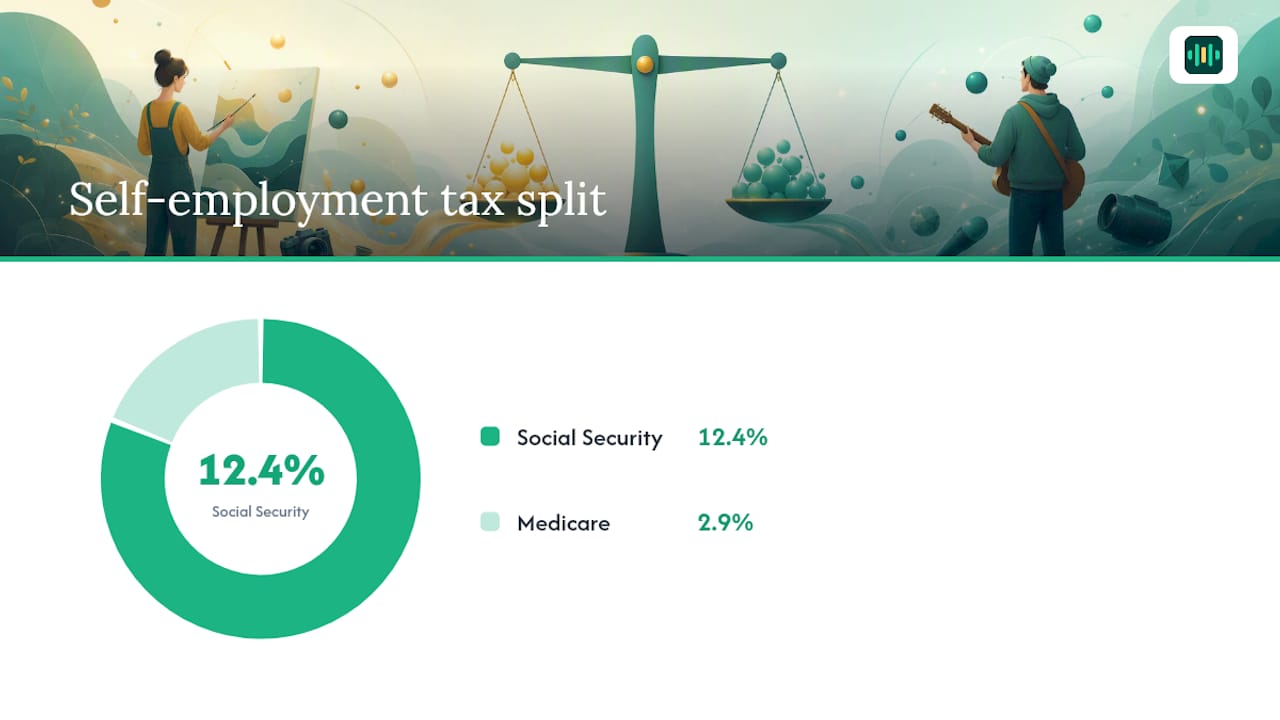
Once your side hustle nets $400 or more in a year, you're required to file and pay self-employment tax, according to the IRS. Self-employment tax runs 15.3% total: 12.4% for Social Security and 2.9% for Medicare, on top of whatever income tax bracket you fall into. That's a different bill than a W-2 job, where an employer covers half of it.
A practical guideline is to set aside about a quarter to a third of your gross side-hustle income for combined federal, state, and self-employment taxes until you know your precise tax situation, then narrow that percentage once you can see your actual filing picture using Mali's calculators.
Practical steps that keep you out of trouble later:
- Open a separate business checking account the day you make your first sale, which the IRS recommends specifically to simplify gig-work recordkeeping and Schedule C reporting.
- Track every receipt and invoice as it happens, not at tax time.
- Move your tax set-aside into a separate savings bucket every time you get paid, not once a quarter.
- Talk to a tax professional once you're consistently netting more than a few hundred dollars a month, or if you're weighing whether to form an LLC.
If your income swings wildly month to month, a voice-first tool like Mali can help you talk through what a slow month means for your quarterly estimated payment, without opening a spreadsheet.
Staying Sustainable While You Scale
Batch your production instead of working reactively. One design day can produce a week's worth of social content; one shoot can become a print, a template, and three social posts. Repurpose relentlessly, since one asset built once should earn you money in more than one place.
Outsource the parts of the work that don't use your core skill once the math supports it: if editing eats four hours a week and you can hire it out for $40 while your own time is worth more than that per hour, outsource it and price the cost into your packages.
The strongest long-term model stacks in sequence: build an audience with free content, convert that audience into digital product buyers, then upsell your highest-intent buyers into higher-priced services. Creators running three or more income streams earn several times more than those depending on a single source, according to creator-economy market data, which is the strongest argument for not stopping at your first successful hustle.
Review monthly: track listings live, leads in your pipeline, and actual revenue banked, not just hours worked.
Pro Tip: Block one repeatable "batch day" every week or two. Creatives who treat production like a schedule, not an inspiration, ship consistently, and shipping consistently is what actually builds income over time. For a deeper look at avoiding burnout while scaling, this guide on sustainable business practices is worth a read.
What I've Learned Watching Creatives Try to Make This Work
Most people quit a digital product idea around week six, right before it would have started working. Products and audience-driven income are genuinely slow. Give a digital product line three to four months of consistent listing and promotion before deciding whether it's viable, but expect a productized service package to produce its first paying client within two to three weeks if you actually post it somewhere.
The habit that separates people who make real money from people who collect half-finished side projects isn't talent. It's a weekly fifteen-minute review: how many listings are live, how many leads came in, how much actually landed in the bank. Chasing five ideas at once feels productive and produces almost nothing. Running one idea with a weekly number attached to it is what turns a hobby into income.
— Todd
Track Irregular Income Without the Spreadsheet Headache
Side-hustle income rarely arrives on a predictable schedule, and that's exactly the kind of mess a voice-first assistant can help sort through out loud. Instead of typing numbers into a form or staring at a dashboard, you can talk to a voice AI assistant about what actually hit your bank account this month, and get help working out what to set aside for taxes and what's safe to spend, based on real transactions rather than a generic percentage. No other personal finance app aims to let you talk through your accounts and transactions in an actual conversation.

If your side income swings from $200 one month to $2,000 the next, Mali's savings goal and emergency fund calculators give you a starting number, and the voice assistant helps you adjust it as your real numbers come in. Start with the free demo to see how it handles a month of irregular income, no card required to try the calculators first.
Sources
- Self-Employment Tax (Social Security and Medicare taxes) | Internal Revenue Service
- Side hustle statistics — The Penny Hoarder
- 12 Creative Side Hustles (and How AI Can Help You Start Them) — Forbes
This article is general information, not a substitute for advice from a qualified financial advisor. Consult a qualified financial professional about your own circumstances before acting on anything here.
FAQ
What Is the Best Side Hustle for Creatives With Little Free Time?
Productized services, like a fixed-price logo package or a mini photo session, generally pay fastest with as little as two to five hours a week. They convert faster than digital products because you're selling a defined outcome instead of building an audience first.
How Much Should Creatives Save for Taxes?
A workable starting point is 25 to 30% of gross side-hustle income set aside for combined federal, state, and self-employment tax until you know your specific numbers. Once net earnings hit $400 in a year, you're required to file and pay self-employment tax.
How Long Does It Take to Earn Real Money From a Creative Side Hustle?
Productized services can land a first paying client within two to three weeks. Digital products and content-driven monetization typically take three to six months of consistent output before revenue becomes predictable.
Do I Need an LLC for a Creative Side Hustle?
Not right away. Most creatives can start as a sole proprietor and revisit forming an LLC once income becomes consistent or liability risk increases, ideally with input from a tax professional at that point.
How Can I Track Irregular Side-Hustle Income Without Spreadsheets?
A voice-first assistant like Mali links to your bank accounts and lets you talk through what came in, what to set aside, and what's safe to spend, based on your actual transactions rather than a generic template. Current pricing and the free demo are available on the Mali site.