
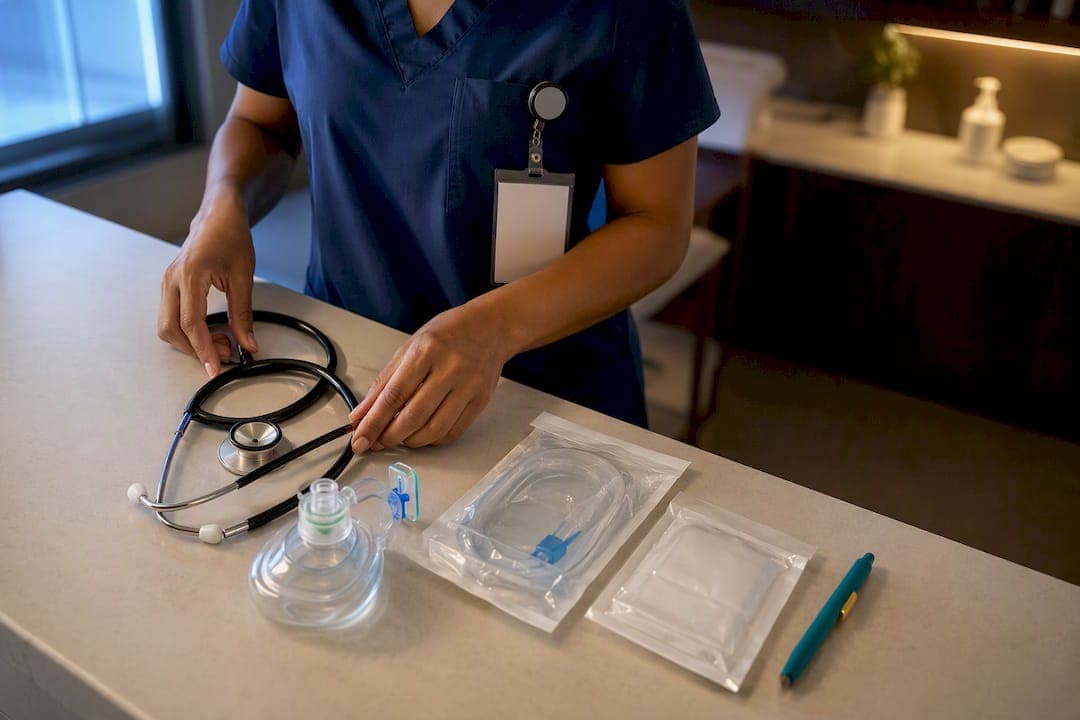
The best side hustles for nurses right now are the ones that stay inside your existing scope of practice: per-diem shifts, telehealth triage, freelance clinical writing, tutoring, and legal nurse consulting all pay reliably without adding regulatory exposure. The one caution that matters more than pay: check your state's Nurse Practice Act, your employer's moonlighting policy, and your malpractice coverage before you accept anything. Below you'll find pay ranges, startup steps, tax basics, and a vetting checklist for each option.
TL;DR:
- Starting with low-risk side gigs like freelance writing or tutoring helps nurses build good record-keeping habits and confirm their scope of practice.
- Per-diem shifts and clinical research work offer higher pay with moderate licensure risk, but require careful review of employer policies and licensure legality.
- High-paying options such as aesthetic procedures or IV hydration pose significant board and liability risks if proper authorization, protocols, and coverage are not in place.
- Proper planning, including verifying jurisdiction rules, obtaining separate liability coverage, and tracking income and expenses, is essential before scaling higher-risk work.
- Accurate tax management requires understanding self-employment rules, making quarterly payments, and using targeted tools to determine realistic monthly income goals.
Table of Contents
- Fastest, Safest, and Highest-Paying Options at a Glance
- 14 Side Hustles for Nurses That Won't Jeopardize Your License
- How to Pick the Right Hustle and Start Safely
- What Nurses Need to Know About Taxes Before Taking a Side Gig
- Five Checks to Run Before You Accept Any Nursing Side Gig
- Your First 90 Days: A Realistic Timeline
- Turning Side Income Into a Real Plan, Not Just Extra Cash
- Why Most Side Hustle Advice for Nurses Misses the Point
- A Practical Way to Plan the Income Side of This
- Where to Verify Pay and Licensing Rules
- Sources
- FAQ
Fastest, Safest, and Highest-Paying Options at a Glance
Some hustles you can start this week with zero licensure exposure. Others pay better but require you to slow down and check your state rules first.
- Lowest risk, fastest start: freelance clinical writing, NCLEX tutoring, medical billing/coding, CPR instructor work. None of these require you to practice across state lines or under ambiguous supervision.
- Moderate risk, solid pay: telehealth triage, PRN/per-diem shifts, clinical research coordination, home health. These are fine once you confirm license compatibility and delegation orders.
- Highest risk, highest headline pay: independent IV hydration and aesthetics. These can trigger board complaints fast without written standing orders and the right liability coverage.
- Three protective moves before you say yes to anything: confirm your state's telehealth licensure rules, read your employer's moonlighting clause, and get a professional liability policy that's separate from your employer's coverage.
Typical pay varies widely depending on the role, from tutoring to legal nurse consulting, with higher rates generally for more specialized gigs, with most gigs asking for 3 to 15 hours a week.
14 Side Hustles for Nurses That Won't Jeopardize Your License
1. Telehealth or Remote Triage Nursing
This suits nurses who want clinical work without a commute. Pay typically ranges in the mid tens to mid forties per hour, often for shifts of 4 to 8 hours you can pick up around your primary job. The license risk sits in the moderate range: you generally need to be licensed in the state where the patient is physically located, which gets complicated fast if you're taking calls nationally. Start by checking whether your state participates in the Nurse Licensure Compact and by asking any platform directly how they verify patient location before you're assigned a case.
2. PRN or Per-Diem Hospital Shifts
If you already work full-time, picking up per-diem shifts at a second facility is the most straightforward way to add income using skills you already have. Pay generally exceeds your base hourly rate by a noticeable margin, and shifts are booked in full blocks, usually 8 or 12 hours. The main risk isn't licensure. It's your primary employer's moonlighting policy, which some hospitals restrict for liability or fatigue reasons. Ask HR for the written policy before you commit to anything with a second facility.
3. Freelance Clinical Writing or Medical Content
Health websites, pharma marketing agencies, and medical education companies all pay nurses to write patient education material, blog content, and clinical explainers. Pay ranges from a few cents up to a dollar per word depending on the client and your specialty, and most nurses start at 5 to 10 hours a week. This is about as low risk as it gets since you're not delivering care. Build a small portfolio with two or three sample pieces and pitch directly through freelance marketplaces or health media job boards.
4. NCLEX or Nursing School Tutoring
Nursing students pay well for one-on-one help, especially ahead of board exams. Rates can range roughly from thirties to eighties per hour, and most tutors work 3 to 8 hours a week around their shift schedule. There's essentially no licensure risk here since you're teaching, not treating. Get listed on tutoring marketplaces or reach out to your former nursing program about adjunct tutoring slots.
5. Legal Nurse Consulting
Attorneys hire nurses to review medical records, translate clinical jargon, and support malpractice or personal injury cases. Pay tends to be among the highest on this list, often well above average hourly wages, project-based, with workloads that flex around a few hours a week or a full case review sprint. Risk is low as long as you're consulting rather than diagnosing. A legal nurse consultant certification helps you get taken seriously, though it isn't always required to start pitching small firms.
6. Vaccination Clinics and Event Nursing
Seasonal flu clinics, community health fairs, and corporate wellness events need licensed nurses on short-term contracts. Pay typically falls between thirty and fifty dollars per hour for single-day or weekend gigs. Risk is moderate and depends entirely on setup: well-run clinics operate under physician-signed standing orders with clear anaphylaxis protocols, while disorganized ones leave you exposed if something goes wrong. Ask to see the standing orders before your first shift.
7. Home Health or Private Duty Nursing
Families and home health agencies hire nurses for one-on-one patient care, often for a set number of hours per week. Pay ranges from about twenty-five to mid-forties per hour, with time commitments as flexible as you negotiate. Risk is moderate. You're practicing independently in someone's home, often without a second set of eyes, so documentation discipline matters more here than almost anywhere else on this list.
8. Clinical Research Coordinator or Research Nurse Work
Pharmaceutical trials and academic research sites need nurses for patient screening, data collection, and protocol adherence. Pay usually ranges from thirty to mid-fifties an hour, usually part-time or per-visit. Licensure risk is low since you're working under a defined study protocol. Research site registries and university clinical trial job boards are the most direct way in.
9. Medical Billing and Coding
This is a fully remote, non-clinical option that pays generally in the twenty to thirty dollar hourly range based on BLS wage data for health information roles, typically 10 to 20 hours a week once you're trained. Zero licensure risk. A billing and coding certificate, which takes a few months, makes you competitive on freelance marketplaces and remote job boards.
10. CPR, BLS, or ACLS Instructor
Teaching certification courses usually pay in the range of thirty to sixty dollars per session, usually a few sessions a month. Risk is essentially nonexistent since you're instructing, not treating patients. You'll need instructor certification through the American Heart Association or the Red Cross before you can lead classes, which is a one-time investment that pays for itself after a handful of sessions.
11. Paid Medical Survey Panels
Market research firms pay clinicians for their opinion on treatments, devices, and workflows. Pay is typically modest per survey, varying by firm and survey length, and time commitment is minimal, often under an hour per survey. There's no licensure exposure at all, making this a reasonable filler income stream rather than a primary hustle.
12. Telemonitoring or Remote Patient Monitoring
Hospitals and remote monitoring companies pay nurses to watch vitals dashboards for at-risk patients between visits. Pay ranges roughly from high twenties to forty dollars per hour, often for evening or weekend shifts of 4 to 8 hours. Risk is moderate, tied to the same multi-state licensure questions as telehealth triage, so confirm jurisdiction rules before signing on.
13. Health Coaching or Case Management
Wellness companies and insurers hire nurses for coaching and utilization review work, often part-time and remote. Pay falls approximately in the twenty-five to fifty dollar per hour range, with 10 to 15 hours a week common. Risk is low to moderate depending on whether you're giving general guidance or something that edges into clinical advice, which is where documentation and scope awareness matter.
14. IV Hydration and Aesthetic Services
Mobile IV therapy and injectable aesthetics command some of the highest pay rates but involve higher risk, the highest rate on this list outside legal consulting. It's also the riskiest. Operating without a physician's standing orders, adequate liability coverage, and a clear understanding of your state's supervision requirements is how nurse entrepreneurs run into board complaints. If you're drawn to this path, talk to a healthcare attorney about your business structure before you take a single client.
How to Pick the Right Hustle and Start Safely
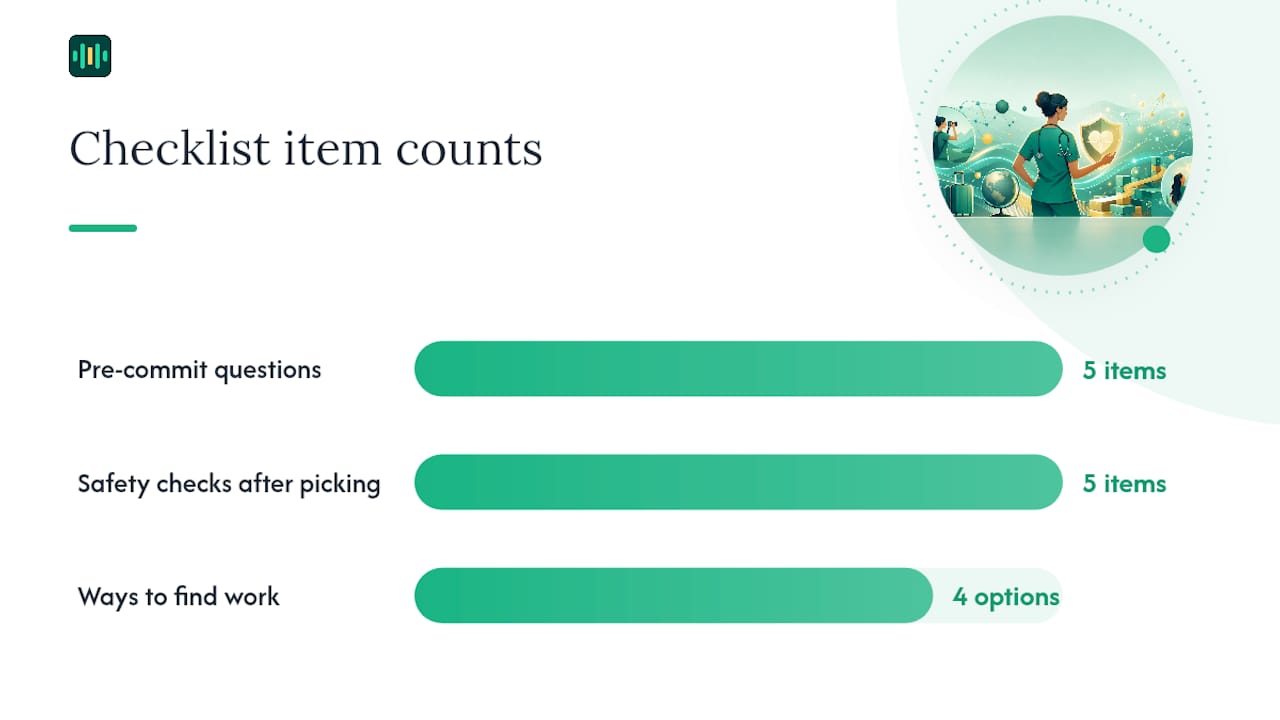
Run through five questions before you commit to anything: How many hours do you actually have free each week? Does the work match a credential you already hold? What will it cost you upfront in certification or insurance? What's your monthly income target? And does the work fall clearly inside your scope of practice, or does it need a supervising physician's sign-off?
Once you've picked a lane, work through these checks in order:
- Pull up your state's Nurse Practice Act and confirm the specific activity is within your scope.
- Read your employer's moonlighting or outside-employment policy word for word, not just the summary HR gives you.
- Buy a standalone professional liability policy. Your employer's coverage almost never extends to independent work.
- Gather your credentials, active CPR/BLS card, and any specialty certifications the gig requires.
- If you're teaching CPR, ACLS, or similar, get instructor certified before advertising availability.
For finding actual work, gig staffing platforms cover per-diem and travel shifts, university adjunct listings cover tutoring, research-site registries cover clinical trial roles, and general freelance marketplaces cover writing and consulting.
Pro Tip: Call your state board's licensing line directly and ask your specific question in writing over email. A verbal answer from a coworker isn't documentation. A written answer from the board is.
What Nurses Need to Know About Taxes Before Taking a Side Gig
Any income you earn as an independent contractor gets taxed differently than your regular paycheck, and this trips up more nurses than any licensure question does.
- 1099-NEC income means no taxes were withheld, so you owe the full self-employment tax yourself.
- W-2 income from a second employer withholds taxes automatically, same as your primary job.
- Stipends (common in travel nursing) may be tax-free if they cover legitimate duplicated living expenses, but the rules are strict about maintaining a genuine tax home.
By the numbers: Self-employment tax totals 15.3%, combining Social Security and Medicare. The Social Security portion applies only up to the annual wage base the SSA publishes each year, while the Medicare portion applies to every dollar you earn from self-employment.
If nobody's withholding taxes for you, the IRS expects quarterly estimated payments, not one check in April. Track mileage, continuing education costs, licensing fees, and home office expenses year round rather than trying to reconstruct them in March. Nurses juggling both W-2 and 1099 income should keep separate records for each income stream, since deductions that apply to contract work don't apply to your regular paycheck. High earners running a consistent freelance or consulting business sometimes explore an S-corp election to manage self-employment tax exposure, but that decision needs a CPA, not a blog post.
Five Checks to Run Before You Accept Any Nursing Side Gig
- Scope of practice. Confirm the specific tasks you'd perform are explicitly within your license type in your state.
- Licensure jurisdiction. For telehealth or remote work, the patient's location determines which state's license rules apply, not yours.
- Malpractice coverage. Verify you have coverage that applies to this specific work, not just your employer's blanket policy.
- Employer moonlighting policy. Some hospitals prohibit outside clinical work entirely; others allow it with disclosure.
- Written delegation or standing orders. Any task performed under a physician's authority, like administering vaccines, needs that authority documented in writing, not implied.
High-risk scenarios share a pattern: no paperwork trail. A vaccination clinic without signed standing orders, an IV hydration gig where the "supervising" physician is unreachable, a telehealth platform that never asks where your patient is sitting. Document everything: photograph standing orders, save your liability certificate, keep copies of every credential check a platform runs on you. Nurses holding a Nurse Licensure Compact license get more flexibility across member states, but compact licenses don't cover every state, and telehealth jurisdiction rules are still evolving state by state.
Your First 90 Days: A Realistic Timeline
Week 1 to 2: Gather your license, CPR/BLS card, and any specialty certifications. Read your state's Nurse Practice Act section relevant to your chosen hustle. Sign up for the platform, registry, or job board that matches it.
Month 1: Complete any required training or instructor certification. Take on one small project or shift as a test run rather than committing to a full schedule immediately. Ask for a reference or testimonial from your first client or facility.
Month 3: Set up real bookkeeping, even if it's just a spreadsheet tracking income and deductible expenses by category. Decide on your pricing if you're freelance or consulting based. Register for quarterly estimated tax payments if you haven't already. At this point, be honest with yourself about whether the hustle is worth scaling up, holding steady, or dropping.
Budget realistically for startup costs: instructor certifications, liability policies, and training certificates vary widely in price, from a couple of hundred to over a thousand dollars.
Turning Side Income Into a Real Plan, Not Just Extra Cash
Extra income only helps if you know exactly what gap it's closing. If your goal is $2,000 a month from tutoring at $50 an hour, that's 10 hours a week, which is a very different lift than hitting the same number through weekend per-diem shifts. Running that math by hand is where most nurses lose momentum.
A financial planning tool can help with exactly this kind of planning:
- Talk through your target income and get back an estimate of hours needed at your expected rate, instead of doing the math yourself between shifts.
- After a shift, get a spoken breakdown of what a paycheck or 1099 payment might net after estimated taxes.
- Set reminders to save toward a certification fee or quarterly tax payment, useful when you're commuting or between patients and can't sit down with a spreadsheet.
None of this replaces a CPA or a licensing attorney. What it does is turn "I should probably earn more" into a number you can actually work toward.
Why Most Side Hustle Advice for Nurses Misses the Point
Most articles on this topic treat side hustles like a menu: pick one, start earning. That framing skips the part that actually determines whether a nurse ends up ahead or ends up in front of a licensing board. The research is consistent on this: license risk isn't evenly distributed across these options, and treating a telehealth gig with the same casualness as freelance writing is where nurses get burned.
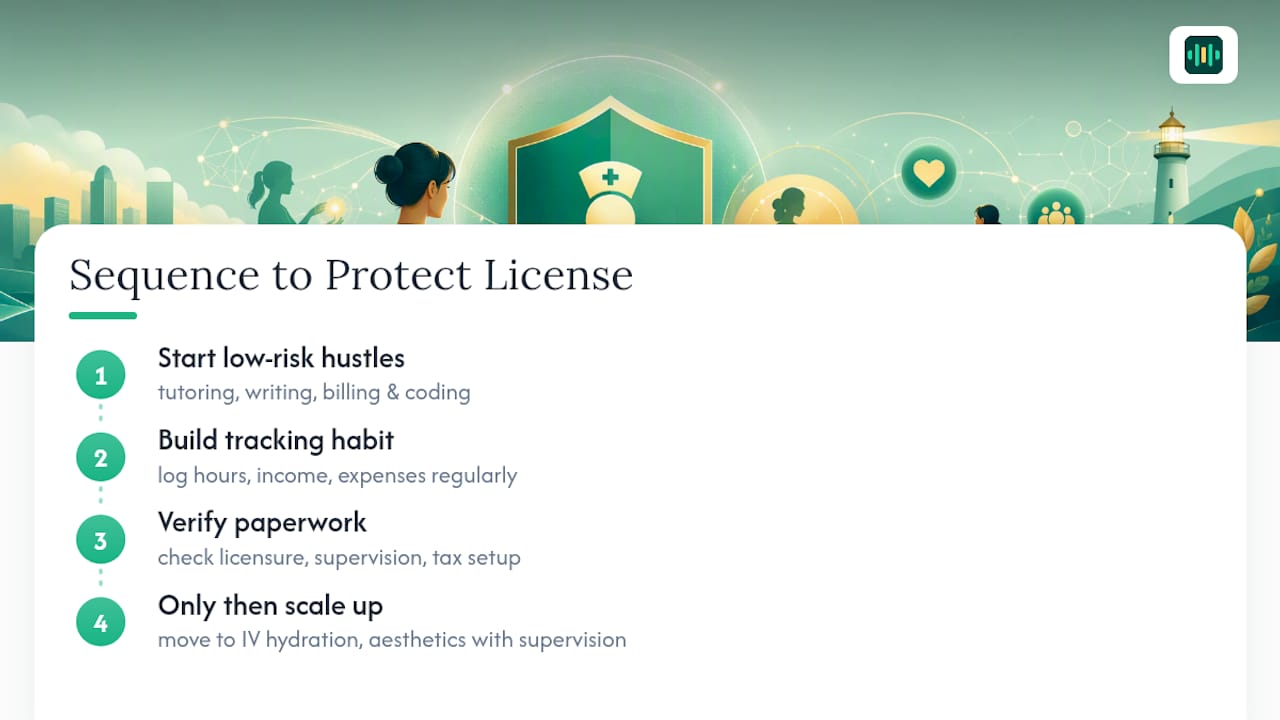
The conventional advice also overweights the highest-paying options. IV hydration and aesthetics generate the most excited blog posts, but they carry real supervision and business-structure requirements that a lot of nurses discover only after a complaint lands. Meanwhile, the boring options, tutoring, writing, billing and coding, get treated as filler when they're often the better starting point precisely because they're low friction.
What actually matters is sequencing. Start with something low risk to build the habit of tracking hours, income, and expenses. Only move toward higher-paying, higher-scrutiny work once you've confirmed the paperwork holds up. Money management matters just as much as gig selection. A nurse who picks the "safe" hustle but never tracks quarterly taxes ends up in nearly as much trouble as one who skips a licensure check.
— Todd
A Practical Way to Plan the Income Side of This
Once you've picked a side hustle, the harder question is usually how much of it you actually need. Mali is a voice-first financial assistant that links to your real bank accounts and tells you, out loud, exactly where your monthly numbers fall short, then sizes side-income suggestions to close that specific gap instead of handing you a generic list.

That's the piece most nurses skip: figuring out whether $2,000 a month actually requires 10 hours of tutoring or 15 hours of per-diem shifts before committing to either. Mali's calculator library covers savings goals, emergency funds, and tax-advantaged accounts like HSAs, so you can run the numbers on a certification cost or a quarterly tax payment before you spend a dollar. This tool doesn't give legal or licensure advice. It's a money tool, not a compliance one. Start with a free demo and connect your accounts to see your actual income gap before you pick a hustle to close it.
Where to Verify Pay and Licensing Rules
- BLS Occupational Employment Statistics for wage data across nurse-adjacent occupations.
- SSA contribution and benefit base for current self-employment tax thresholds.
- NurseCred's guide to nurse side gigs and licensure for state-by-state risk breakdowns.
- American Heart Association CPR & ECC for instructor certification requirements.
- Your own state board of nursing website for the current Nurse Practice Act text.
Sources
- Social Security Administration — Contribution and benefit base
- Bureau of Labor Statistics — Medical Records and Health Information Technicians wages
- NurseCred — Nurse side gigs & your license: what's safe in 2026
- NurseOnestop — Nurspreneurs & ethical practice: how to stay in your lane
FAQ
What can nurses do to make extra money?
The lowest-risk options are freelance clinical writing, tutoring nursing students, and medical billing or coding. Higher-paying but higher-scrutiny options include telehealth triage, per-diem shifts, and legal nurse consulting.
How can I make $2,000 a month with a side hustle?
At $50 an hour, that's about 10 hours a week, achievable through tutoring, freelance writing, or per-diem shifts depending on your rate and availability. A calculator that converts your target into required hours makes this math immediate rather than guesswork.
How realistic is it to make $200,000 a year as a nurse?
That typically requires combining a high-paying primary role, like a nurse practitioner or specialty nurse, with consistent high-value side work such as legal nurse consulting or clinical research contracts, since this total sits well above typical single-job nursing pay.
Can nurses realistically earn $300,000 through online work alone?
This is uncommon and usually requires building a scaled business, like a large tutoring practice, a content agency, or a consulting firm with multiple clients, rather than a single freelance gig. Treat any claim promising this from part-time online work with real skepticism.
Do I owe taxes on side hustle income even if it's part-time?
Yes. Any 1099 income over a small threshold is subject to self-employment tax, and if no one withholds taxes for you, the IRS expects quarterly estimated payments rather than a single payment at tax time.