

Tutoring, selling lesson plans, and selective freelance writing are the fastest, lowest-friction side hustles for teachers who need flexible income without wrecking their week. Most of these fit into 1 to 10 hours a week, use skills you already have, and can start generating income within a month. The tradeoff is real, though: every dollar you earn outside your paycheck is taxable, and the wrong hustle can eat into grading time faster than you'd expect.
TL;DR:
- Virtual assistant work offers about 5 to 10 hours weekly with earnings around $15 to $35 per hour, suitable for detail-oriented teachers seeking flexible, off-class income.
- Selling lesson plans or digital products can generate passive income after 4 to 8 hours of upfront work, but income varies widely depending on the number of listings and quality.
- Freelance education writing and editing can add approximately $200 to $600 monthly, requiring just a few hours per week and a small portfolio of samples.
- Teachers must track all side income and expenses diligently and understand they will owe self-employment taxes once earnings exceed $400 annually.
- To begin, choose a hustle aligned with timely skills, set a realistic weekly time limit, create a low-cost initial profile, and adjust rates gradually to increase income without burnout.
Table of Contents
- The 8 Best Side Hustles for Teachers, Ranked by Ease and Fit
- Side Hustles for Teachers, Broken Down by Category
- How to Choose the Right Hustle Without Burning Out
- Taxes and Recordkeeping Teachers Can't Skip
- Your 7-Step Plan to Start This Month
- What Actually Makes a Side Hustle Worth It for a Teacher
- Talk Through Your Income Gap Instead of Guessing at It
- Sources
The 8 Best Side Hustles for Teachers, Ranked by Ease and Fit
Some hustles pay well but demand hours you don't have. Others pay modestly but slot neatly into a Tuesday evening. Here's how the most realistic options for teachers stack up, ranked by how fast you can start and how well they survive a school-year workload.
A 2026 Walton Family Foundation and Gallup study found that 71% of U.S. teachers hold at least one second job, and 85% of those work at least partly during the school year rather than waiting for summer. This isn't a niche habit. It's closer to the norm.
- Online tutoring/academic coaching — best for subject specialists; 3 to 8 hours per week; start by listing your certification and one specific subject niche.
- Selling lesson plans and curriculum resources — best for organized planners with a backlog of materials; 2 to 5 hours per week upfront, less after; start by uploading three of your best existing units.
- Freelance writing or editing (education-focused) — best for strong writers; 3 to 6 hours per week; start with a portfolio of two writing samples.
- Virtual assistant or remote admin work — best for detail-oriented multitaskers; 5 to 10 hours per week; start with a profile highlighting scheduling and communication skills.
- Selling printables and digital products — best for teachers with design sense; 4 to 10 hours upfront, then mostly passive; start with one themed product bundle.
- Test prep or standardized exam coaching — best for teachers who know the SAT, ACT, or state exams cold; 2 to 6 hours per week; start by advertising to your own school community first.
- Gig platform work (rideshare, delivery) — best for anyone needing quick, schedule-flexible cash; 1 to 15 hours per week, entirely on your terms; start by activating one app and driving during a single weekend.
- Seasonal or local flexible gigs — best for summer-heavy availability; 5 to 20 hours per week seasonally; start by checking summer camp or local rec department postings each spring.
Pro Tip: Pick the hustle that overlaps with something you're already doing. If you're already writing detailed feedback on essays, freelance editing barely feels like new work.
Side Hustles for Teachers, Broken Down by Category
1. Online Tutoring and Academic Coaching
Tutoring remains the most natural fit for a licensed teacher, and it pays accordingly. Rates for subject-specific tutoring commonly run $25 to $60 an hour depending on subject, grade level, and whether it's test prep or ongoing academic support. A teacher tutoring two students for an hour each, twice a week, can realistically add $200 to $400 a month without touching a weekend.
Three next actions: build a one-page profile listing your certification and specialty, set an introductory hourly rate slightly below market to land your first three clients, and ask current parents or colleagues for referrals before advertising publicly.
Pro Tip: Batch your tutoring sessions back to back on one or two evenings instead of spreading them across the week. It protects the rest of your schedule and keeps your energy for grading intact.
2. Creating and Selling Lesson Plans or Curriculum Resources
If you've spent a decade building units, worksheets, and assessments, you already own inventory. Selling curriculum resources through online marketplaces turns materials you built for free into a recurring income stream. According to insight from the Walton Family Foundation report, reusing classroom-developed materials and optimizing how they're listed can scale into low-effort recurring income, though it takes real upfront preparation to format and package resources for other teachers to use.
Earnings vary enormously here. Some sellers earn a few hundred dollars a year from a handful of listings; others with dozens of polished products build four figures monthly. The honest starting point is closer to the former.
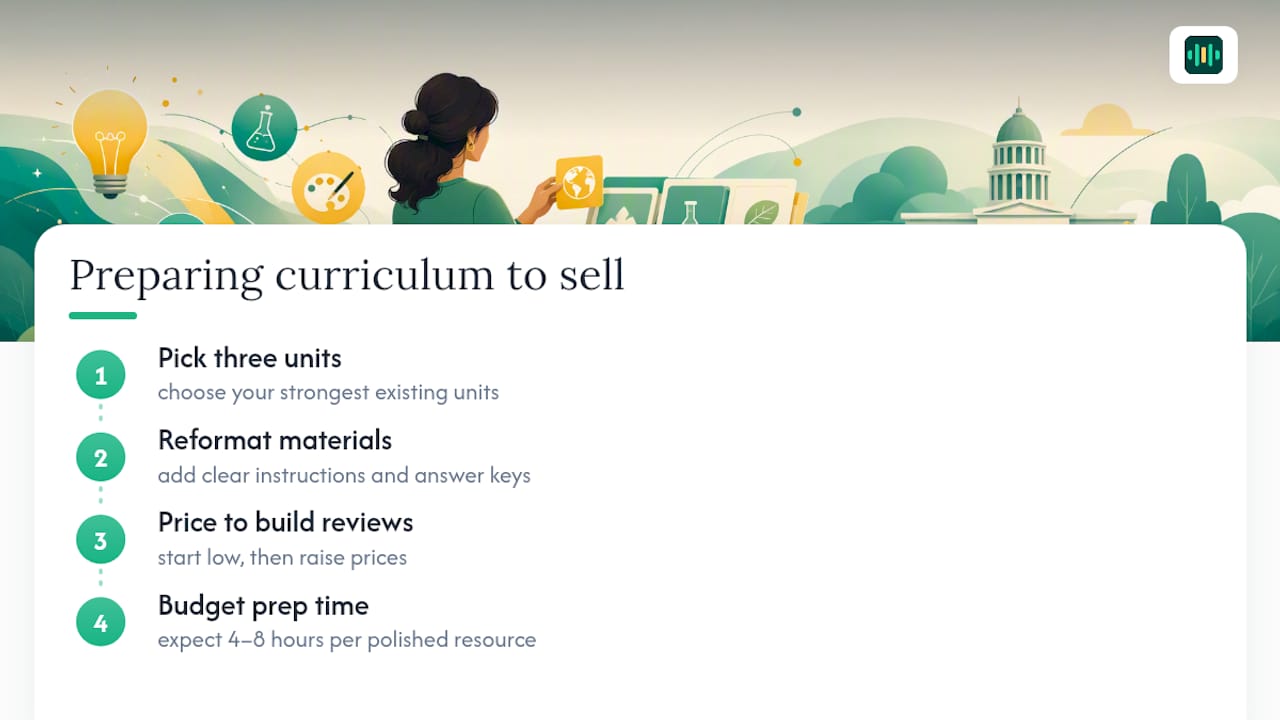
Three next actions: pick your three strongest existing units, reformat them with clear instructions and answer keys, and price your first listings low to build reviews before raising prices.
Pro Tip: Sell once, earn repeatedly, but budget real time upfront. A polished, well-formatted resource can take 4 to 8 hours to prepare properly, even from an existing lesson.
3. Freelance Writing, Editing, and Content Creation
Teachers write constantly, whether it's feedback, IEP documentation, or parent communication. That skill translates directly into freelance writing and editing work, particularly in education-focused content, curriculum writing for ed-tech companies, or academic editing for grad students.
Freelance education writers commonly charge $0.10 to $0.50 per word for articles, or $25 to $50 an hour for editing work, depending on experience and niche. A teacher picking up two 1,000-word articles a month at a moderate rate can add $200 to $600 without a fixed schedule.
Three next actions: draft two writing samples focused on education topics, create a simple one-page portfolio site or document, and pitch three education-focused publications or ed-tech companies directly.
4. Online Selling and Passive Digital Products
Beyond curriculum resources, teachers sell printables, classroom decor templates, planners, and craft goods through online marketplaces and print-on-demand platforms. This category leans passive after the initial build, but the initial build is real work.
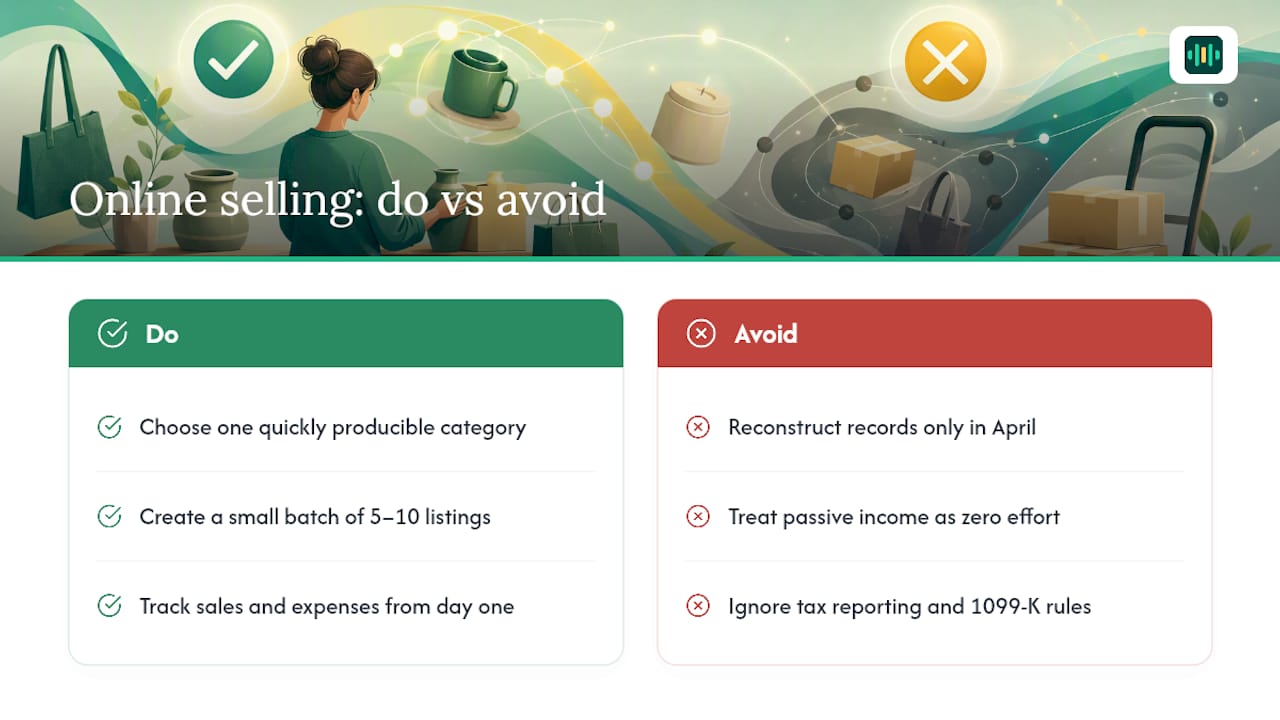
The IRS is explicit that profits from selling goods or services are taxable, and payment apps or online marketplaces may issue a Form 1099-K once you cross reporting thresholds. Keep records from day one rather than reconstructing them in April.
Three next actions: choose one product category you can produce quickly, create a small batch of 5 to 10 listings rather than one, and track every sale and expense in a simple spreadsheet from the start.
Pro Tip: Passive income is never zero effort. It's front-loaded effort. Expect 10 to 15 hours of setup before a digital product starts earning without you actively working.
5. Virtual Assistant and Remote Admin Work
Virtual assistant work suits teachers who are naturally organized: managing calendars, inboxes, or client communication for small business owners. It doesn't require teaching credentials at all, which makes it a good option if you want side income that's completely disconnected from the classroom.
Rates typically run $15 to $35 an hour depending on the complexity of tasks and your specialization. A teacher working 5 hours a week as a VA can add roughly $300 to $700 a month.
Three next actions: list your organizational and communication skills on a general freelance platform, target small business owners rather than large companies for faster response times, and set clear weekly availability so clients don't expect same-day turnaround during school hours.
6. Local Flexible Gigs and Seasonal Work
Rideshare driving, food delivery, weekend event staffing, and seasonal camp or tutoring center work round out the list. These options offer the most schedule flexibility of anything on this list because you control exactly when you work, down to the hour.
CNN's coverage of teachers working second jobs documents educators piecing together gig work and seasonal roles specifically because the flexibility matches an unpredictable teaching schedule better than a fixed part-time job would.
Three next actions: activate one gig platform account and test a single weekend shift, check your local parks and recreation department for summer program postings each March, and calculate your actual per-hour earnings after gas and app fees before committing to it long term.
How to Choose the Right Hustle Without Burning Out
Run every hustle idea through four filters before committing: how much weekly time you actually have, how much unpaid setup work it demands, its realistic income ceiling, and whether it's seasonal or year-round. A hustle that scores well on income but poorly on setup time (like building a curriculum store from scratch) needs a different season of your life than one that scores well on flexibility but modestly on pay (like tutoring two students a week).
Scheduling matters more than the hustle itself. Time-block a single weeknight and one weekend morning rather than spreading small tasks across every day. Batching similar tasks, grading five tutoring sessions' worth of homework at once, or writing three blog posts in one sitting, cuts the mental switching cost that makes side work feel heavier than it is.
On pricing, a fair starting rule: price your first few clients slightly below market to build reviews and confidence, then raise rates every few months as demand grows. Never negotiate down more than 10 to 15% from your stated rate, and never work for "exposure" or vague future payment promises.
- Red flag: a client expects texts or calls during school hours.
- Red flag: payment terms are vague or "we'll figure it out later."
- Red flag: the gig routinely runs past your set weekly hour cap.
Gallup's research on teacher finances found that financially strained teachers are more likely to take non-teaching side gigs, and those non-teaching gigs are more likely to negatively affect classroom performance. Picking a hustle that draws on skills you already use in the classroom tends to protect your teaching more than one that's completely disconnected from it.
Pro Tip: If a hustle makes you dread Monday mornings, the hourly rate doesn't matter. Drop it and try something else on this list.
Taxes and Recordkeeping Teachers Can't Skip
The IRS requires you to file and pay self-employment tax once net earnings from self-employment hit $400 or more, a threshold nearly every side hustle on this list will cross within a few months. Every dollar you earn is taxable whether or not you ever receive a 1099.
Self-employment tax covers your Social Security and Medicare contributions, on top of regular income tax. You can offset some of that with legitimate deductions, mileage to tutoring sessions, supplies for products you sell, a portion of home office costs, so keeping records matters as much as earning the money.
A few habits keep tax season painless:
- Open a separate checking account for side-hustle income, even a free one.
- Track mileage with a simple app or paper log every time you drive for the hustle.
- Log income and expenses weekly rather than reconstructing them in March.
- Choose between adjusting your W-4 withholding at your teaching job or making quarterly estimated payments, not neither.
The IRS also flags that electronic payments through apps or online marketplaces may trigger a Form 1099-K once you cross reporting thresholds, so the recordkeeping habit matters even if you think you're too small to notice. Mali's free calculators can give you a fast estimate of what you'll owe before it surprises you in April.
Your 7-Step Plan to Start This Month
- Pick one hustle from this list based on your available hours and existing skills.
- Set a firm weekly time budget, no more than what you can sustain for a full semester.
- Build a minimal profile, listing, or product page, nothing needs to be perfect to launch.
- Set an introductory rate slightly below market for your first three to five clients or sales.
- Open a separate account for side income and pick one bookkeeping method you'll actually use.
- Choose your tax approach: adjusted W-4 withholding or quarterly estimated payments.
- Set a 30/60/90-day income goal and check it against actual hours worked, not just dollars earned.
What Actually Makes a Side Hustle Worth It for a Teacher
Every teacher I've talked through this with runs the same math eventually: is the extra income worth the hours it takes from grading, planning, or just being off the clock? The honest answer depends less on the hourly rate and more on whether the hustle drains the same mental energy teaching already uses up. Tutoring after a day of teaching the same subject rarely feels like a second job. Driving for a delivery app after that same day often feels like exactly the break you needed.
That's the calculation Mali is built to help with, using voice-first, bank-linked calculators that can quickly estimate how many tutoring hours at $30 an hour it actually takes to close a $300 monthly gap, versus how many delivery shifts at a lower effective wage would do the same. Before joining the team behind Mali, I spent years building and evaluating financial planning tools, and the pattern I kept seeing was people guessing at numbers that took thirty seconds to actually calculate.
— Todd
Talk Through Your Income Gap Instead of Guessing at It
Malimoney is the alternative to spreadsheets and generic budgeting apps for teachers trying to figure out exactly how much side income they need. Link your bank accounts, and Mali reads your real spending and income to tell you the actual size of your monthly gap, then helps you talk through which hustle closes it fastest.

Say you're short $300 a month after bills. Ask about how many tutoring hours at an hourly rate that takes, or how a $200 curriculum-resource month changes your withholding needs, and get walked through it out loud, not through a dashboard full of charts. The calculators behind that conversation cover everything from tax withholding to savings goals, and the full feature set shows how the voice-first approach ties your real accounts to real answers instead of generic advice. Start a trial and ask Mali to size your own gap tonight.
Sources
- New Report Shows Many Teachers Rely on Second Jobs to Make Ends Meet – Some Side Gigs Show Negative Impact on Teaching
- One in Five K-12 Teachers Struggle Financially
- Are you making extra cash selling stuff or providing a service? | Internal Revenue Service
This article is general information, not a substitute for advice from a qualified financial advisor. Consult a qualified financial professional about your own circumstances before acting on anything here.