

If you qualify, your spousal Social Security benefit can reach 50% of your spouse's Primary Insurance Amount at your own full retirement age. Divorced spouses follow different eligibility rules built around a 10-year marriage requirement. Claiming before full retirement age permanently shrinks your monthly check, and Social Security always pays whichever is higher: your own benefit or the spousal top-up.
TL;DR:
- Claiming spousal benefits before full retirement age can reduce your monthly check by up to 35 percent, depending on how early you start.
- Deemed filing rules prohibit claiming just the spousal benefit and switching later to your own higher benefit for most claimants born after 1954.
- Your spousal benefit is capped at 50 percent of your spouse's PIA, and waiting past FRA does not increase this amount.
- Remarriage after age 60 generally does not disqualify you from claiming survivor benefits based on an ex-spouse's record.
- Proper documentation and understanding of your claiming strategy can significantly impact your household's lifetime Social Security income.
Table of Contents
- What Are the Social Security Spousal Benefits Eligibility Rules?
- How Is the Spousal Benefit Calculated?
- How Does Deemed Filing Affect When You Should Take Social Security?
- How Do You Estimate Your Spousal Benefit Before You File?
- How Do You Apply for Spousal Social Security Benefits?
- What Mistakes Cost People the Most on Spousal Benefits?
- Does Remarrying Affect Your Divorced-Spouse Benefits?
- What's the Best Strategy for Maximizing Your Spousal Benefit?
- A Practical Take on Coordinating When to Claim
- Model Your Claiming Scenarios With Mali
- Sources
What Are the Social Security Spousal Benefits Eligibility Rules?
Eligibility splits into two tracks: current spouses and divorced spouses. Each has its own checklist, and missing a single line item can delay or derail your application.
For current spouses, you generally need to meet these conditions:
- You're at least 62 years old, or you're caring for the worker's qualifying child under 16 or disabled.
- Your spouse is already receiving retirement or disability benefits, or is eligible for them.
- You've usually been married at least one year, though some exceptions apply if you're the parent of the worker's child.
For divorced spouses, the requirements shift:
- The marriage lasted at least 10 years before the divorce was final.
- You're currently unmarried.
- You're at least 62.
- If you've been divorced for two years or more, your ex-spouse doesn't need to have filed for their own benefits yet, according to AARP's divorced spouse guidance.
Before you file, pull together your marriage certificate, a divorce decree if applicable, and both Social Security numbers. The Social Security Administration cross-checks these records, and a name mismatch or missing document is one of the most common reasons applications stall.
How Is the Spousal Benefit Calculated?
Two terms drive every calculation: your spouse's Primary Insurance Amount (PIA), which is the benefit they'd receive starting exactly at their Full Retirement Age (FRA), and your own FRA, which depends on your birth year and typically falls between 66 and 67.
At your FRA, your spousal benefit tops out at 50% of your spouse's PIA. That's a ceiling, not a bonus stacked on top of your own retirement benefit. If your own benefit is lower than the spousal amount, Social Security pays your benefit first and adds the difference, according to the SSA handbook's rules on multiple entitlement.
Claim before FRA and the math turns against you. The reduction runs like this:
- For each month before FRA, up to 36 months early, your benefit drops by 25/36 of 1%.
- Beyond 36 months early, each additional month cuts an extra 5/12 of 1%.
- At exactly age 62 for someone with a 67 FRA, those reductions stack up to about a 35% cut, leaving about 32.5% of the worker's PIA instead of 50%.
Quick math: if your spouse's PIA is $2,000, your spousal benefit at your own FRA is $1,000. Claim at 62 instead, and that same benefit drops to around $650, according to the SSA's spousal benefits calculator.
One rule surprises almost everyone: unlike your own retirement benefit, spousal benefits earn no delayed retirement credits. Waiting past your FRA to claim a spousal benefit gains you nothing, so there's no upside to delaying past that point.
How Does Deemed Filing Affect When You Should Take Social Security?
Deemed filing closes off a strategy a lot of people assume still exists. Under the Bipartisan Budget Act's expanded rules, filing for your own retirement benefit while eligible for a spousal benefit means Social Security automatically treats your application as filing for both, paying you the higher of the two, according to the SSA's claiming rules for spouses. You can't collect a smaller spousal benefit now and switch to your larger retirement benefit later. That door closed for nearly everyone born after January 1, 1954.
If you're still working before reaching FRA, the earnings test adds another layer. Earn above the annual limit and Social Security withholds $1 in benefits for every $2 you earn over that threshold, applying to your spousal benefit the same way it applies to your own. The SSA's Retirement Earnings Test Calculator lets you check the exact impact based on your projected income.
Before you decide when to file, work through these checkpoints:
- Do you need income now, or can you afford to wait and lock in a larger monthly check?
- Whose PIA is higher, yours or your spouse's, and how does that affect the household's total lifetime benefit?
- What happens to the surviving spouse's income if one of you passes away first?
Complex situations, like a pension from work not covered by Social Security, foreign work credits, or a prior benefit suspension, change these calculations. In those cases, a call to the SSA or a session with a financial planner is worth the time.
Pro Tip: Run the numbers for both spouses claiming at 62, at FRA, and at 70 before deciding anything. The difference between the best and worst combination can be substantial in lifetime household income.
How Do You Estimate Your Spousal Benefit Before You File?
Getting a real number, not a rough guess, takes about fifteen minutes if you have the right accounts open.
- Have the worker (your spouse or ex-spouse, if accessible) create or log into their my Social Security account to pull their FRA-based PIA estimate.
- Gather your own birth date, your planned claiming age, and any current earnings if you're still working.
- Plug those numbers into the SSA's Benefits for Spouses calculator to see your estimated monthly amount at different claiming ages.
- Sanity check the output: your spousal estimate at FRA should land near 50% of the worker's PIA, and any age before that should show a proportionally smaller figure.
SSA's tools give you the official number, but they don't model your household's full financial picture. That's where a tool like Mali's Social Security Claiming Age Calculator can help, since it layers your linked account data on top of the SSA math to show how different claiming ages affect your actual monthly cash flow, not just the isolated benefit figure.
How Do You Apply for Spousal Social Security Benefits?
You can apply online if you're within three months of turning 62 or older, by phone, or at a local Social Security office. Form SSA-2 covers the application for spouse's and divorced spouse's benefits and lists exactly what you'll need.
Have these ready before you start:
- Your marriage certificate, or divorce decree if you're applying as a divorced spouse.
- Birth certificates for you and, if relevant, any qualifying child.
- Social Security numbers for you and the worker.
- Bank routing and account information for direct deposit.
Processing typically takes a few weeks. Your first payment usually arrives the month after your benefit becomes payable, though exact timing depends on your birth date and when the application clears.
What Mistakes Cost People the Most on Spousal Benefits?
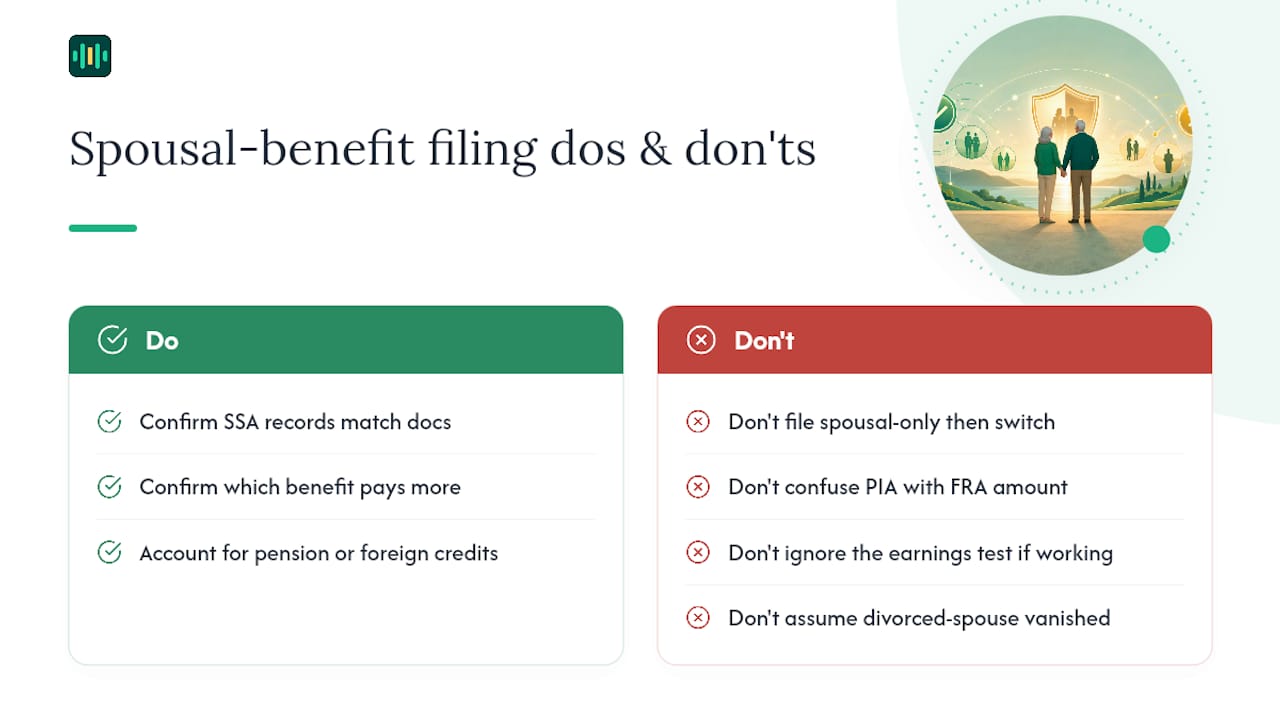
The costliest mistake is assuming you can file for just the spousal benefit and switch to your own larger retirement benefit later. Deemed filing rules mean that's off the table for almost everyone now.
Other frequent errors: confusing PIA with the benefit-at-FRA figure, ignoring how the earnings test shrinks checks if you're still working before FRA, and assuming divorced-spouse eligibility disappeared just because the marriage ended. Nonprofit groups like the NCOA note that Social Security doesn't always know you're eligible for a divorced-spouse benefit. You have to apply.
Before filing, confirm three things: your marriage or divorce documentation matches SSA's records, you understand which benefit (yours or spousal) will actually pay more at your chosen age, and you've accounted for any pension or foreign work credits that could complicate the calculation.
Does Remarrying Affect Your Divorced-Spouse Benefits?
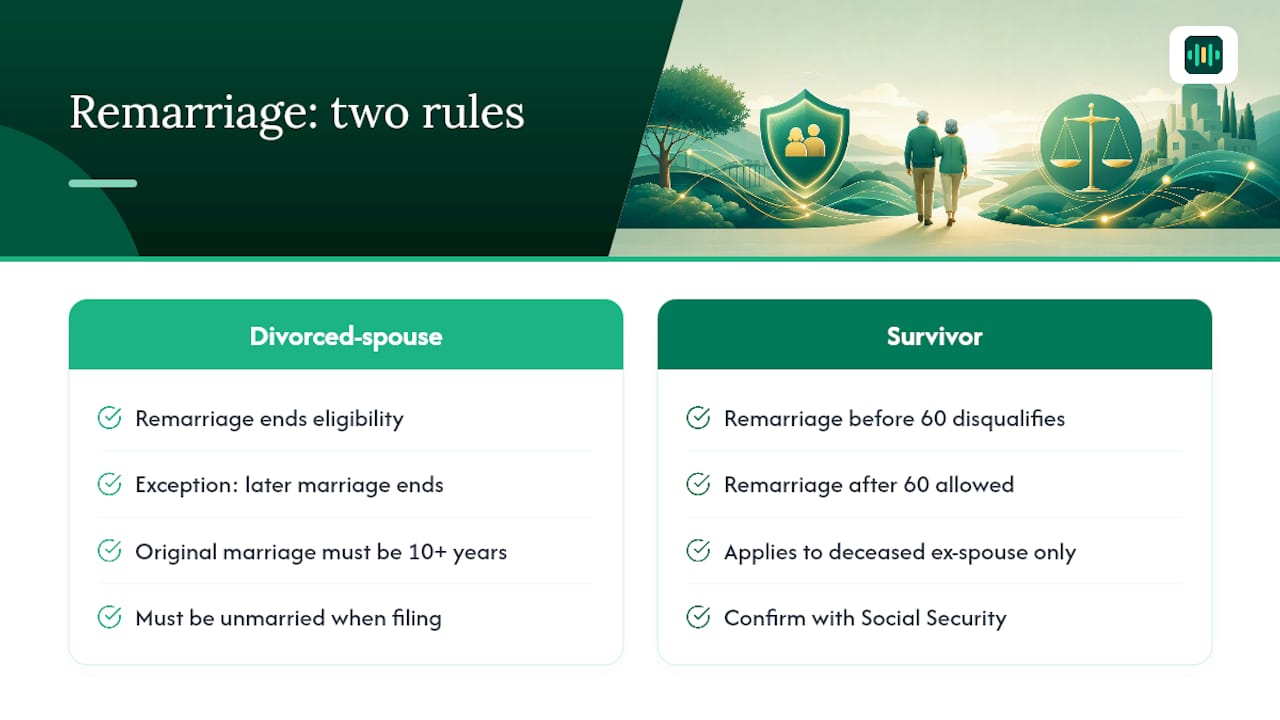
Remarriage generally ends your eligibility for benefits based on your ex-spouse's record, with one notable exception: if your later marriage also ends, through death, divorce, or annulment, your divorced-spouse eligibility on the earlier marriage can be reinstated, as long as that earlier marriage still meets the 10-year rule.
This trips people up more than almost any other rule in this system. Say you were married to your first spouse for 15 years, divorced, remarried for three years, and that second marriage ended in divorce. You could become eligible again for spousal benefits based on your first ex-spouse's record, provided you meet the age and unmarried requirements at the time you file.
There's a separate wrinkle for survivor benefits. If you're a surviving divorced spouse, remarriage after age 60 doesn't disqualify you from survivor benefits tied to your deceased ex-spouse, even though remarriage before 60 typically does. That's a meaningfully different threshold than the divorced-spouse spousal benefit rule, and conflating the two leads to bad filing decisions.
If your marital history includes more than one marriage that could plausibly qualify, this is exactly the kind of situation worth confirming directly with Social Security before you assume you're locked out.
What's the Best Strategy for Maximizing Your Spousal Benefit?
Timing is the single biggest lever you control. Because spousal benefits max out at 50% of the worker's PIA exactly at your FRA and never grow beyond that point, waiting past FRA to claim a spousal benefit buys you nothing. The real strategic question isn't when to take the spousal benefit. It's how the two spouses' claiming ages interact.
If one spouse has a much higher PIA, that spouse delaying their own retirement benefit to 70 doesn't just grow their own check by roughly 8% a year past FRA. It also permanently raises the survivor benefit the lower earner would receive later. Meanwhile, the lower earner can often claim their own reduced retirement benefit early for household cash flow, since spousal benefits (unlike survivor benefits) aren't affected by when the higher earner claims.
Tax treatment matters here too. Spousal benefits are taxed the same way retirement benefits are: up to 85% of your Social Security income becomes taxable if your combined income exceeds IRS thresholds. Claiming earlier and taking a smaller monthly amount can sometimes keep you under those thresholds longer, which is worth weighing against the lifetime-value math.
The households that come out ahead usually run the numbers for several claiming-age combinations before settling on one, rather than defaulting to "as soon as we're eligible."
A Practical Take on Coordinating When to Claim
The tension in every spousal benefit decision boils down to one trade: income now versus a larger check for as long as either spouse lives. There's no universal right answer, because it depends on health, other savings, and how long you both expect to need this income.
Three conversations are worth having before either of you files: who benefits more from delaying, what happens to the survivor's income if one spouse dies first, and how realistic your assumptions are about longevity given family history. Couples who skip these conversations tend to default to the earliest possible claiming age, which isn't wrong, but it's rarely a decision, either. A tool that can model both spouses' scenarios against your actual household spending, like Mali's retirement planning features, turns a guess into an actual comparison.
— Todd
Model Your Claiming Scenarios With Mali
Running the SSA calculators gives you the official numbers, but they can't tell you what a given claiming age means for your household's actual monthly budget. This tool fills that gap by considering your actual spending and Social Security claiming ages, going beyond a generic retirement worksheet.

Talk to Mali the way you'd talk to a financial planner friend, out loud, about what claiming at 62 versus 67 versus 70 actually does to your household cash flow. No other personal finance app lets you have a spoken conversation about your own linked bank accounts and transactions this way. These estimates are a planning aid, not a substitute for your official SSA figures; always confirm your exact benefit amount through your my Social Security account or a local office before filing. To see how the numbers might shift for your specific situation, try the Social Security Claiming Age Calculator and start a free trial to model your full household picture with Mali's couples planning tools.