

For most borrowers, the smartest of all student loan payoff strategies is the hybrid lane: keep federal loans on a plan that preserves flexibility while throwing extra cash at high-rate private debt. This week, do three things: pull your full loan list at Studentaid, enroll in autopay for the interest discount, and set one extra-payment amount you can sustain every single month.
TL;DR:
- Most borrowers benefit from a hybrid strategy that maintains federal flexibility while aggressively paying down high-interest private loans.
- Running a full loan list, checking eligibility for forgiveness programs, and comparing repayment options with official calculators are essential before choosing a plan.
- Enrolling in autopay, giving clear instructions to loan servicers, and automating consistent extra payments help ensure progress and avoid costly errors.
- Refinancing federal loans into private debt is irreversible and should only be considered if the borrower is certain they will not need income-driven plans or forgiveness later.
- Keeping employment and income documentation current, recertifying income-driven plans annually, and using voice-guided tools can optimize repayment and prevent setbacks.
Table of Contents
- What Are the Three Student Loan Payoff Strategies?
- How Do You Choose the Right Payoff Lane?
- How Do RAP, PSLF, and Refinancing Actually Work?
- How Do You Turn a Strategy Into a Monthly Habit?
- What Does a 90-Day Student Loan Payoff Plan Look Like?
- What Mistakes Cost Borrowers the Most Money?
- Which Tools Help You Run the Numbers?
- A Pragmatic Take on Paying Off Student Debt
- Talk to Mali About Your Actual Loan Balances
- Where to Verify the Official Rules
- Sources
- FAQ
What Are the Three Student Loan Payoff Strategies?
Every borrower fits roughly one of three lanes, and picking the wrong one wastes years of extra payments.
- Aggressive payoff. You throw every spare dollar at principal, ignore forgiveness programs, and aim to be debt-free in the shortest time possible. This fits high earners, private-loan holders, and anyone whose job will never qualify for Public Service Loan Forgiveness (PSLF).
- Forgiveness-first. You make the minimum required qualifying payments, stay enrolled in an income-driven plan, and let PSLF or a similar program erase the remaining balance. This fits government employees, nonprofit workers, and teachers with stable, long-term public-service careers.
- Hybrid optimization. You protect federal flexibility (income-driven options, deferment, potential forgiveness) but aggressively target private or high-interest federal loans that will never qualify for cancellation. This fits most borrowers who have a mix of loan types and some uncertainty about their long-term career path.
The trade-off is simple: aggressive payoff minimizes total interest but sacrifices safety nets. Forgiveness-first minimizes monthly cash outflow but requires career discipline for years. Hybrid splits the difference, which is why it works as the default for people who aren't sure yet.
How Do You Choose the Right Payoff Lane?
Run this process before committing to any strategy:
- List every loan with balance, interest rate, and servicer, and mark each one federal or private. Federal loans carry protections private loans don't.
- Calculate your debt-to-income ratio. If your total loan balance is close to or above your annual income, forgiveness-first or hybrid usually beats aggressive payoff.
- Check PSLF or employer LRAP eligibility. Government, nonprofit, and some healthcare or education employers offer loan repayment assistance that borrowers routinely forget to ask about.
- Run the numbers with the Loan Simulator at StudentAid.gov and compare against Mali's credit card payoff calculator logic to see how extra payments shift your timeline.
- Only then consider refinancing, and only after confirming you won't need federal income-driven plans or PSLF later.
Pro Tip: Before you touch a refinance application, write down every federal benefit you'd be giving up. If you can't name three, you're not ready to decide.
How Do RAP, PSLF, and Refinancing Actually Work?
The repayment landscape shifted in 2026, and the changes matter more than most borrowers realize.
The Department of Education's new Repayment Assistance Plan (RAP) and Tiered Standard plan, effective July 1, 2026, set payments between 1% and 10% of income, add a $50 reduction per dependent, waive certain interest accrual, and match up to $50 a month toward your principal for qualifying borrowers. That matching payment only works if you don't accidentally overpay in a way that advances your due date. On some RAP accounts, paying more than required without written instructions to your servicer can forfeit that principal-matching subsidy entirely.
PSLF still requires 120 qualifying monthly payments while employed full time by a government or qualifying nonprofit employer, plus annual employment certification. The program has approved over 700,000 applications with an average forgiveness of $54,000, which shows the scale is real, not theoretical, but the paperwork trips people up constantly. Missing a single year of certification can delay your count by months.
Key distinctions to keep straight:
- Consolidation merges federal loans and can preserve eligibility for programs like PSLF; refinancing moves you into private debt and eliminates those protections permanently.
- The CFPB warns that refinancing is irreversible and belongs only to borrowers confident they'll never need income-driven repayment or forgiveness.
- Recertification deadlines for income-driven plans, including RAP, come annually. Miss one, and your payment can jump sharply while your forgiveness clock resets.
How Do You Turn a Strategy Into a Monthly Habit?
Strategy without execution is just a spreadsheet. Here's what actually moves the balance down.
- Enroll in autopay immediately. Many federal loan programs offer an interest rate reduction, up to 1% off with 2026's autopay discount, simply for enrolling before the deadline.
- Give your servicer written instructions. Tell them explicitly to apply extra payments to principal and not advance your next due date. Save the confirmation email or screenshot; servicer errors are common, and documentation is your only defense.
- Pick avalanche or snowball, not neither. Avalanche (highest interest rate first) saves the most money mathematically. Snowball (smallest balance first) keeps you motivated. Either beats spreading extra cash evenly across every loan.
- Route windfalls on purpose. Tax refunds, bonuses, and raises should have a standing rule, such as 50% to loans and 50% to savings, decided before the money lands so you don't spend it by default.
- Keep an emergency fund first. A repayment plan that collapses the moment your car breaks down isn't a strategy. Three months of expenses in savings protects your payoff momentum.
Pro Tip: Automate the smallest extra payment you'll never notice missing, not the largest one you'll abandon after two months. Consistency beats intensity here.
What Does a 90-Day Student Loan Payoff Plan Look Like?
- Weeks 1 to 2: Pull your loan list from StudentAid.gov, enroll in autopay, pick one extra-payment amount, and send your servicer written instructions on principal application.
- Weeks 3 to 6: Build your monthly budget around that extra payment, start making it, and set your raise or bonus allocation rule in writing.
- Month 3: Review refinance quotes if you're firmly in the aggressive lane, submit your PSLF employment certification if you're pursuing forgiveness, and schedule a quarterly check-in on your calendar.
| Checkpoint | What to verify | Why it matters |
|---|---|---|
| Week 2 | Autopay enrolled, servicer instructions sent | Locks in interest discount and protects extra payments |
| Week 6 | Extra payment posted to principal correctly | Confirms servicer followed instructions |
| Month 3 | PSLF certification filed or refinance quotes compared | Keeps forgiveness clock running or locks in savings |
What Mistakes Cost Borrowers the Most Money?
The most expensive mistakes are quiet ones that surface years later.
- Refinancing federal loans while still PSLF-eligible, which permanently forfeits forgiveness potential.
- Letting a servicer advance your due date on extra payments instead of applying them straight to principal.
- Missing an income-driven recertification deadline and watching your payment spike.
- Losing employment documentation needed for PSLF certification.
Before any major move, confirm which loans are federal versus private, verify payment application in writing, save employment proof if pursuing forgiveness, and keep your contact information current with your servicer.
Which Tools Help You Run the Numbers?
Running these scenarios by hand is where most people give up. StudentAid.gov's Loan Simulator handles the official math, but seeing how an extra $75 a month actually changes your payoff date is easier when you can just ask. You can talk through your real loan balances, income, and goals out loud, using actual linked accounts instead of guesswork, and pair that with tested calculators for debt payoff and budgeting.
Confirm any refinance decision or PSLF paperwork directly with your servicer or StudentAid.gov before submitting. Mali's calculators and voice guidance help you model the plan. They don't replace the official forms.
A Pragmatic Take on Paying Off Student Debt
Most advice pushes borrowers toward one extreme: pay everything off yesterday, or chase forgiveness and ignore the balance. Neither serves most people. The hybrid lane wins for the majority of borrowers because it doesn't require betting your entire financial life on a career staying exactly the same for ten years.
The behavioral piece matters more than the math. One sustainable automated extra payment beats three ambitious promises you abandon by spring.
— Todd
Talk to Mali About Your Actual Loan Balances
There are calculators, spreadsheets, and government simulators for this, and you should use them. But typing your numbers into a form is exactly the friction that makes people quit halfway through planning.

There are financial sites that offer a voice AI you can talk to about your bank accounts and transactions. Linking your accounts allows the AI to read your actual income and spending, then talk you through where your student loan payment fits against everything else, out loud, without a dashboard full of charts to decode. You can ask it to run numbers on extra monthly payments, and it answers based on your real balances instead of generic averages. If you want to see how your 90-day payoff plan actually plays out against your paycheck, start with Mali's account setup or try the free loan and payoff calculators first with no signup required.
Where to Verify the Official Rules
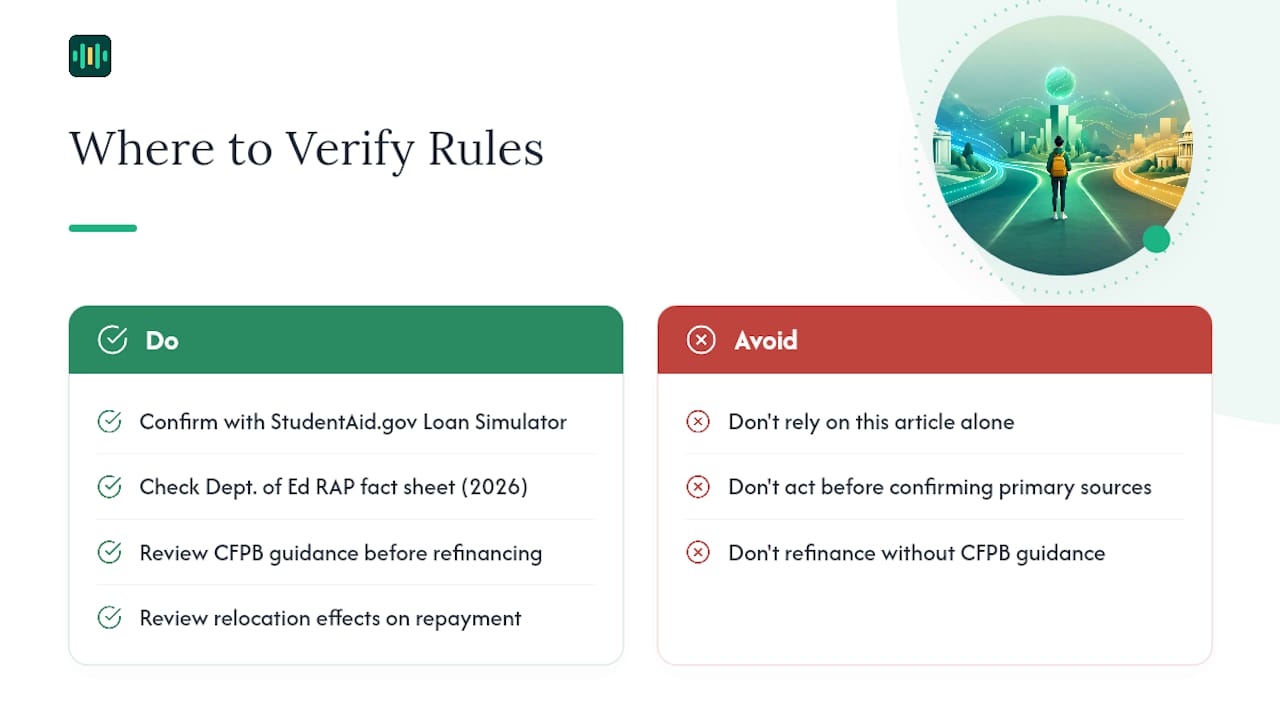
Confirm every major decision directly with these primary sources before acting: StudentAid.gov's Loan Simulator for personalized scenarios, the Department of Education's RAP fact sheet for 2026 plan details, and CFPB guidance before refinancing. Borrowers weighing a move abroad while carrying loan debt should also review how relocation affects repayment obligations.
This article is general information, not a substitute for advice from a qualified financial advisor. Consult a qualified financial professional about your own circumstances before acting on anything here.
Sources
- The past, present and future of the Public Service Loan Forgiveness program — Brookings
- Fact sheet: simplifying student loan repayment — U.S. Department of Education
- Should I consolidate or refinance student loans? — Consumer Financial Protection Bureau
- 5 Ways to Pay Off Your Student Loans Faster — Federal Student Aid
- Studentaid
FAQ
What Is the 7-Year Rule for Student Loans?
There is no federal rule that cancels or forgives student loans automatically after a certain number of years. The confusion often comes from old rules around private loans and credit reporting or statute-of-limitations timelines that vary by state, not a forgiveness program, so check StudentAid.gov directly if you've heard this claim.
How Long Would It Take to Pay Off $100,000 in Student Loans?
It depends entirely on your interest rate, monthly payment, and repayment plan. On a standard 10-year federal plan it takes exactly 10 years, but aggressive extra payments or a lower-rate refinance can shorten that, while an income-driven plan can stretch it out for two decades or end in forgiveness instead. Running your specific numbers through the Loan Simulator gives the real answer for your situation.
Is It Smart to Aggressively Pay Off Student Loans?
It's smart if your loans are private, high-interest, or you have no realistic path to forgiveness through PSLF or an income-driven plan. If you're pursuing forgiveness, aggressive extra payments on that same loan usually work against you, since the balance is meant to be canceled rather than paid down early.
Is It Possible to Negotiate a Student Loan Payoff?
Federal loans generally aren't negotiable for a reduced payoff, but private lenders occasionally offer settlement for a lump sum, particularly on defaulted debt. Before pursuing that route, check whether your employer offers loan repayment assistance, since that benefit is often easier to unlock than a lender settlement.
Does Mali Help With Student Loan Payoff Planning?
Mali connects to your real bank accounts and talks through your income, spending, and loan balances by voice, then helps you test extra-payment scenarios using its calculators. Current pricing and plan details are available directly on the Mali accounts page.