

Net worth is total assets minus total liabilities, and you can calculate yours in the next ten minutes. Grab a net worth calculator or open a blank spreadsheet, list what you own, subtract what you owe, and write down the number. Then pick one tracking method, spreadsheet, a calculator, an account-linked app, or a voice-AI companion, and set a recurring monthly or quarterly reminder to update it.
TL;DR:
- Tracking liquid net worth by excluding illiquid assets like home equity and private business stakes provides a more accurate view of available cash for emergencies.
- Updating net worth should be done monthly for active investors and debt payers, quarterly for most savers, and immediately after major financial events for accuracy.
- Using account-linked apps or voice-AI companions like Mali reduces manual effort and keeps balances current, but security and account connection quality are crucial.
- Relying solely on home or retirement account values can overstate accessible wealth; consistent valuation methods and regular updates avoid misleading snapshots.
- Focus on long-term trends and liquidity, pairing net worth with cash flow review instead of comparing absolute numbers to others or online benchmarks.
Table of Contents
- How Do You Calculate and Start Tracking Net Worth?
- What Counts as an Asset or Liability, and Why Liquidity Matters
- How Often Should You Update Your Net Worth Tracker?
- Which Tools Actually Work for Tracking Net Worth?
- How Mali Helps You Track Net Worth by Voice
- Updating Net Worth After Inheritance, Big Purchases, or Debt Payoff
- Common Mistakes That Wreck Net Worth Tracking
- Strategies for Automating Net Worth Tracking Securely
- Net Worth Is a Compass, Not a Scoreboard
- Try Mali's Free Net Worth Calculator Today
- Sources
How Do You Calculate and Start Tracking Net Worth?
The formula never changes: assets minus liabilities equals net worth, and Investopedia frames it correctly as a recurring benchmark rather than a one-time score. Treat your first calculation as a baseline, not a verdict.
- List every asset at realistic value. Cash, checking, brokerage accounts, retirement balances, your home's current market estimate, vehicles at trade-in value, not what you paid.
- Flag illiquid assets separately. Home equity, a stake in a private business, or a car you need to drive daily aren't cash you can spend next week.
- List liabilities using current balances. Credit cards, student loans, auto loans, and mortgage principal, pulled from this month's statement, not an old estimate.
- Subtract to get net worth, then calculate liquid net worth by excluding home equity and illiquid holdings. This second number often matters more for day-to-day decisions.
- Choose your cadence. Monthly works if you're actively investing or paying down debt fast; quarterly is plenty for most people.
- Set one measurable goal (cut debt by a specific amount, grow investable assets by a target percentage) and put your first review on the calendar.
Pro Tip: Run the numbers twice in your first month, once at the start and once three weeks later, just to catch input mistakes before they become a false trend line.
What Counts as an Asset or Liability, and Why Liquidity Matters
Your asset list should include cash and checking balances, brokerage and investment accounts, retirement accounts, real estate at current market value, and vehicles at realistic resale value, never the purchase price. Liabilities cover every outstanding debt: credit cards, personal loans, auto loans, student loans, and mortgage balances, all at their current payoff amount, not the original loan size.
Where people go wrong is treating every dollar of net worth as equally spendable. It isn't.
- Home equity counts toward total net worth but can't cover next month's rent without selling or borrowing against it.
- Retirement accounts belong on the list, but early withdrawals often trigger penalties and taxes, so the number on paper overstates what you could actually access.
- Private business equity or collectibles are real value, but they're notoriously hard to price and even harder to convert to cash quickly.
Kiplinger has flagged this directly: a high headline net worth can mask a thin cash cushion, and that gap becomes dangerous the moment an emergency hits. This is why tracking liquid net worth, your total minus illiquid holdings, gives you a second, more honest number to watch alongside the big one.
How Often Should You Update Your Net Worth Tracker?
Match your update frequency to how much your finances actually move. Monthly tracking suits people actively trading, paying down debt aggressively, or building an emergency fund from scratch. Quarterly is the right rhythm for most long-term savers whose balances shift slowly. An annual check is the bare minimum, useful mainly as a gut check against inflation and life drift.
- Run an off-cycle check after a major life event: a job change, inheritance, home purchase, or a sharp market drop.
- Compare rolling 12-month and year-over-year figures instead of month-to-month, since a single bad market month can look scarier than it is.
- Pair every net worth check with a quick cash-flow review; for practical advice on managing this aspect, see our guide to cash flow for stables; a rising number paired with maxed-out credit cards is a warning sign, not a win.
A Wealth of Common Sense makes the case that a static snapshot only becomes useful once you track it on a schedule and read it alongside spending patterns.
Pro Tip: If your net worth dips two months in a row, check whether it's market volatility in your investments or an actual behavior change in spending, those require completely different fixes.
Which Tools Actually Work for Tracking Net Worth?
You've got four real options, and they trade off effort against automation differently.
Manual spreadsheets give you full control and zero cost, but they demand discipline. You'll forget to update account balances unless you block time for it every month.
One-off calculators, including government resources like FINRED's downloadable net worth tracker, are fast for a single snapshot but don't carry history forward automatically.
Account-linked apps pull balances directly from your bank and investment accounts, cutting manual entry but requiring you to trust a third party with read access to your financial data.
Voice-AI companions go a step further: instead of a dashboard you have to interpret yourself, you get spoken analysis of what changed and why it matters.
Before picking a method, run through this checklist:
- Does it use bank-grade encryption and clear data-handling policies?
- Can it link accounts securely, or are you stuck entering balances by hand?
- Does it distinguish liquid assets from illiquid ones automatically?
- Does it track liabilities with the same rigor as assets?
- Can you export history or see trend lines over time?
- What does it cost, and is there a free tier to test first?
If you're security-cautious or only checking a few times a year, start with a free calculator. If you want lower-maintenance automation with less manual entry, an account-linked tool, including voice-AI options, saves real time. Try one simple calculator first, then graduate to automated tracking once you know what numbers you actually care about watching.
How Mali Helps You Track Net Worth by Voice
Mali is a voice-first financial companion, so instead of scanning a dashboard full of charts, you ask a question out loud and get a spoken answer back. Mali links to your bank accounts to pull real balances and spending, then works out where your finances stand without you building a spreadsheet from scratch.
Here's what that looks like in practice:
- Ask Mali to run your net worth calculation and it pulls current balances instead of relying on numbers you typed in three months ago.
- Mali flags liquidity concentration out loud, telling you plainly if too much of your net worth sits in your house or illiquid holdings.
- The full calculator library covers retirement, emergency funds, and debt payoff, so net worth tracking connects to the rest of your planning instead of sitting in isolation.
- Data handling runs through encrypted, private connections, detailed on Mali's security page.
A simple way to start: run Mali's net worth calculator once without linking anything. If the output is useful, link accounts and ask for a monthly spoken check-in instead of remembering to log in yourself.
Updating Net Worth After Inheritance, Big Purchases, or Debt Payoff
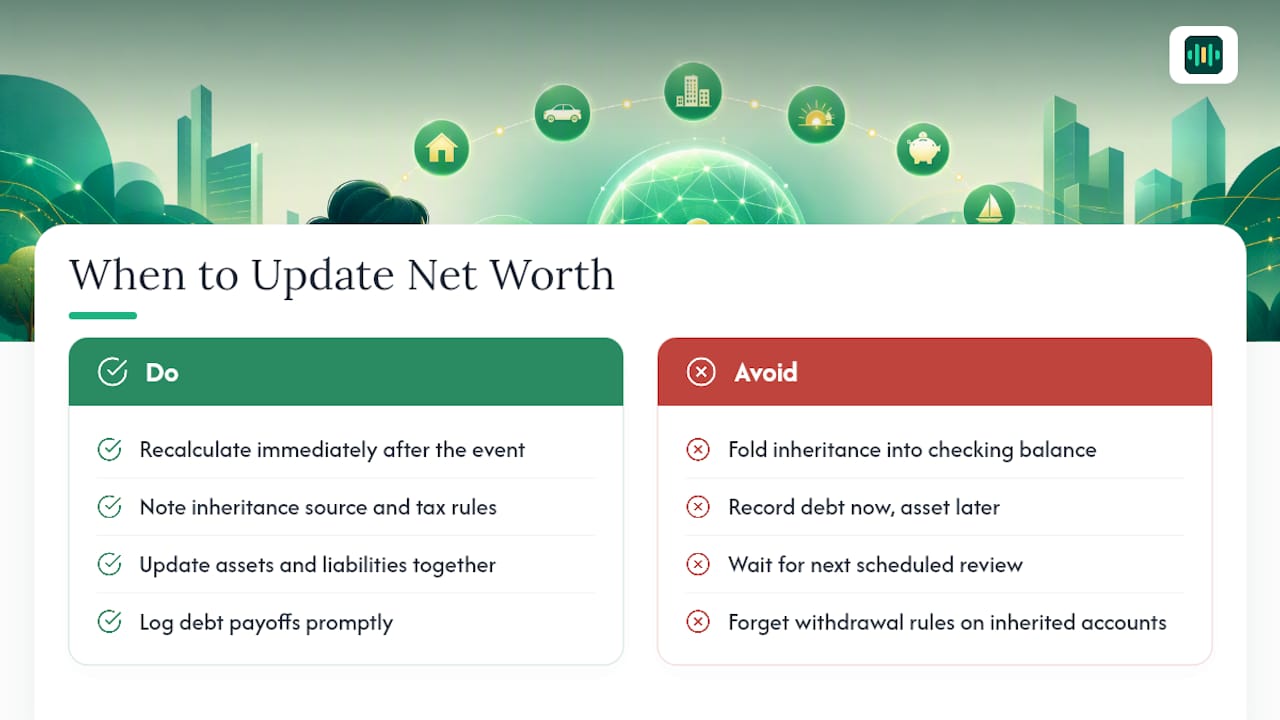
A major life event breaks your normal tracking cadence, and that's exactly when an update matters most. An inheritance adds a lump sum to your assets, but resist folding it into your regular checking balance without noting its source. Cash from inheritance often needs different tax treatment than income you earned, and if part of it is an inherited retirement account, it carries its own withdrawal rules.
A large purchase, a house, a car, a wedding, works the other direction. If you financed it, your liabilities jump immediately while the asset side might lag until you know a realistic resale value. Update both sides at once rather than recording the debt now and the asset "later," since that gap makes your net worth look artificially worse for weeks.
Paying off a chunk of debt deserves its own update too, even outside your normal schedule. Watching a liability drop to zero is one of the most motivating moments in tracking net worth, and logging it promptly reinforces the habit.
For any of these events, recalculate immediately rather than waiting for your next scheduled review. The goal isn't a perfectly smooth line, it's an accurate one. A single sharp jump or drop tied to a known event is easy to explain later. A jump you can't remember the reason for six months from now just creates confusion.
Common Mistakes That Wreck Net Worth Tracking
The most common mistake is using purchase price instead of current market value for homes, vehicles, or investments. A house bought for one amount five years ago is worth a different number today, and using the old figure quietly inflates your entire calculation.
A close second: forgetting liabilities that don't show up on a monthly statement, like a private loan from family or a tax bill you haven't paid yet. Net worth only works when both sides of the ledger are complete.
Some other patterns worth watching for:
- Counting retirement accounts at full face value without acknowledging the taxes you'll owe on withdrawal, which overstates what you could actually spend.
- Updating sporadically, then reacting emotionally to a big jump or drop that's really just an inconsistent measurement gap.
- Ignoring liquid net worth entirely and only watching the total, which can hide a real cash crunch behind a healthy-looking headline number.
- Comparing your number to strangers online instead of your own trend line, Federal Reserve data shows wealth distribution varies enormously by age and region, making outside comparisons mostly noise.
The fix for nearly all of these is consistency: same valuation method, same account list, same day of the month, every time you update.
Strategies for Automating Net Worth Tracking Securely
Manual tracking works, but it decays. People start strong in January and stop updating by April, which is why automation matters more than most guides admit.
Linking your bank, investment, and loan accounts to a tracking tool removes the biggest failure point: forgetting to log in and type numbers. Look for encrypted connections and read-only access, which means the tool can see your balances but can't move your money. Check whether the service publishes clear security documentation before you connect anything.
Once accounts are linked, automation should do three things: refresh balances without you asking, flag liquidity shifts (a growing share of net worth locked in home equity, for instance), and hand you a plain-language summary instead of a spreadsheet you have to interpret yourself. A voice-AI companion like Mali adds a fourth layer, it can walk you through what changed out loud during a quick monthly conversation instead of requiring you to open an app and dig through tabs.
If you'd rather ease into automation, start with one linked account, your primary checking or brokerage, before connecting everything at once. That lets you confirm the balances match your own records before trusting the full picture.
Net Worth Is a Compass, Not a Scoreboard
Net worth tells you direction, not status. Treat it as a planning input, something that tells you whether your habits are working, not a number to compare against a stranger's Twitter post. Trends across months of data are what makes it useful.
Pick one tracking method and commit to it for three months before judging whether it fits. Pair every check with a quick look at your cash flow. Liquidity and after-tax value matter more than the headline figure, a $500,000 net worth locked in home equity and a retirement account behaves nothing like $500,000 sitting in a brokerage account.
— Todd
Try Mali's Free Net Worth Calculator Today
This option offers net worth tracking without building a spreadsheet or manually re-entering balances every month, and features a voice-first design that differs from typical financial tools. This app lets you talk out loud about your bank transactions and get a spoken answer back instead of a dashboard full of charts.

Start with the free net worth calculator to get a baseline in minutes, no account linking required. If the output is useful, connect your accounts securely and ask Mali for a monthly spoken check-in instead of remembering to log back in yourself. Curious how Mali stacks up against a traditional budgeting app? Compare it directly on the Mali vs YNAB breakdown or browse the full calculator library to see what else is free to try, including a demo tier before you ever consider a paid plan.
Sources
- Investopedia — What's Your Net Worth Telling You?
- FINRED — Track Your Personal Net Worth
- Kiplinger — Average net worth by age
- Federal Reserve — Distribution of Household Wealth
- A Wealth of Common Sense — How much is one million dollars worth?