

Zero-based budgeting assigns every dollar of your monthly income a job, so income minus allocations equals zero. It's the most hands-on way to control spending, because nothing goes unaccounted for. The main payoff is speed: people using it to attack debt or build savings tend to see faster progress simply because no dollar sits idle. It suits anyone who wants tight visibility and doesn't mind a little monthly upkeep to get it.
TL;DR:
- Zero-based budgeting is best suited for those with fluctuating incomes or high debt payoff goals, as it requires frequent recalibration of expenses.
- Automating fixed expenses and variable categories can reduce the time commitment and prevent burnout, making monthly updates more manageable.
- Keeping a small buffer or sinking funds for irregular costs helps prevent budget-breaking surprises and maintains the zero-balance principle.
- Using tools like spreadsheets or budgeting apps can streamline the process, but periodic resets, rather than monthly rebuilds, improve sustainability.
- Test the method for at least one month to evaluate whether the discipline leads to faster savings or debt reduction before committing long-term.
Table of Contents
- What Is Zero-Based Budgeting and How Is It Different?
- What Are the Pros and Cons of Zero-Based Budgeting?
- How Do You Build a Zero-Based Budget Each Month?
- What Does a Zero-Based Budget Look Like in Practice?
- Is Zero-Based Budgeting Right for You?
- What Tools Make Zero-Based Budgeting Easier?
- How Do You Stick With Zero-Based Budgeting Long Term?
- A Realistic Take on Zero-Based Budgeting
- How Mali Turns Zero-Based Budgeting Into a Conversation
- Sources
- FAQ
What Is Zero-Based Budgeting and How Is It Different?
Zero-based budgeting isn't a modern personal-finance invention. Accountant Peter Pyhrr developed it in the 1970s for corporate budgeting, where managers had to justify every line item from scratch instead of carrying forward last year's numbers automatically, according to Fidelity. Households adapted the same logic decades later: nothing gets funded just because it was funded last month. You defend it again, every period.
The mechanics are straightforward once you see them laid out. You total your monthly income, subtract fixed expenses like rent and insurance, then work through variable costs, savings, and debt payments until every dollar has a destination. When income minus allocations lands at zero, the budget is complete. Not a dollar short, not a dollar unassigned.
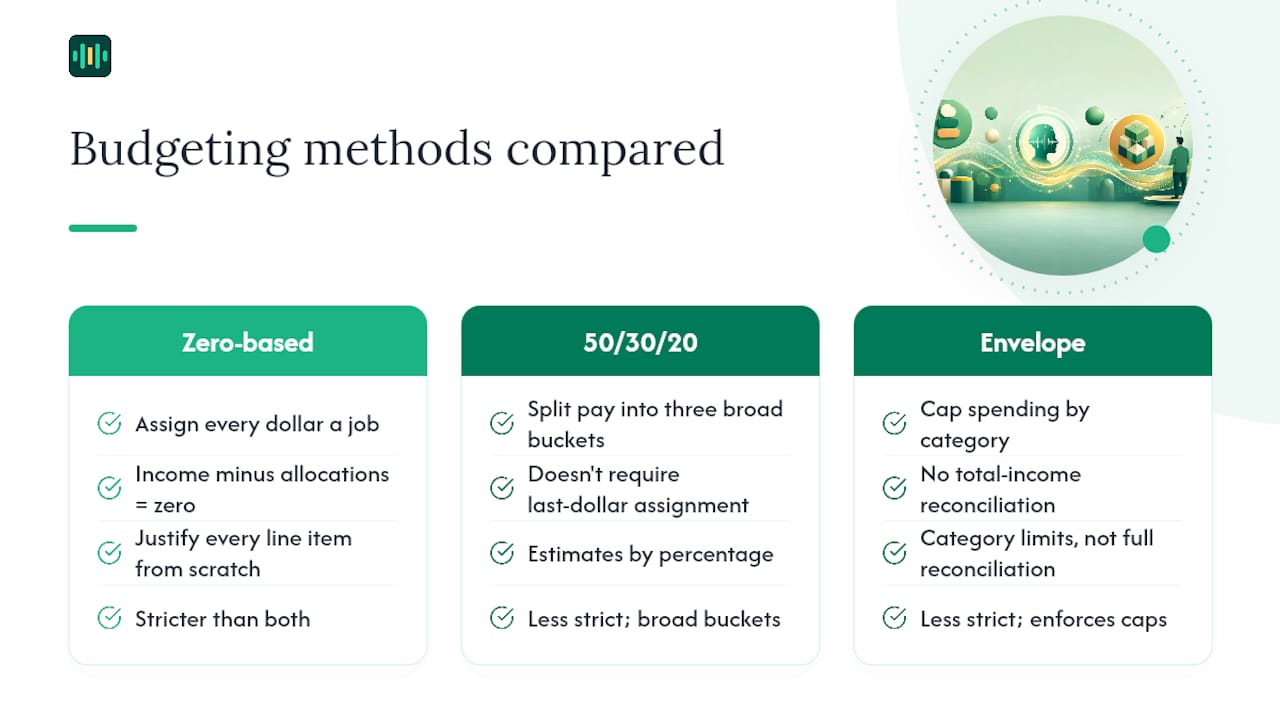
That's a real departure from the 50/30/20 rule, which splits pay into three broad buckets (needs, wants, savings) and never asks you to name a home for the last dollar. It's also different from envelope budgeting, which caps spending by category but doesn't force you to reconcile total income against total allocations each month. Zero-based budgeting is stricter than both. You're not estimating percentages or filling envelopes until they're full. You're solving an equation where the answer has to be zero, which is exactly what makes it either appealing or exhausting, depending on your temperament.
What Are the Pros and Cons of Zero-Based Budgeting?
The upside is real, and it's not just about feeling organized. Forcing yourself to justify every dollar surfaces opportunity costs you'd otherwise miss. That streaming subscription competing with an extra debt payment becomes an actual decision instead of something that happens by default, a point Fidelity's research backs up directly. The manual friction of the process is also part of what makes it work. Financial professionals note that having to physically account for every dollar builds an accountability loop, which is why it tends to work especially well for people living paycheck to paycheck or racing to pay off debt.
The downsides are just as real, though, and worth naming honestly:
- Time cost: this isn't a "set it and forget it" system. It demands more manual tracking than looser frameworks, and that time adds up over a year.
- Burnout risk: rebuilding the same categories from zero every single month, forever, wears people down. Motivation fades before month six for a lot of first-timers.
- Short-term tunnel vision: when you're hyper-focused on making this month balance, it's easy to lose sight of annual or five-year goals.
None of these are fatal flaws. Sinking funds (small monthly set-asides for irregular costs like car repairs or holiday gifts) smooth out the lumpy expenses that otherwise blow up your zero balance. A small buffer category, even $50, absorbs the inevitable math errors. And treating ZBB as a periodic reset rather than a lifetime sentence, something we'll get into later, solves the burnout problem outright.
How Do You Build a Zero-Based Budget Each Month?
The process breaks into five steps, and most households can run through the full cycle in well under an hour once they've done it a couple of times.
- Calculate net monthly income. Add up every paycheck after taxes, plus any side income, freelance pay, or irregular earnings you can count on. Underestimate the uncertain stuff rather than round up.
- List and subtract fixed expenses. Rent or mortgage, insurance, loan minimums, subscriptions. These don't move month to month, so knock them out first and see what's left.
- Estimate variable expenses and add savings or debt lines. Groceries, gas, entertainment, plus whatever you're funneling toward an emergency fund or extra debt payments. Treat savings and debt payoff as line items with the same weight as rent, not afterthoughts.
- Assign every remaining dollar until the balance hits zero. This is the step that actually defines the method. If you land on $42 unassigned, it goes somewhere: a sinking fund, extra debt principal, a small buffer category. Build the buffer in deliberately; it catches the overspending you'll inevitably do somewhere else.
- Track spending through the month and reassign as needed. Overspend on groceries by $30? Pull $30 from entertainment or the buffer. At month's end, use your actual numbers, not your estimates, as the starting point for next month.
This basic sequence lines up with the six-step workflow The Penny Hoarder outlines for building a monthly zero-based budget from scratch. Most households land somewhere around 30 to 60 minutes per month once the categories are set up, according to the same guide, with the first month or two running longer while you calibrate your variable-expense estimates.
Pro Tip: Don't rebuild every category from memory each month. Keep a running template and only adjust the numbers that actually changed. Recreating fixed expenses like rent or your phone bill from scratch every 30 days is where most people waste their time and lose patience with the whole method.
What Does a Zero-Based Budget Look Like in Practice?
Numbers make this concrete. For example, your take-home pay for the month might be a few thousand dollars.
| Category | Amount |
|---|---|
| Rent | $1,400 |
| Utilities | $180 |
| Groceries | $450 |
| Car payment and insurance | $380 |
| Minimum debt payments | $220 |
| Extra debt payoff | $300 |
| Emergency fund | $250 |
| Sinking fund (car repairs, gifts) | $150 |
| Entertainment and dining | $220 |
| Personal and miscellaneous | $150 |
| Buffer | $100 |
| Total allocated | $4,200 |
$4,200 in income minus $4,200 in allocations leaves zero. Notice that debt payoff and emergency savings sit in the table as budgeted line items, exactly like rent, not as whatever happens to be left over. That's the entire philosophy in one row.
Now imagine a $180 unexpected expense shows up midmonth, a co-pay or a parking ticket. You don't add a new category. You pull $180 out of entertainment, the sinking fund, or the buffer, and the budget still sums to zero. That reshuffling, not the initial allocation, is the daily discipline that actually makes the method work.
Is Zero-Based Budgeting Right for You?
It fits best if you're carrying debt you want gone faster, you like detail, or your income varies enough that a fixed percentage rule doesn't hold up month to month. People who rebuild their financial picture regularly (freelancers, gig workers, anyone tracking multiple income streams) tend to get the most value, because ZBB forces the kind of monthly recalibration their situation already demands.
It's a worse fit if you have a large, stable surplus every month and no debt urgency. It's also a poor match for anyone who knows, realistically, that they won't rebuild a budget from scratch every month. A system you abandon by March isn't better than a simpler one you keep for a year.
If ZBB feels like overkill, three alternatives cover most of what's left:
- The 50/30/20 rule splits pay into needs, wants, and savings with almost no ongoing maintenance, decent for stable earners who want general guardrails.
- Envelope budgeting caps category spending without demanding a full income reconciliation, good for people who overspend in one or two specific areas.
- Pay-yourself-first automates a savings transfer on payday and lets the rest flow freely, suited to disciplined savers who hate line-item tracking.
What Tools Make Zero-Based Budgeting Easier?
A workable spreadsheet needs three things at minimum: income rows at the top, category rows below with planned versus actual columns, and a running unallocated balance that updates as you type. That last piece is what actually enforces the "zero" in zero-based. Without it, you're just making a list.
Budgeting apps built around a give-every-dollar-a-job approach, along with free Excel and Google Sheets templates, make a fast start realistic even for a first-timer, per The Penny Hoarder's rundown of ZBB tools. Before you build anything, run this quick checklist:
- Pull your last two pay stubs and three months of bank statements.
- Separate fixed costs from variable ones on paper before touching a spreadsheet.
- Set up sinking funds for anything that hits irregularly (car maintenance, gifts, annual subscriptions).
- Build in a buffer category from day one, not after the first overspend.
- If you'd rather talk through the numbers than build a spreadsheet, Mali's savings goal calculator and emergency fund calculator can size those lines for you in a minute.
How Do You Stick With Zero-Based Budgeting Long Term?
The biggest mistake practitioners make is treating rigidity as the goal. It isn't. A better approach: keep recurring allocations locked in for stable fixed costs, and reserve the full ground-up rebuild for periodic resets, maybe quarterly, rather than fighting your own budget every single month, which is consistent with the reset-based approach Workday describes for avoiding burnout.
Variable income needs its own adjustment. Budget to a conservative baseline (your lowest typical month, or a rolling 12-month low) and treat anything above that as a bonus you assign to a specific goal, a tactic Fidelity recommends for freelancers and commission earners. That single habit removes most of the anxiety irregular paychecks cause, because you're never budgeting against income you're not sure will show up.
Pro Tip: Automate what doesn't change. Rent, insurance, and minimum debt payments rarely shift month to month, so set them as standing line items and spend your monthly review time on the variable categories that actually need attention.
A Realistic Take on Zero-Based Budgeting
Test it for one month before deciding it's your permanent system. Track how much time it actually costs you against how much progress you make on debt or savings, then decide honestly whether the trade is worth it. Some people find the discipline addictive. Others find it's a great debt-payoff sprint that they retire once the balance hits zero, and that's a completely legitimate way to use the method.
Where it gets sustainable long term is combining the manual logic with automation, something like voice reminders that flag when a category is running low, so you're not manually reconciling every transaction by hand.
— Todd
How Mali Turns Zero-Based Budgeting Into a Conversation
Building a zero-based budget by hand teaches you the logic. Keeping it running every month is where most people quit, and that's the exact gap Mali was built to close. Link your accounts once, and Mali reads your real income and spending, tells you out loud where your allocations are drifting, and flags a category before it runs dry, instead of you finding out at month's end when the math doesn't hit zero.

No spreadsheet, no dashboard full of charts to interpret. You talk to Mali about your bank accounts and transactions directly, out loud, and she answers back with a real personality, not a scripted chatbot. That's not something you'll find on a typical budgeting app. Mali's emergency fund and savings goal calculators size your sinking funds and buffer automatically, and her proactive reminders handle the "track and adjust" step of zero-based budgeting so you're not doing it manually every week. If you've relied on a rigid give-every-dollar-a-job app before, see how Mali's voice-first approach compares to that method. Check out Mali's app to see where your money's actually going this month by linking your accounts.
Sources
- Zero-based budgeting — Western & Southern
- What is zero-based budgeting and how does it work? — Fidelity
- Zero-Based Budgeting: The Complete Guide — The Penny Hoarder
- What is zero-based budgeting? — Workday
This article is general information, not a substitute for advice from a qualified financial advisor. Consult a qualified financial professional about your own circumstances before acting on anything here.
FAQ
What Is an Example of a Zero-Based Budget?
A $4,200 monthly income split across rent, utilities, groceries, debt payments, savings, and a buffer category, with every dollar assigned so income minus allocations equals exactly zero, is a typical zero-based budget.
What Are the Pros and Cons of Zero-Based Budgeting?
The pros are clarity, accountability, and faster debt payoff or savings progress; the cons are the time it takes to maintain, burnout risk from monthly rebuilding, and a tendency to focus on the short term over long-range goals.
What Is the 70/20/10 Rule for Money?
The 70/20/10 rule allocates 70% of income to living expenses, 20% to savings or debt payoff, and 10% to giving or discretionary spending. It's a simpler, percentage-based alternative to zero-based budgeting for people who want general guardrails without assigning every individual dollar.
What Best Describes Zero-Based Budgeting?
Zero-based budgeting is a method where every dollar of income is assigned a specific job (expenses, savings, or debt) until income minus allocations equals zero, requiring you to justify each expense every period rather than carrying forward last month's plan by default.
Do I Have to Rebuild My Zero-Based Budget From Scratch Every Month?
No. Practitioner guidance favors keeping recurring allocations for stable fixed costs and reserving full ground-up rebuilds for periodic resets, which reduces burnout while keeping the accountability benefits of the method.